Salesforce Unveils Agentforce 360: Slack Finally Becomes the Front Door to the Agentic Enterprise
As AgentScript Reveals the Industry’s Orchestration Struggle, Slack Emerges as the Conversational Layer We’ve Been Waiting For
“We’re entering the age of the Agentic Enterprise where AI elevates human potential like never before,” declared Marc Benioff as Salesforce announced the general availability of Agentforce 360 today ahead of Dreamforce 2025. Yet beneath the fanfare lies both a sobering admission and an overdue evolution: while AgentScript acknowledges that low-code agent orchestration remains unsolved, Slack’s emergence as the “Agentic OS” delivers the conversational interface that many of us have been anticipating since early 2023.
Table of contents
- What Was Announced: The Complete Agentforce 360 Platform
- Slack as the Agentic OS: A Natural Evolution
- The Adoption Challenge: Teams vs. Slack
- The Industry Context: Trodding New Territory Together
- Model Context Protocol: Blurring the Lines
- Customer Traction Despite Complexity
- Analysis: Pioneering Through the Unknown
- The Road Through the J-Curve
- Cognitive DevOps: The Sleeper Opportunity
- The Bottom Line
What Was Announced: The Complete Agentforce 360 Platform
The Agentforce 360 launch represents the culmination of a year of transformation, with four major releases and thousands of customer deployments. As one would expect with a Dreamforce announcement, today’s news is Salesforce’s attempt to transform beyond CRM into a comprehensive platform for the Agentic Enterprise, with Slack taking its natural place at the center.
Agentforce Platform: The Core Infrastructure
The platform update introduces several significant capabilities:
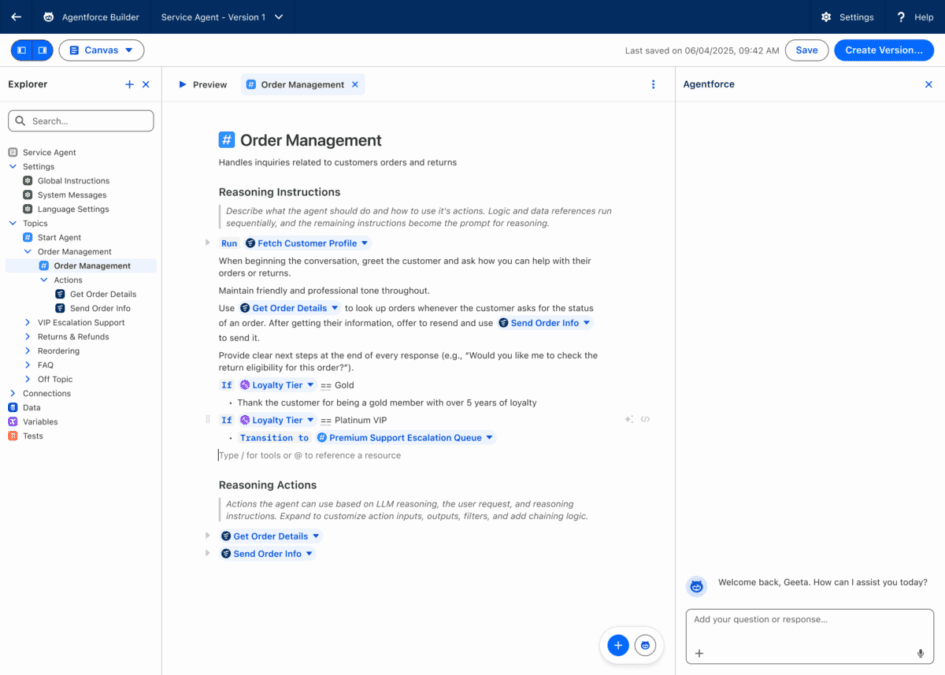
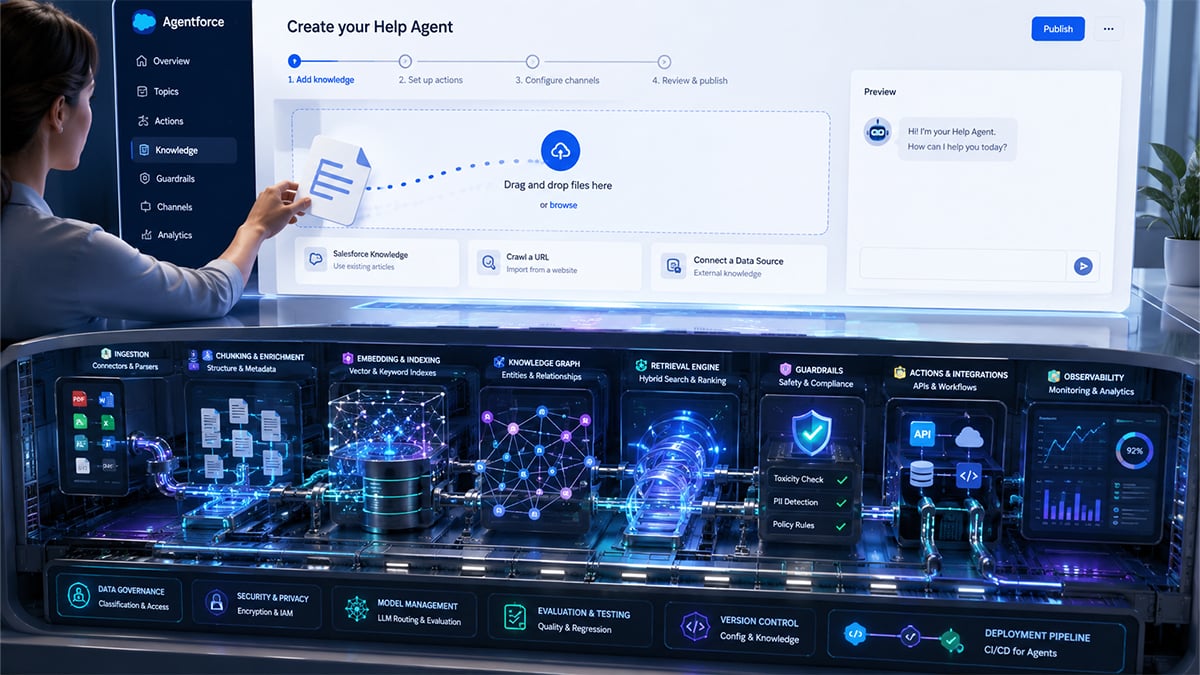
- Agentforce Builder – A new conversational development studio that lets teams design, test, and deploy agents using natural language with no manual configuration required. This represents a shift toward making AI development accessible to non-technical users.
- AgentScript and Hybrid Reasoning – Agent Script gives users the ability to program their AI agents to be more flexible and better respond to “if/then” situations, combining deterministic workflows with flexible LLM reasoning. This portable JSON language lets teams author complex agent behavior while maintaining control through the configurable Atlas Reasoning Engine.
- Agentforce Voice – A native voice layer that transforms IVR systems into natural, real-time conversations with low-latency transcription, realistic speech synthesis, and deep Salesforce integration.
- Agentforce Vibes – Extends low-code development to AI, letting builders “vibe-code” apps grounded in company data and governance.
Data 360: Context and Intelligence
Data 360 now activates a company’s data, both structured and unstructured, to give every agent business context and personalization. Salesforce still does not officially reveal the underlying technology for Data 360, which appears to align with open table-format patterns (e.g., Iceberg/Delta/Hudi) that supports referential (zero-copy) data integrations. Key features include:
- Intelligent Context enabling agents to access unstructured content like PDFs or diagrams
- Tableau Semantics translating data into business language through the Customer 360 Semantic Data Model
- Partnerships with Databricks, dbt Labs, and Snowflake for standardized semantics across platforms
Customer 360 Apps: Agents in Every Workflow
In an attempt to further demonstrate how Agentforce is being embedded into all existing Salesforce offerings, Salesforce seems to be replacing the concept of having products named as clouds and now identifying them as Agentforce functions:
- Agentforce Sales for prospecting, qualification, and quoting automation
- Agentforce Marketing for autonomous campaign and journey creation
- Agentforce Service powering the Command Center for 24/7 support
- Agentforce Field Service with voice-to-form capabilities
- Industry-specific solutions for Life Sciences, Public Sector, and Manufacturing
Slack as the Agentic OS: A Natural Evolution
Perhaps the most significant announcement is Slack’s transformation into the “agentic OS” where people, data, apps, agents, AI, and workflows come together. While some of us saw this convergence coming back in 2023, Salesforce has taken its time getting good Slack-Salesforce integration going. We hope this new commitment changes the pace of improvements.
Salesforce is making Slack the conversational interface for Salesforce with new, purpose-built experiences for Agentforce Sales, IT and HR Service, and Tableau. Teams can now interact with their CRM data and agents through natural language—right in the flow of work. This includes:
- Agentforce Sales in Slack – A new Salesforce experience that puts customer records, notifications, and AI agents in the Slack sidebar, right alongside team conversations. Managing your pipeline becomes as simple as having a conversation.
- Agentforce IT Service in Slack – Brings support right into Slack, where employees can get instant help for common requests like password resets, with AI agents resolving issues on the spot. For complex problems, incident channels are automatically created with full context.
- Agentforce HR Service in Slack – Quick answers to HR questions without leaving Slack, from onboarding to benefits, with seamless handoff to human HR teams when needed.
The rebuilt Slackbot now serves as a personal AI companion that connects to tools like Google Drive, Salesforce, and OneDrive to bring clear insights from all conversations and files.
The Platform Play
Most critically, Slack is introducing Real-Time Search API and Model Context Protocol server capabilities, enabling partners like OpenAI, Anthropic, Google, Perplexity, Writer, Dropbox, and Notion to build intelligent agents that live natively in Slack. This transforms Slack from a communication tool into a genuine platform for AI orchestration.
OpenAI brings ChatGPT directly inside Slack with the new Real-Time Search API, while Anthropic integrates Claude for team collaboration via DMs, an AI assistant panel, or @mentions. Google Agentspace creates a seamless information flow through the Slack RTS API.
The Adoption Challenge: Teams vs. Slack
Let’s address the elephant in the room: Microsoft Teams. For organizations already invested in the Microsoft ecosystem, Salesforce faces a significant adoption challenge. The promise of a Slack-first approach to IT services, what we call Cognitive DevOps, is compelling, but it requires organizations to either move away from Teams or maintain dual communication platforms.
The reality is that Salesforce is betting on functionality over incumbency. By making Slack the place where agents actually do work rather than just chat, they’re creating a differentiation that Teams can’t easily match without restructuring their entire platform architecture. As Engine’s SVP of Operations Mollie Bodensteiner notes, “We’re building for scale, not just speed. Slack and Salesforce give us the structure to automate the work that slows people down.”
For small and medium enterprises not yet locked into Teams, this Slack-first mentality for delivering all IT services—including updating and maintaining Customer 360 and Data Cloud setups via Slack—represents Salesforce’s best opportunity to capture new customers. The conversational interface eliminates the complexity barrier that has traditionally kept smaller organizations from fully adopting Salesforce.
The Industry Context: Trodding New Territory Together
The timing of Agentforce 360 reveals a crucial pattern. Just a week earlier, OpenAI launched AgentKit with a visual Agent Builder, embeddable ChatKit interface, and drag-and-drop workflow creation; all features remarkably similar to what Salesforce now offers. This parallel evolution isn’t coincidence, but rather evidence that the entire industry is collectively trodding new territory, like pioneers in the late 19th-century American West.
The introduction of AgentScript is Salesforce’s admission that they’re still mapping the terrain of low-code agent orchestration at scale. The timing of Slack’s full integration suggests careful pathfinding rather than rushing ahead blindly. But here’s the crucial insight: no one else has found the promised land either.
Both OpenAI’s AgentKit and Salesforce’s Agentforce 360 now offer visual builders, drag-and-drop workflows, and embedded chat interfaces. The convergence suggests the industry is discovering the same mountain passes through parallel exploration. We’re all pioneers here, trying different routes through uncharted territory, hoping our particular expedition finds its way to Agent Shangri-La.
This is further demonstration that we’re deep in the trough of the Industry J-Curve we’ve written about before. It’s a risky endeavor, and there’s no guarantee that billion-dollar investments will lead to the expedition that makes it over the pass. But at least now, multiple wagon trains are following similar trails, suggesting we might be converging on viable routes.
Model Context Protocol: Blurring the Lines
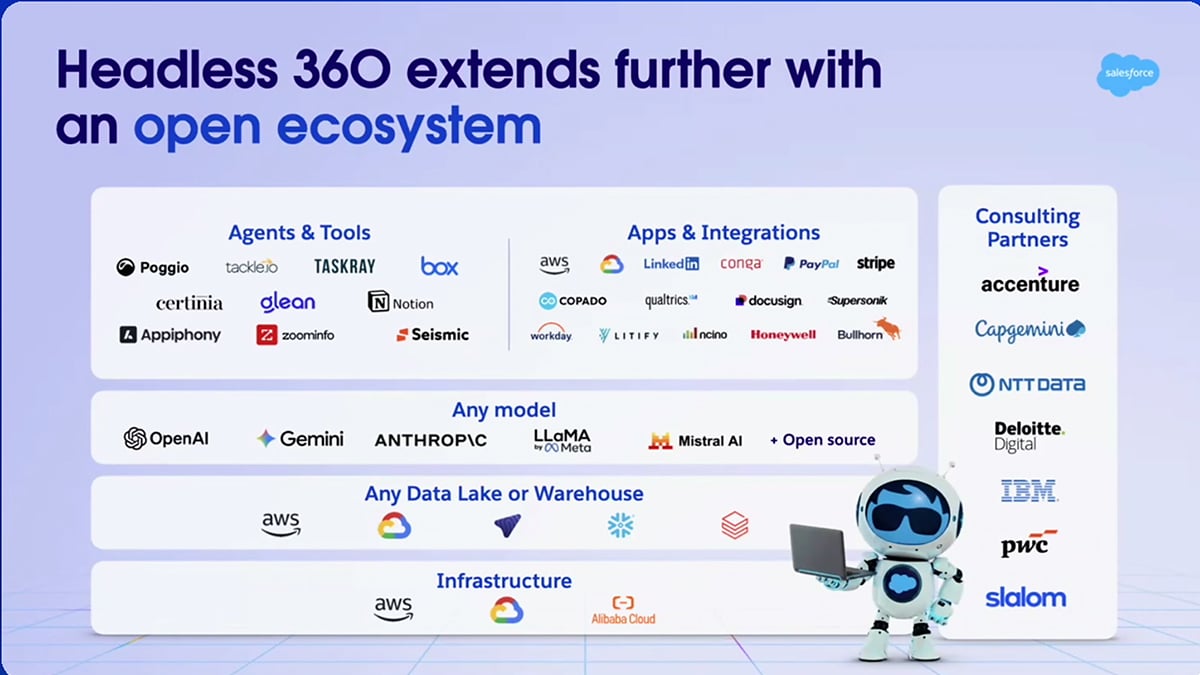
Salesforce’s integration of third-party AI through Model Context Protocol APIs, supporting Anthropic, Dropbox, and OpenAI, represents a pragmatic acknowledgment that no single vendor will own the entire agentic stack. This begins to blur the lines between Salesforce’s predominantly Embedded AI architecture and the Overlay AI characteristics of competitors.
By allowing external agents to operate within the Salesforce ecosystem while Salesforce agents can access external data sources, they’re creating a hybrid model that could accelerate industry-wide learning. This openness might shorten the J-Curve journey for everyone, though it comes at the expense of reducing Salesforce’s competitive moat.
Customer Traction Despite Complexity
Complex Salesforce implementations, when done thoroughly with good documentation and adequate staffing for Data Cloud support, are the best candidates for Agentforce success. These organizations have what we call “high activation energy” for AI success. Early results demonstrate what’s possible when the pieces come together:
Reddit deflected 46% of support cases and cut resolution times by 84%, reducing average response time from 8.9 minutes to 1.4 minutes. Adecco handled 51% of candidate conversations outside standard working hours. OpenTable resolved 70% of inquiries autonomously, while Engine reduced handle time by 15%, saving over $2 million annually.
But not every enterprise is experiencing success with AI implementations. At Keenan Vision we recently completed Architecture as Strategy, a study of the Enterprise AI ecosystem in collaboration with a team from UC Berkeley Haas School of Business. One survey subject, a consulting partner with a major global firm, reported that 96% of their generative AI projects have failed to make it to production. Our research reveals four key factors causing firms to languish in the liminal space of pilot purgatory.
Enterprises run into Action without Strategy and a Skills Shortage first. Board-level pressure creates a “scramble mentality” that optimizes for visible pilots over durable value—teams rush to “show AI” on impossible timelines, which yields scattered proofs that don’t scale. Meanwhile, AI literacy is thin at the top and practical build skills are thin on the ground, so buyers default to familiar vendors, evaluation cycles stall, and internal “vibe coding” produces brittle solutions that miss the business problem.
Next comes the Promise–Reality Gap and the Capability-vs-Technology Trap. Vendors routinely oversell while buyers underestimate integration and governance work, inflating expectations that chill future investment when results lag. More fundamentally, many treat AI like a conventional software purchase; but AI behaves like a capability that evolves with each model update and touches data, security, compliance, workflows, and culture—so it demands coordinated change management, not just a license key. These four forces collectively explain why so many pilots stall before production impact.
Analysis: Pioneering Through the Unknown
Salesforce’s recognition of Slack as the natural interface for agents reflects a broader pattern in the industry: we’re all trodding new territory together. While the conversational interface approach seemed inevitable to many observers, the technical and organizational challenges of making it work at enterprise scale are like navigating unmapped wilderness.
This evolution isn’t just about technical challenges; it’s about finding new paths through conceptual frontiers. Salesforce initially saw agents as features within applications, like settlers building isolated homesteads. Now they’re recognizing that agents need to live where work happens: using conversation to create connected communities rather than isolated outposts. As Vercel COO Jeanne Grosser states, “We have a goal that 100% of sellers never have to directly enter data in our CRM but only interface via an Agent deployed in Slack.”
The introduction of AgentScript alongside Slack’s elevation reveals the two-pronged challenge Salesforce faces: making agent creation accessible to non-programmers while ensuring agents can operate effectively in conversational contexts. These aren’t separate problems; they’re two aspects of the same fundamental question: How do you democratize AI orchestration? It’s like trying to build roads through the mountains that both experienced guides and newcomers can navigate.
The Road Through the J-Curve
We’re witnessing textbook J-Curve behavior across the industry. The parallel development of similar features by Salesforce, OpenAI, and others suggests we’re in the collective learning phase where best practices emerge through experimentation rather than innovation. Like pioneers discovering the same mountain passes independently, vendors are converging on similar solutions through trial and error.
The good news for Salesforce customers is that the company is assembling a coherent vision. With Slack as the conversational layer, AgentScript as the orchestration language, and MCP as the integration protocol, the pieces of an “agentic layer” are falling into place. The challenge now is execution, and particularly in convincing enterprises to adopt Slack over Teams and in making agent creation truly accessible to business users.
Cognitive DevOps: The Sleeper Opportunity
For the Salesforce DevOps community, Slack’s emergence as the agentic OS creates an intriguing possibility: Cognitive DevOps delivered entirely through conversational interfaces. Imagine maintaining your entire Salesforce org through Slack conversations with specialized DevOps agents; no more clicking through Setup menus or managing deployment pipelines through separate tools.
This Slack-first approach to DevOps could be Salesforce’s secret weapon in the SME market. Smaller organizations that lack dedicated Salesforce administrators could maintain and evolve their implementations through natural language conversations. It’s a vision that’s been percolating for a while and is now becoming technically feasible.
The Bottom Line
CIOs remain unsatisfied with any vendor’s ability to produce Enterprise AI success at scale. The Agentforce 360 announcement, while impressive in scope, confirms that neither Salesforce, Microsoft, ServiceNow, nor OpenAI has solved the fundamental challenge of making AI agents both powerful and accessible.
The elevation of Slack as the conversational interface shows Salesforce finding its bearings in this new frontier. The introduction of AgentScript reveals ongoing exploration of orchestration models. The MCP integration acknowledges that no single pioneer will map the entire territory alone.
We’re deep in the trough of the Industry J-Curve, with vendors and customers alike trodding new territory together. Salesforce’s latest moves, particularly around Slack, suggest they’re blazing a promising trail, even if it took them a while to find the right path. Whether this expedition ultimately reaches Agent Shangri-La remains uncertain, but at least they’re moving in the right direction with the right tools.
The journey continues, and for those of us who’ve been advocating for conversational interfaces, it’s satisfying to see Salesforce bringing Slack to the forefront. The timing may have been deliberate pathfinding rather than delay, but in this pioneer race through uncharted territory, those who learn fastest from the trail will ultimately succeed, regardless of who spotted the destination first.