Slack Agent-Ready APIs: Conversations as Enterprise AI Infrastructure
Slack wants to turn conversations into infrastructure. With its new Agent-Ready Platform APIs, the company is staking a claim as the integration layer for enterprise AI. The move reframes Slack from being “just a chat app” into becoming the connective tissue between collaboration and AI-powered workflows. Instead of walking back its controversial summer ban on indiscriminate channel scraping, Slack has converted that restriction into a blueprint for secure, governed access to conversational data. “The future of work is undeniably agentic,” said Denise Dresser, Slack’s CEO. “Our latest platform innovations create the data-rich environment necessary for AI agents to become trusted companions.”
Table of contents
What Slack Announced
Slack’s platform expansion is a mix of net-new capabilities and familiar elements reframed under its agentic story:
- Real-Time Search (RTS) API (closed beta): secure, permission-respecting retrieval for agents, replacing ad hoc “message fetching” with scoped, context-aware access.
- Model Context Protocol (MCP) server (closed beta): a universal bridge for LLMs and AI agents to discover data and execute tasks inside Slack.
- Slack Work Objects (GA late October): a new way to render third-party data inline in Slack with direct actions like “mark complete.”
- Third-party agents in the Marketplace (available today): distribution channel for partners like Anthropic, Perplexity, Notion, Dropbox, and Google.
- Agentic developer tools: CLI support for Bolt, streamlined deploys with Vercel/Heroku, AI best-practice guides, and prebuilt Block Kit Tables.
What’s also notable is how Slack reframed existing features into this vision: Block Kit Tables are now pitched as AI-ready UI scaffolding, marketplace distribution is emphasized as the onramp for agent adoption, enterprise-grade security is highlighted as the governance backbone, and existing DevOps partnerships (Heroku, Vercel) are positioned as agent-first deployment paths.
Together, these moves set the stage for Slack’s larger claim: the platform is the natural home for modern AI apps and agents because it unifies both context and distribution.
From Restriction to Strategic Opening
Slack’s RTS API is the product embodiment of its summer policy shift. Instead of rolling back the no-hoovering stance, Slack turned it into a framework for responsible AI integration. RTS is scoped, use-case-driven, and always permission-aware. The company’s bet is that developers don’t need raw replication; they need safe, reliable pipelines for context.
As Kurtis Kemple, Slack’s head of Developer Relations, put it in our briefing: “The APIs we had previously were built for ad-hoc, atomic message fetching. They can’t handle Perplexity wanting to do deep research across threads. RTS is purpose-built for that.”
Slack in the Overlay vs. Embedded Debate
Slack’s positioning also sharpens the architectural divide in enterprise AI. In our Overlay vs. Embedded thesis:
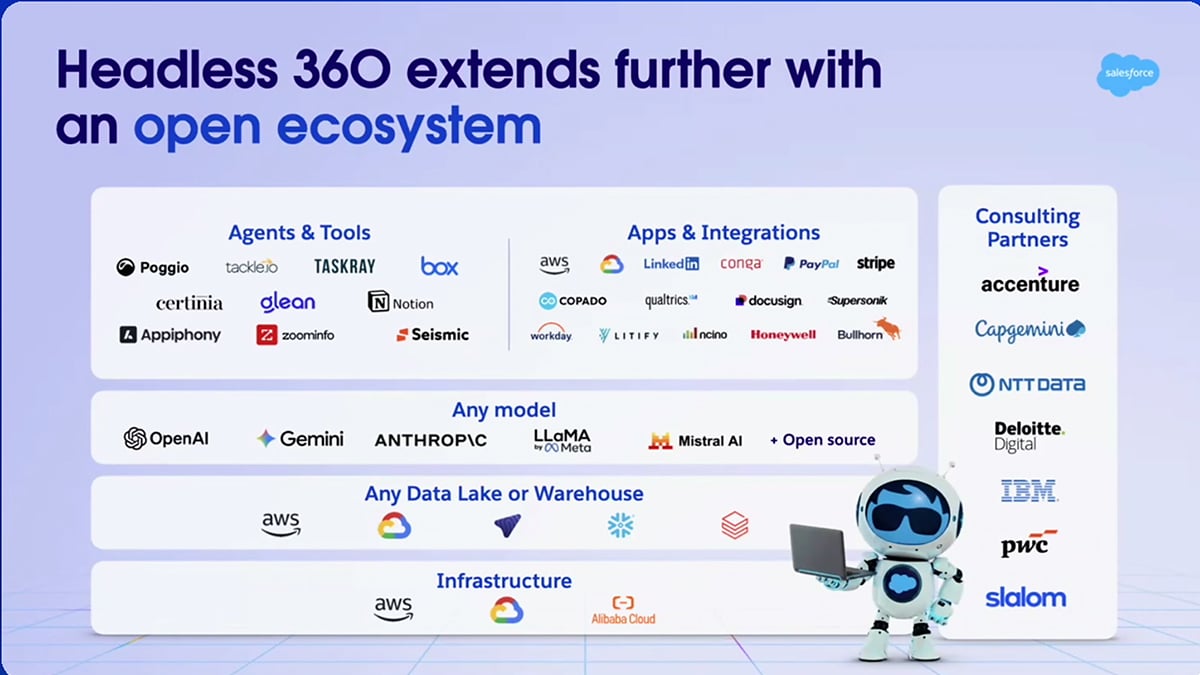
- Embedded platforms (Salesforce Agentforce, Workday) keep data inside the platform.
- Overlay platforms (Sierra, Decagon) sit above multiple systems.
Slack now sits squarely in the middle as the integration layer between the two. It offers overlay players a controlled front door to contextual data, while serving as the conversational face of embedded stacks like Agentforce.
This is a differentiation strategy as opposed to a side note. As enterprises experiment with both overlay flexibility and embedded governance, Slack is angling to be the connective tissue that makes hybrid architectures viable.
The Impact on Salesforce DevOps
For Salesforce customers, the implications are direct. Slack is no longer just the chat sidebar but the orchestration layer for agentic workflows. Work Objects standardize state, RTS provides governed access to conversational knowledge, and MCP ensures agents can act responsibly within the flow of work.
That means Cognitive DevOps teams can unify overlay services like Perplexity with embedded Agentforce agents, all of which are surfaced using Slack as the conversational front door.
Bottom Line
Slack’s strategy is not to compete as a model provider but to turn 14 years of enterprise conversations into a defensible moat for AI. With 1.7 million apps active in Slack every week and adoption rates proving users get more value when apps live inside Slack, the distribution is already there.
With all of this being said, there are still some risks: RTS and MCP are in closed beta with GA not until early 2026, and long-running agent workloads could create cost headaches. But the trajectory is clear. Slack wants to be the place where enterprise AI becomes useful and where conversation (finally) becomes infrastructure.