Everything, Everywhere, All at Once
Salesforce AI Co-opetition Explained: Why Benioff Bets on Rivals
Last week Anthropic shipped Claude Tag into Slack, the product Salesforce owns, and Marc Benioff, instead of treating it as a home invasion, helped carry the headline. In The Information, Laura Bratton captured the reaction inside Salesforce: confusion, a flicker of anxiety, and an executive scramble to explain why Slackbot is still the better mousetrap. The distinction Slack’s leadership reached for — that Claude Tag only sees the channels you add it to, while Slackbot sees the whole workspace — struck a lot of employees as a rounding error. A member of Salesforce’s own advisory board, Gaurav Kheterpal, said the quiet part out loud: Claude Tag is “what Slackbot was supposed to be.”
To The Information this is a morality play with a winner and a loser. The piece runs a chart — annualized revenue for Anthropic, OpenAI, and Salesforce — showing the two labs climbing a near-vertical wall while Salesforce flattens in the low-to-mid forties of billions. The implied verdict: the model companies are eating the application companies, and Benioff handing Anthropic a co-marketing moment is a man holding the door for the people robbing his house. I read it the other way. That chart isn’t the verdict. It’s the reason — and once you see why, Benioff’s behavior stops looking confused and starts looking like the only rational move on the board.
Table of contents
An old map for new territory
In August 1995, at the end of Netscape’s pre-IPO roadshow, Jim Barksdale took a last question from a banker at the Savoy in London: how do you know Microsoft won’t just bundle a browser into Windows and crush you? In a hurry to make a plane, Barksdale gave the line he’s remembered for — there are only two ways he knew of to make money, bundling and unbundling. (He retold it years later on HBR’s IdeaCast, Marc Andreessen beside him.) The banker, of course, was right: Microsoft bundled Internet Explorer into Windows, and the browser war was on.
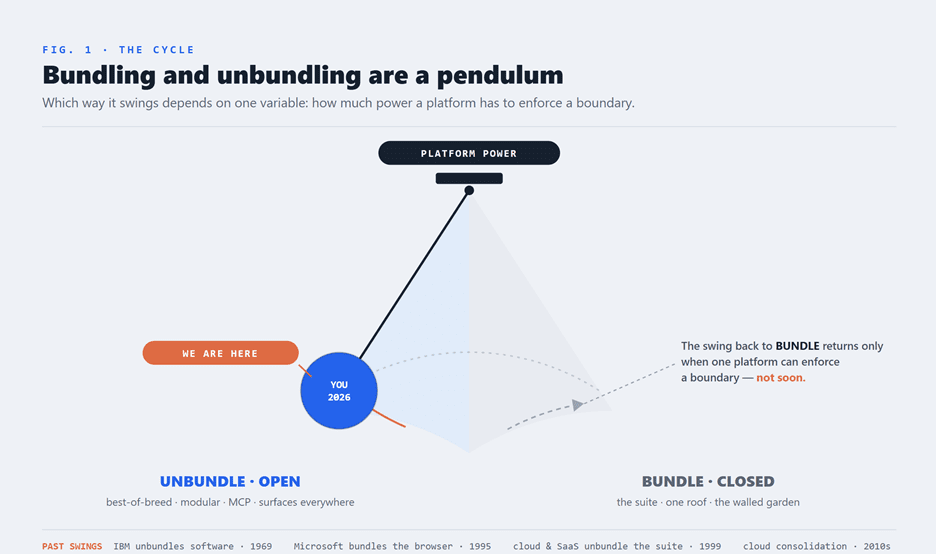
That banker is The Information, circa 2026, and the question is identical: won’t Salesforce just bundle this into Slackbot and crush Anthropic? So is the answer. Bundling and unbundling aren’t a destiny; they’re a pendulum, and which way it swings turns on one variable. It depends on how much power a platform has to enforce a boundary. Salesforce knows the cycle intimately, because it is a child of it: born in 1999 by unbundling CRM from the on-premises suite and re-bundling it into a browser tab, an opportunity and path Siebel couldn’t see. Twenty-five years on, Salesforce is at peak bundle — Sales, Service, Marketing, Slack, Tableau, Data 360, Agentforce, all under one roof. Unbundlers grow into bundlers; bundlers get unbundled by whoever spots the next growth opportunity. Today the opportunity is the conversational surface — where work happens — and the players who can see it are the AI labs.
When a category isn’t good enough yet, integrated and proprietary architectures win, because performance must be wrung out of tight coupling. When it overshoots, modular and open architectures win, because customers start optimizing for choice instead of capability.
Enterprise AI is squarely in the first regime: nobody’s agent is good enough, and no model holds a lead that survives more than a release cycle. With no decisive leader and customers demanding that intelligence show up wherever they already work, the winning architecture is open, modular, and promiscuous.
The academic name for “Everything, Everywhere, all at Once” is co-opetition — coined at Novell, formalized by Brandenburger and Nalebuff in 1996 — the recognition that a firm can be your complementor and competitor at once.
What they didn’t anticipate was a market where no one has the power to force boundaries, so co-opetition stops being a clever option and becomes the default. Putting your interface inside a rival’s surface, and inviting rival models into your own, is simply what you do when you can’t yet afford to be anywhere in particular.
The week before Dreamforce 2025
I caught the first glimpse of this a year ago. In early October 2025, OpenAI debuted their integrated app strategy, where they showed consumer apps integrated into ChatGPT directly. The week before Dreamforce 2025, I advised Salesforce leadership that OpenAI’s new apps in ChatGPT weren’t really a consumer-shopping story. They were a bid to own the place people live their working day — Slack’s job — even if the launch partners (Booking.com, Expedia, Spotify, Zillow) all pointed at the consumer for now.
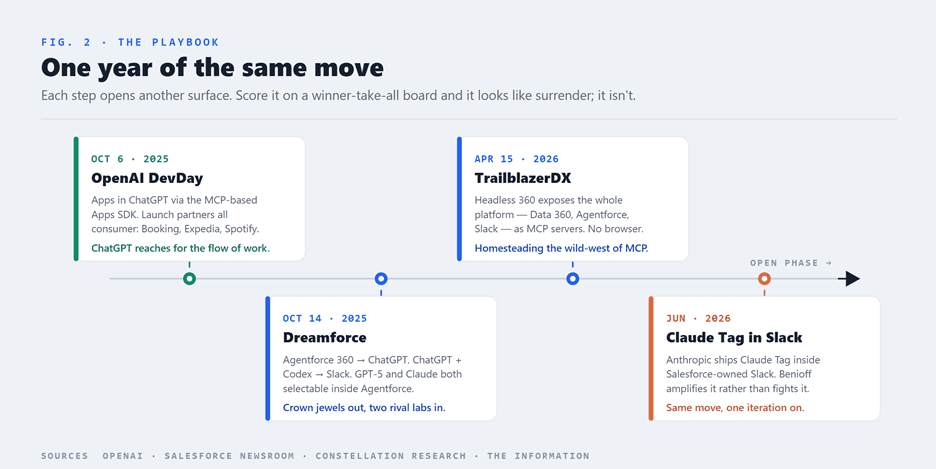
A week later, on Dreamforce’s opening morning in San Francisco, Benioff didn’t defend the walls — he dissolved them on purpose. Agentforce 360 would surface inside ChatGPT. Agentforce Commerce would plug into ChatGPT’s Instant Checkout. ChatGPT and Codex would land inside Slack. And OpenAI’s frontier models, GPT-5 among them, would be selectable inside Agentforce — alongside, in the same breath, an expanded partnership with Anthropic to do the same with Claude. Constellation Research read it precisely: a hedge, a way to “play into whatever the new enterprise user interface” turns out to be. Benioff had put his crown jewels — CRM data, commerce, the agent platform — inside a direct competitor’s front end and invited two competing labs into his own. Score that keynote on a winner-take-all board and you’d be as confused as the Slack employees are now.
Why promote Claude Tag?
Because it’s the same move, one iteration on, and Benioff has run this play for a year. If you can’t enforce the boundary, the next best thing is to make sure that whatever wins, it wins on your surface, with your data, under your governance — and to keep your name in every headline while the question stays open. Sharing the spotlight with Anthropic isn’t capitulation; it’s optionality. If Claude becomes the agent enterprises reach for, it reaches for them inside Slack. Or if ChatGPT wins the flow of work, Agentforce is already in it. If Salesforce’s own Agentforce pulls ahead, better still. Benioff is long every horse in the race, and the confusion The Information is documenting isn’t a bug in the strategy. It is the strategy.
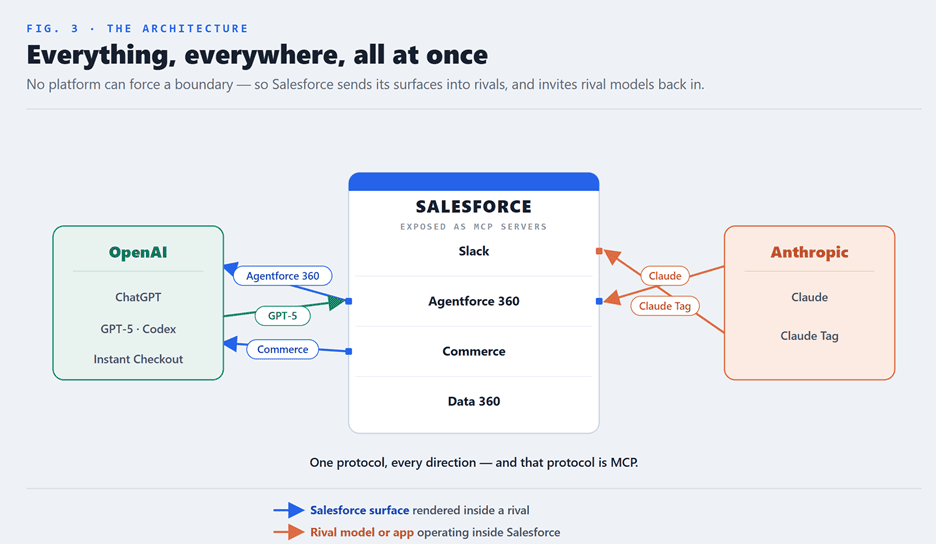
Name the connective tissue, because it’s the part that should worry CIOs. OpenAI’s Apps SDK is built on MCP; Claude Tag rides the same plumbing; and at TDX in April, Salesforce went all in — shipping Headless 360 to expose its entire platform, Data 360 and Agentforce and even Slack, as MCP servers any agent can call with no browser in sight. Salesforce isn’t a bystander on this frontier; it’s homesteading the wild-west of MCP servers itself, betting the biggest architectural shift in its 27-year history on a protocol Anthropic invented.
The old API economy — point-to-point integrations you owned and audited — is being reconstituted as a wide-open agent-surface frontier where any capable model reaches into your channels and records through a single standard. Wonderful for velocity, genuinely dangerous for data sovereignty — and the “which channels can it see” distinction Slack’s leadership waved away last week is the entire ballgame.
What CIOs should do now
The posture writes itself, and it is not to bet on a winner who doesn’t exist yet:
- Architect for portability, not allegiance. Standardize on the emerging preferred architecture — MCP-style, model-agnostic integration — and keep governance and data under your own roof rather than inside any one vendor’s surface. The re-platforming bill comes due to whoever hard-wired their workflow to the loser.
- Treat flow-of-work sprawl as a governance problem now. Every surface — ChatGPT, Claude Tag, Agentforce, Slackbot — is another door into your CRM and your conversations. The cost isn’t the license; it’s the audit, access-scope, and exfiltration risk that compounds with each one you light up.
- Budget for the swing. The open phase likely runs twelve to eighteen months. Plan 2027 renewals on the assumption that re-bundling pressure returns as model leadership concentrates and avoid multi-year lock-in to any single front end while the field is this fluid.
Your one measurable next step: before your next Slack or Salesforce renewal, run a 30-day surface audit — inventory every AI agent and app with access to your Slack channels and CRM records, document each one’s access scope, and shut down the ones reading more than they need. If you can’t produce that inventory today, you aren’t leaning into the agentic enterprise. You have an open door.
Where we go from here
See this era for what it is. We are at or near the point of maximum uncertainty in the largest platform shift since the web — terrifying precisely because it’s unreadable and moving at unprecedented speed. No one can tell you who wins, because the lead changes hands with every release.
Industrial and societal uncertainty isn’t incidental to what Benioff is doing; it is the entire explanation. When you cannot know which platform will own the future, the only rational move is to own a stake in all of them. It’s the chaos that makes the bets land everywhere, on every model, every surface, every protocol at once. It is the best and the worst of times to be the one deciding: the fiercest competition and fastest product improvement the industry ever produces, and the most dangerous moment imaginable to marry any single platform, because the one you wed today can be a footnote by the next earnings call.
Take comfort in the one thing history guarantees: the AI bundling era will return.
But, the pendulum always swings back. The day those revenue curves stop being a horse race and resolve into a clear leader — and Microsoft and SAP are already testing the instinct, fencing their apps against outside AI — is the day that leader starts closing the surfaces it once threw open and walls its garden for good. It’s coming as surely as it came for mainframes, for browsers, for the cloud. Just not soon — not in any future you can yet see from here. Until then, there is only one rational bet, and it’s the one Benioff is already placing: everything, everywhere, all at once.
Vernon Keenan is the CEO of Keenan Vision and the editor of SalesforceDevops.net. Disclosure: Keenan Vision is a paid advisor to Salesforce and to other companies across the enterprise software and AI ecosystem. The views expressed here are the author’s own and were developed independently of those relationships.