Agentforce Help Agent: Strong on Setup, Better on Pricing, Still Vague on Fin
Salesforce’s new prepackaged service agent gets progressive disclosure right
Salesforce today launched Agentforce Help Agent, a prepackaged, autonomous service agent that the company says deploys in minutes across voice, web, portal, and messaging. And it only bills when it resolves a customer’s issue from start to finish. Agentforce Help Agent reaches general availability in July, along with the pay-per-resolution pricing that ships with it.
I sat down with Kishan Chetan, EVP and GM of Agentforce Service, and Prasad Raje, SVP of product on his team, ahead of the announcement. The short version: this is the right product, built the right way, and it directly answers the two loudest complaints about Agentforce: setup friction and pricing anxiety. It also leaves a couple of real questions open, and in one place Salesforce can boast a little harder.
Table of contents
The genuine advance: progressive disclosure, done properly
Agentforce Help Agent is not a new platform. Chetan was emphatic on that point, and it matters. “This isn’t new technology,” he told me. “It has everything from Agentforce — the ability to define your topics, to use Agent Script, our more deterministic approach. We just did three things on top of it.” Those three: make setup genuinely fast, simplify the pricing to a single meter, and push the agentic portal experience further.
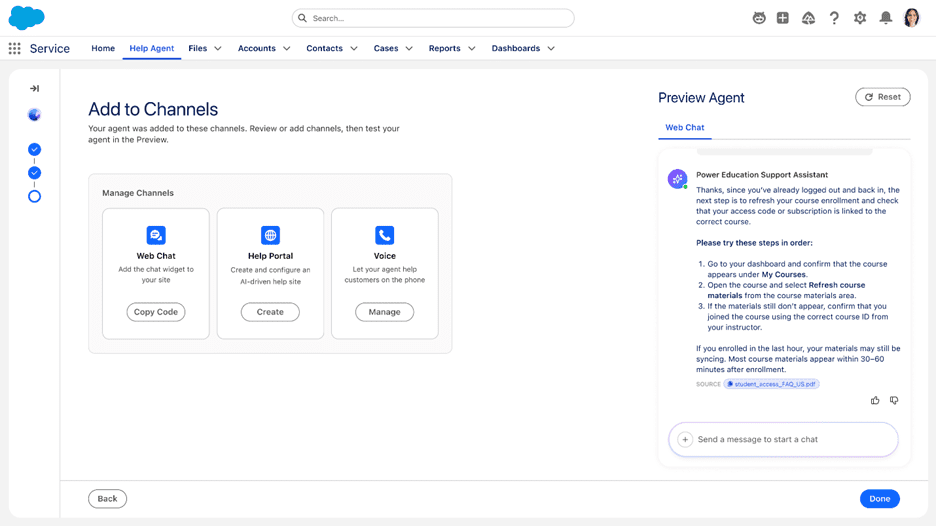
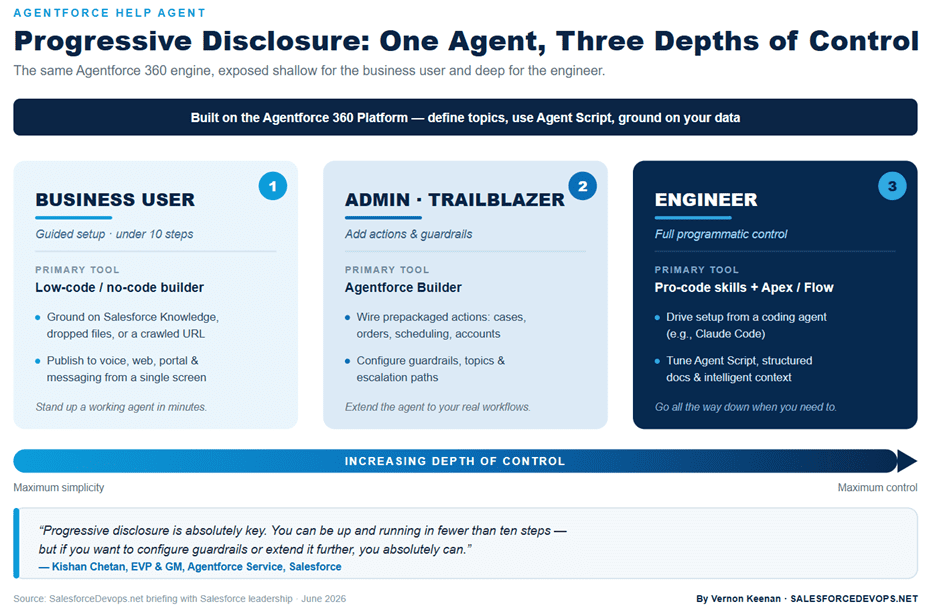
The setup story is the strongest of the three. When I put the principle of progressive disclosure to them — let a business user stand up a working agent in a handful of steps, while leaving every advanced knob available underneath for the admin or data engineer who needs it — both executives grabbed the term and ran. “Progressive disclosure is absolutely key,” Chetan said. “Our goal is that you can have an agent up and running in fewer than ten steps. But if you want to configure guardrails or extend it further, the way a lot of enterprises do, you absolutely can.”
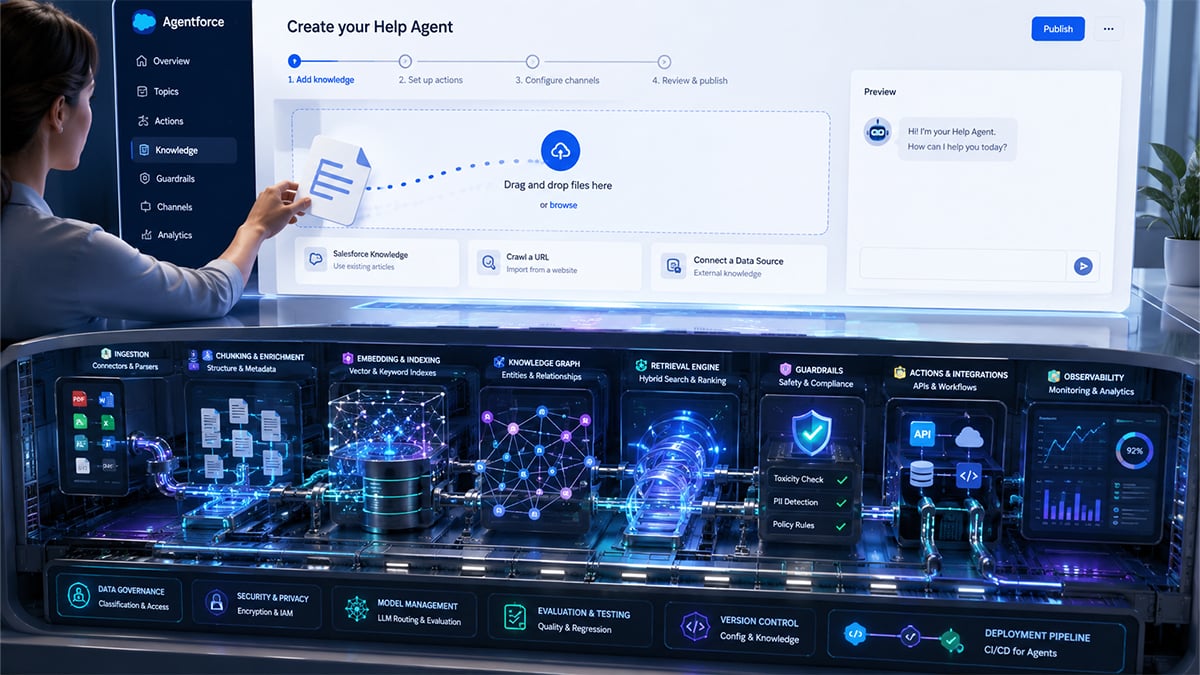
Progressive disclosure can help make complicated Salesforce features more accessible to Trailblazers. The business-user path grounds the agent on existing Salesforce Knowledge, dragged-and-dropped files, or a crawled URL, then publishes it to channels from a single screen. The pro-code path delivers the same setup through skills you can drive from a coding agent like Claude Code. And the admin path drops straight into Agentforce Builder. In the live demo, Raje provisioned a working voice agent — including procuring a new phone number in-flow, a capability Salesforce only has because it became a CCaaS provider with Agentforce Contact Center. Anyone who has tried to stand up a help line through a third-party telephony vendor knows that “huge pain in the butt,” as Chetan accurately called it, is usually a multi-week project, not three screens.
Raje framed the payoff for the implementer cleanly: “This takes care of the grunt work that used to take many steps. Three screens, and you have an agent running and grounded on your knowledge. The fun part for Trailblazers is adding the actions — connecting the agent to your order-management system, your appointment scheduling, your loan process. That’s where you focus, and you get there fast.”
Pricing: one meter, at last — but it’s a fourth model
Here is where Salesforce deserves real credit, and where the confusion still lives.
The headline is clean. Pay-per-resolution is, in Raje’s words, “a flat $2 when a resolution is achieved.” If the customer escalates to a human or walks away unhappy, there is no charge — and the human gets full context. Crucially, both Data 360 and Agentforce are unmetered during the interaction. As Chetan put it, “Customers don’t have to estimate any of that. They’re looking at one meter — a clearly defined metric of what a resolution means.”
That is the right instinct. The original sin of Agentforce pricing was forcing buyers to forecast how many actions, conversations, or voice-minutes a support interaction would consume. Collapsing all of that into a single outcome the customer already understands — a resolved case — is exactly the alignment the market has been asking for.
But the briefing also revealed that “one meter” is doing a lot of work. It isn’t one model; it’s outcome-based pricing with vertical-specific flavors. “If you’re very portal-heavy — financial services or health, which are portal-centric — we’ll offer unlimited resolutions for every login,” Chetan explained. “Some customers prefer to buy by members. If they have 100,000 members, they’ll pay per member per month, and resolutions are unmetered. The key is it’s not a different consumption meter for each thing. There’s one meter.” One meter per deal, yes. Across the portfolio, this is now a fourth pricing construct layered onto the three Agentforce already runs — per-conversation, Flex Credits, and per-seat — a stack the ecosystem was already, fairly, calling a hedge rather than a settled answer.
Two questions follow, and CIOs should ask both before signing.
First, what counts as an autonomous “resolution,” and who adjudicates it? Salesforce has tied price to the customer’s own satisfaction signal, which is admirable — but it also makes “resolution” the new contested metric, exactly as “conversation” was. The moment money attaches to a measured outcome, negative instincts can take over: the metric becomes a target, and targets get gamed. Get the resolution definition in writing.
Second, there’s a competitive oddity. At $2 per resolution, Salesforce is pricing the outcome at roughly twice Intercom Fin’s ~$0.99 — and Fin is the company Salesforce is buying. More on that in a moment.
Skeptics will read outcome-based pricing as Salesforce capitulating to Sierra, Bret Taylor’s resolution-priced agent company. I floated that framing directly. Chetan didn’t flinch: “It’s absolutely what customers are asking for. Fin has been a pioneer in outcome- and resolution-based pricing, and others — Sierra, even HubSpot — are moving there too. If other vendors have good ideas and that’s what customers want, we want to give customers the maximum flexibility for what they actually need.” That’s the correct answer. In an unsettled market, matching the buyer’s mental model beats defending a metric they reject.
Fin: market expansion, not yet integration
If you’re looking to this launch for clarity on how the Fin acquisition fits, you won’t find much, and Salesforce is candid about why. The deal isn’t expected to close until Q4 of Salesforce’s fiscal 2027 — roughly January — and the two companies operate independently until then.
Chetan was clear that the rationale is reach, not capability fusion. “It gets us into SMB, especially the lower end, which is a very big area for Fin. They bring almost 30,000 customers. It’s a strong market-expansion component.” Fin also runs on third-party desks like Zendesk and HubSpot and has built proprietary, service-tuned inference models — both of which Chetan flagged as potential synergies once the companies combine, without committing to a roadmap. “As we bring them together, we’ll understand the synergies and what we can do even better.”
So, here’s an interesting thread: Salesforce launched a $2-per-resolution product the same week it agreed to acquire the $0.99-per-resolution pioneer, and has said nothing about how two outcome-priced service agents coexist at the segment boundary. The stated split — Fin for SMB, Help Agent for mid-market and enterprise — papers over a price discontinuity that buyers near that line will notice. Watch this space through Dreamforce.
The part Salesforce is underselling
The most valuable thing I heard in the briefing is the one place the messaging is actively working against the product.
When the setup flow shows a business user dragging files into an agent, the sophisticated reader’s reaction is: that’s just dumping content into RAG, and naive retrieval is unreliable. I said as much in the room. Raje’s response was the tell: “You’re absolutely right. We’re doing intelligent processing — we feed the content through an LLM pre-processing step that generates derived content beforehand, and use it together with the customer’s query at runtime.” Under the covers, the Help Agent leans on Agent Data Library, structured-document handling, and intelligent context — not plain vector retrieval.
Chetan conceded the framing problem directly: “We’ve built a lot, in Data 360 and in Agentforce, to make unstructured-data processing far more impactful than plain RAG. While we’re simplifying the experience, we’re using all of that infrastructure to keep making retrieval better. We need to land that message carefully.” They do. Our own research into retrieval architectures points the same way — structuring knowledge as a graph rather than feeding raw chunks can outperform naive RAG by a factor of three to four. That’s precisely the skeptic’s objection, and Salesforce has a real answer to it that the current simplicity narrative buries. Progressive disclosure has a marketing cost: when you hide the hard engineering, you also hide the part that wins the technical argument.
Where this is heading — and the takeaway for CIOs
Step back and the strategy is coherent. Salesforce now has an IT service product, a contact center, and a prepackaged Help Agent. “You essentially have all the parts to run your customer service in a box,” Chetan said, “or you expand it to run your entire enterprise service in a box. That’s what we’re going for.” The employee-facing side — including a service-rep assistant that listens to live calls and feeds the closed loop back into self-service — is the next frontier, and the one most likely to broaden the TAM beyond customer service. It’s also, frankly, a little overdue.
For now, the executive guidance is specific. Do not model Agentforce Help Agent on the $2 flat rate alone. Before you sign, pin down two things in the contract: the precise definition of an autonomous “resolution” and who measures it, and which meter your vertical buys on — resolution, login, or member. That’s where the budget surprise lives, and it’s a thirty-minute conversation with your account executive that will save you a quarter of reconciliation later.
Salesforce got the hard parts right here: setup that respects both the business user and the engineer, and pricing that finally speaks the buyer’s language. The open questions — what “resolution” means when money rides on it, how Fin slots in, and why the company keeps hiding its best retrieval engineering — are the ones worth pressing them on between now and Dreamforce.