Salesforce Test Automation Landscape 2025 Report
Salesforce testing is undergoing a major transformation. As the platform becomes more complex and central to enterprise operations, traditional testing approaches have reached their limit. Manual regression cycles and brittle, script-based automation can’t keep pace with the velocity of Salesforce development or its constant configuration changes.
A new generation of vendors is tackling the problem through AI and agent-driven innovation. These platforms use natural language authoring, self-healing automation, and predictive analytics to generate, execute, and maintain tests automatically. Some are even extending coverage to Salesforce’s own AI layer, Agentforce, where conversational reliability must be validated like any other business process.
This report examines how testing is evolving in response to Salesforce’s broader shift toward the agentic enterprise. The direction is clear: QA is moving into the realm of Cognitive DevOps, where quality becomes an intelligent, embedded capability that ensures both human and digital agents perform reliably across every release cycle.
Key points from this report:
- Salesforce testing is distinct, shaped by dynamic architecture, heavy customization, and quarterly releases.
- Manual and script-heavy testing approaches are breaking under the pace of change.
- Vendors are split between Salesforce specialists, AI-first innovators, and lifecycle-focused hybrids.
- Testing is moving from scripted regression to intelligent, continuous assurance aligned with Salesforce’s agentic enterprise vision.
Methodology: This analysis is based on vendor briefings, public materials, customer feedback, and analyst research conducted August-October 2025. Only those vendors who opted in and provided a briefing were evaluated for inclusion.
Table of contents
Market Context
Testing Salesforce applications presents a set of challenges unmatched by other enterprise platforms. Its metadata-driven architecture means that UI elements, APIs, and workflows are dynamically generated and customized for each org. What works in one environment can fail in another, even before factoring in custom code or AppExchange integrations. Lightning Web Components and Shadow DOM further complicate element identification, making traditional locators brittle and maintenance-intensive.
Release velocity adds another layer of strain. Salesforce delivers three major updates every year, often with changes that subtly alter UI behaviors or metadata relationships. QA teams must retest not only core Salesforce functionality but also all the dependent systems integrated through MuleSoft, Slack, CPQ, or external CRMs. This constant motion has pushed manual testing and legacy frameworks past their practical limits.
The result is a market looking for solutions that blend automation with intelligence. AI-powered test creation, self-healing capabilities, and adaptive analytics are becoming the baseline for modern Salesforce QA. These advances reflect Salesforce’s move toward that agentic enterprise idea, where intelligent systems coordinate work across people and platforms. To support that model, testing itself must become not just adaptive and cognitive, but an active participant in change rather than a step that follows it.
What is Agentforce?
Agentforce is Salesforce’s AI agent platform launched in late 2024. Unlike traditional chatbots, Agentforce agents can handle multi-turn conversations with context retention, take actions across Salesforce (create records, trigger flows, update data), and escalate to humans when needed. Testing Agentforce requires validating both conversational accuracy across multiple dialogue turns and proper execution of business processes. This is a unique challenge that combines conversational AI validation with traditional workflow testing.
Vendor Landscape
ACCELQ

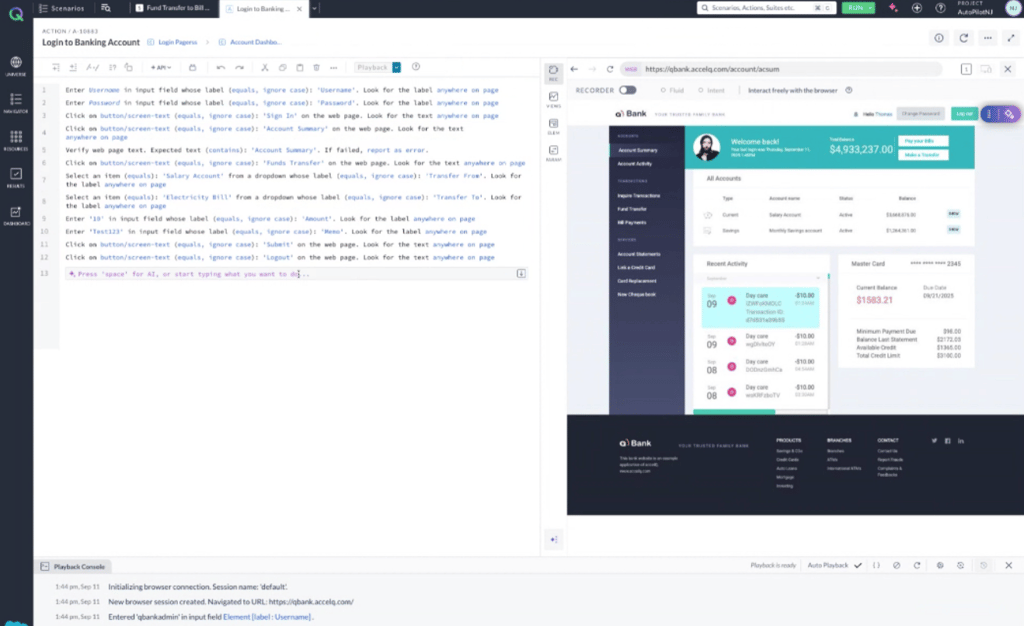
ACCELQ has become one of the most balanced players in the Salesforce testing ecosystem. The platform supports web, API, mobile, and database testing, but its Salesforce focus sets it apart. Its “Live Behaviors” accelerators model common Salesforce flows such as login, impersonation, and navigation, and are updated with each Salesforce release. This alignment helps teams stay current without constant rework.
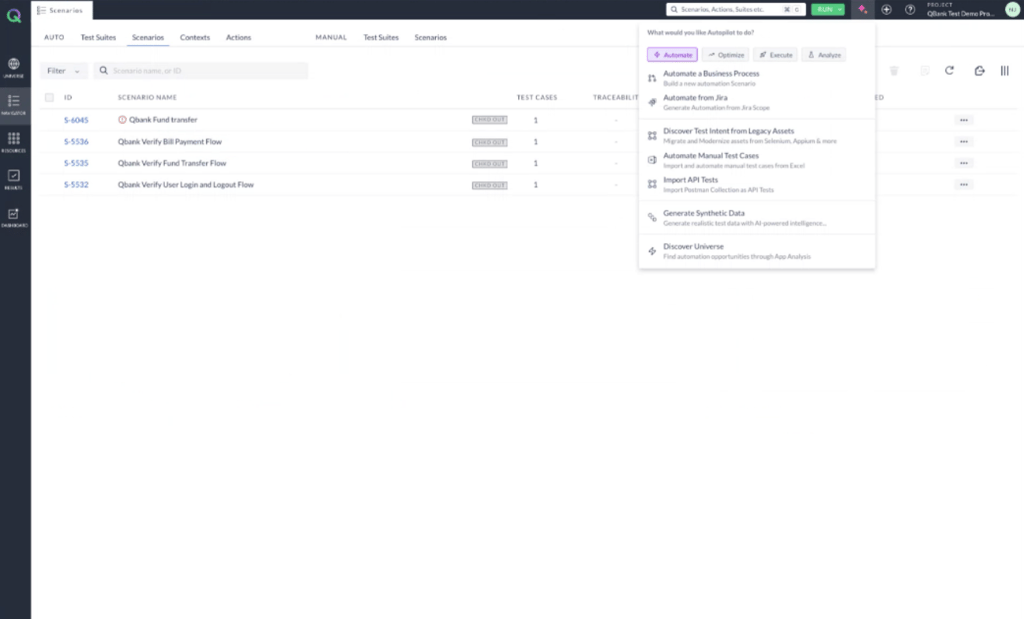
ACCELQ’s Autopilot engine brings AI into the process to reduce technical debt. It generates tests in natural language, discovers scenarios automatically, and heals them as the UI changes. Rather than adding AI on top of legacy workflows, ACCELQ built it into a modular architecture designed for reuse and maintainability.
The platform bridges two worlds: Salesforce specialists who focus on packaged apps and enterprise tools that treat Salesforce as one of many targets. ACCELQ offers both depth in Salesforce and coverage across systems, making it a fit for enterprises that want one automation platform spanning multiple technologies. Its main challenge is focus, balancing a broad enterprise story with its Salesforce credibility, but that same versatility makes it one of the more future-ready options in the market.
HIGHLIGHTS
Locator-free testing for Salesforce stability
Autopilot AI for natural language and self-healing
Broader “agentic SDLC” positioning
End-to-end lifecycle and cross-app coverage
Fast-moving roadmap with monthly updates
Hybrid AI engine (QGPT) for enterprise reliability
ContextQA
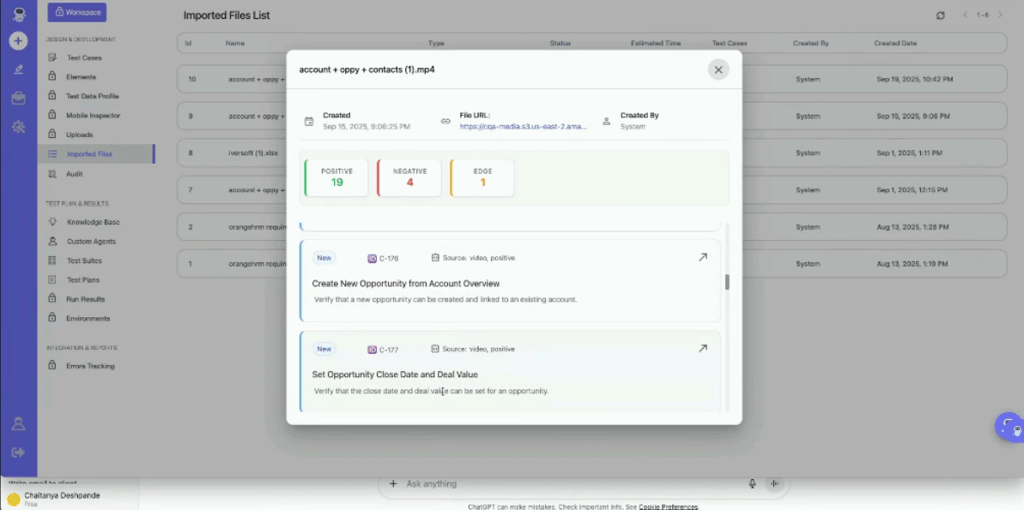
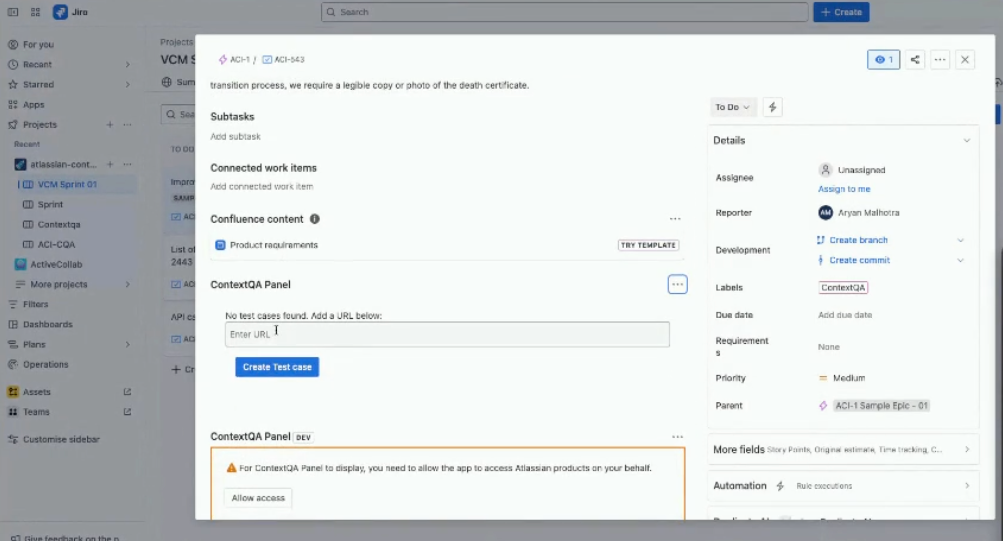
ContextQA presents itself as an agentic AI platform for end-to-end quality management. It spans the full testing lifecycle, from ingesting requirements in PRDs, spreadsheets, or Jira items to generating, executing, and maintaining tests automatically. The platform adapts with each Salesforce or application update, removing much of the manual upkeep that slows traditional automation.
Its strength lies in layering intelligence over automation. ContextQA prioritizes tests, highlights critical issues, and delivers root cause and impact analysis through predictive analytics. With built-in test management and integrations to Jira and TestRail, it operates more like a quality engine than a conventional framework.
In Salesforce environments, ContextQA extends beyond CRM workflows. It supports Agentforce testing to validate conversational accuracy and applies multimodal AI to verify Tableau dashboards and visual analytics—areas that have traditionally required manual testing.
For enterprises, the platform emphasizes flexibility and governance. It supports SaaS and private cloud deployment across AWS, Azure, and GCP, meets SOC2, ISO 27001, and GDPR standards, and can export automation into Selenium, Playwright, or Cypress to prevent lock-in. This combination of adaptability and control positions ContextQA as a bridge between modern QA operations and Salesforce’s emerging agentic enterprise model.
HIGHLIGHTS
Agentic AI for full lifecycle testing, from requirements to release
No-code automation that adapts automatically to Salesforce releases
Predictive analytics with prioritization, RCA, and impact analysis
Supports Salesforce and Agentforce testing, plus analytics/visual validation
Enterprise-ready (SOC2, GDPR, ISO)
Export capability to Selenium, Playwright, or Cypress (no lock-in)
Copado

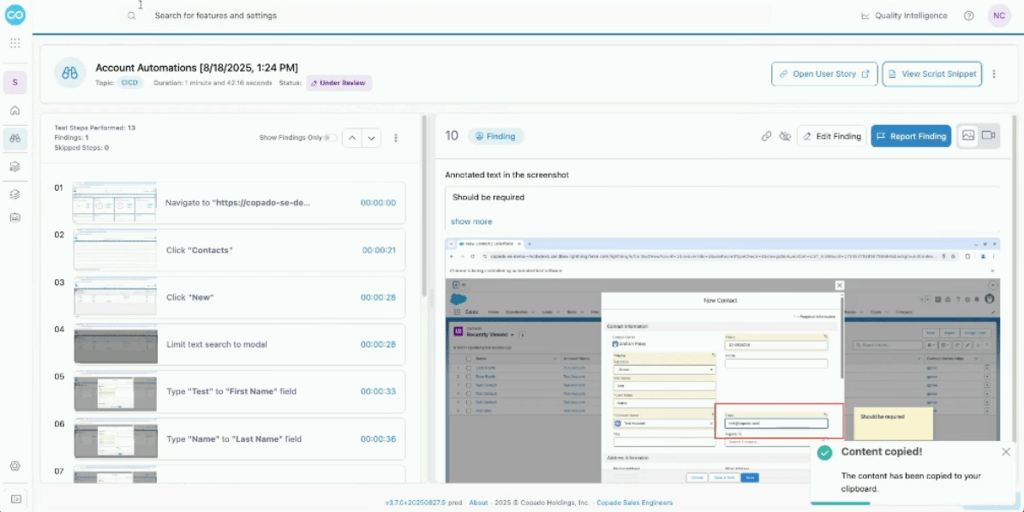
Copado is best known as the Salesforce-native DevOps platform, and testing has become an extension of that story rather than a standalone product. The company built its testing capability through acquisitions and now positions it as part of a full DevOps lifecycle. Rather than emphasizing automation tools in isolation, Copado frames testing as a way to reduce risk and ensure release governance.
The value proposition rests on bringing quality into the same pipelines where development and deployment already live. In Copado’s model, testing is not an afterthought but a checkpoint embedded in CI/CD, connected to version control, and tied to compliance reporting. That positioning resonates with release managers and IT leaders who see testing as part of delivery health, not just QA.
Copado’s depth in Salesforce is significant. It has spent years building metadata awareness and deployment automation, and testing fits neatly into that foundation. The strength of its message lies in continuity: the same platform that governs builds and deployments also runs the quality gates. This integrated view helps customers streamline governance across large, complex Salesforce programs.
HIGHLIGHTS
DevOps-first platform with testing built in
Testing framed as risk reduction and governance
Deep Salesforce metadata awareness
Integrated into pipelines, version control, and compliance
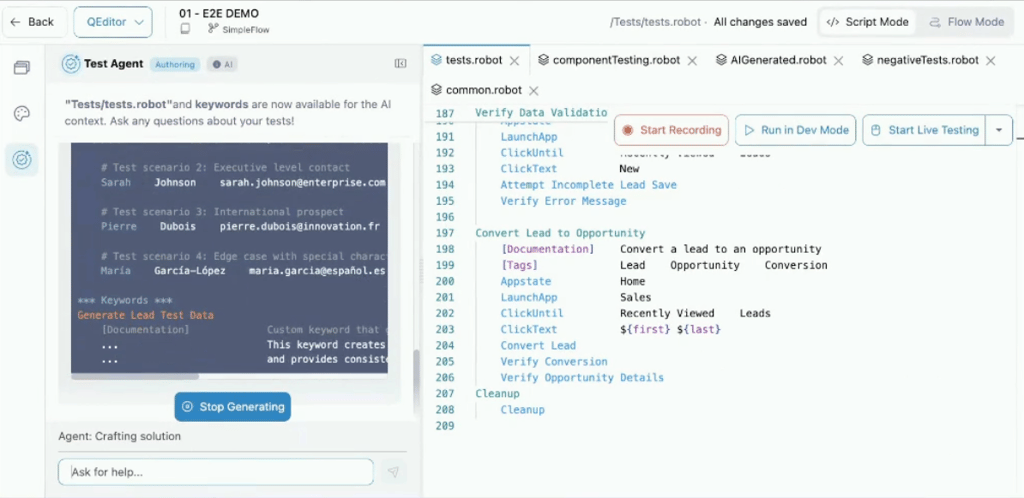
The challenge is perception. Copado is still seen primarily as a DevOps vendor, and its testing capabilities are often overshadowed by that larger identity. While competitors lead with testing-first narratives, Copado continues to emphasize risk management within DevOps. That framing gives it credibility with IT leadership but can feel less compelling for QA leaders who are evaluating tools head-to-head.
Functionize

Functionize approaches Salesforce testing from a broader, cloud-native perspective. Instead of positioning itself as Salesforce-first, the company built an AI-driven automation platform designed for scale across web, mobile, and enterprise systems. Its long-standing “agentic-first” vision frames scripts as obsolete and positions intelligent agents as the future of test creation and execution.
The platform uses a layered AI architecture to balance speed, cost, and reliability. Lightweight CPU models handle large-scale execution, semantic models provide reasoning and natural language understanding, and vision models are applied selectively for UI accuracy. Years of execution data across Fortune 500 customers fuel and refine these agentic workflows, giving Functionize a strong data foundation for continuous improvement.
In Salesforce projects, Functionize has proven effective in complex, multi-system environments but does not market itself as a Salesforce specialist. Its appeal lies in helping enterprise QA teams scale automation and embed AI into continuous delivery pipelines without adding operational overhead. For organizations seeking an AI-driven approach to testing that spans multiple technologies, Functionize offers a clear path forward.
HIGHLIGHTS
Cloud-native, AI-first automation platform
“Script is dead, everything is agentic”
Layered AI design for cost, speed, and accuracy
Strong enterprise traction, Fortune 500 customer base
Less Salesforce-specific depth compared to specialists
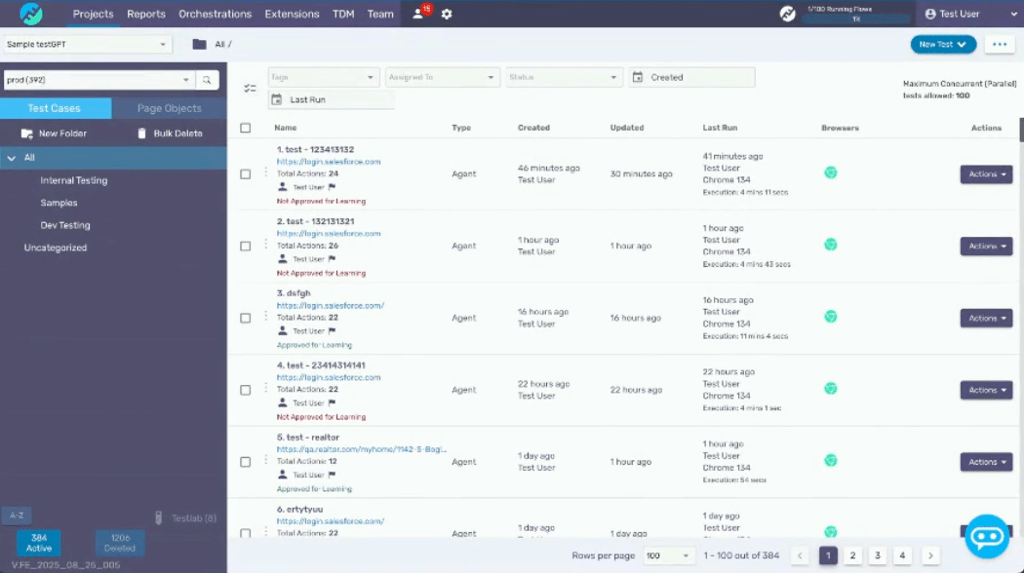
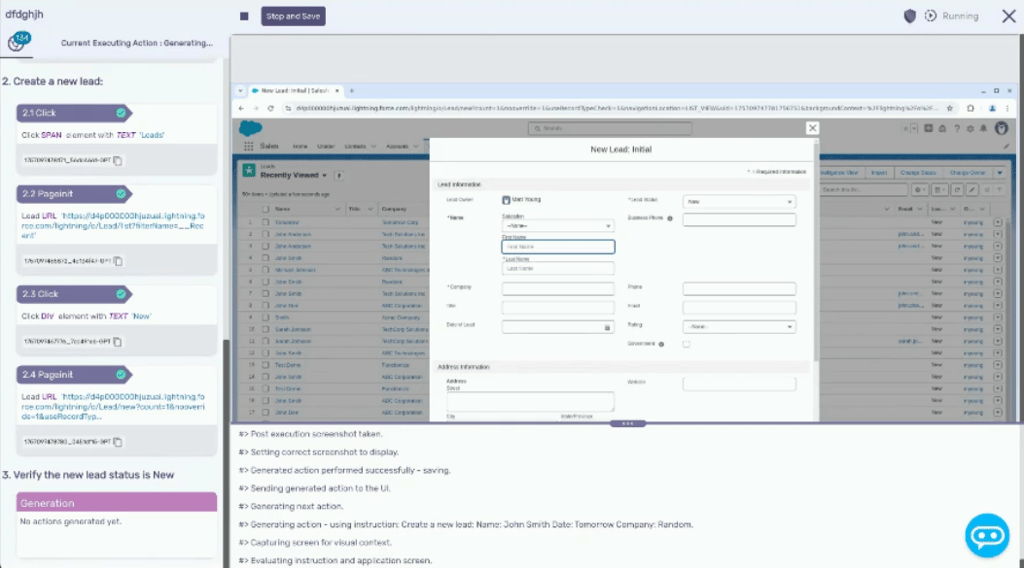
Its strength is innovation and scale; its tradeoff is depth. Compared to Salesforce-native tools with packaged accelerators and metadata awareness, Functionize can feel less specialized. Yet its platform-wide vision makes it an important reference point for where agentic testing is headed across the enterprise.
Inflectra

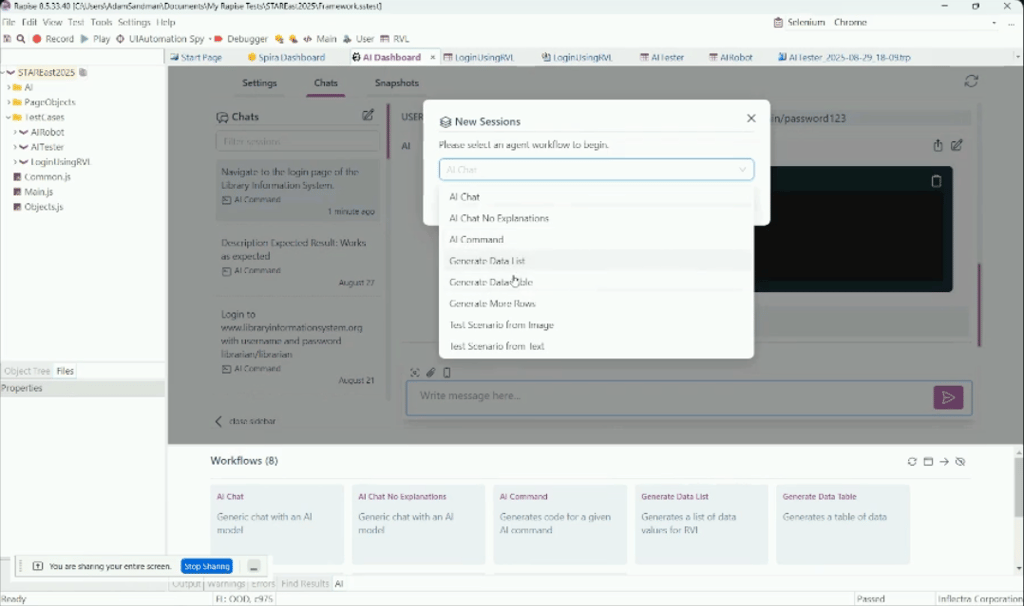
Inflectra approaches Salesforce testing from the perspective of a broad application lifecycle management (ALM) and QA suite rather than as a Salesforce specialist. Its flagship platform, Spira, integrates requirements, test management, automation, and reporting in a single environment. Salesforce support exists through connectors and integrations, making Inflectra an option for organizations that want a unified toolchain across multiple systems rather than a narrowly focused Salesforce solution.
The company’s value lies in governance and control. Industries that require traceability and compliance—such as government, defense, and regulated enterprises—gravitate toward Inflectra because of its emphasis on end-to-end oversight. In Salesforce projects, this plays out in its ability to track requirements through to execution while still connecting into automation frameworks. The Salesforce angle is present, but it is not the centerpiece of the story.
In the broader test automation conversation, Inflectra differentiates itself less through agentic innovation and more through stability and breadth. It appeals to teams that want everything from requirements to reporting in one place, and it positions itself as a steady, reliable vendor rather than a disruptor. The tradeoff is that Salesforce coverage is not as deep as the ecosystem specialists, and AI is not a strong part of its message.
HIGHLIGHTS
Broad ALM and QA suite (Spira platform)
Salesforce supported through connectors and integrations
Strong in traceability, compliance, and governance
Appeals to regulated industries needing full oversight
Less depth in Salesforce and AI innovation compared to peers
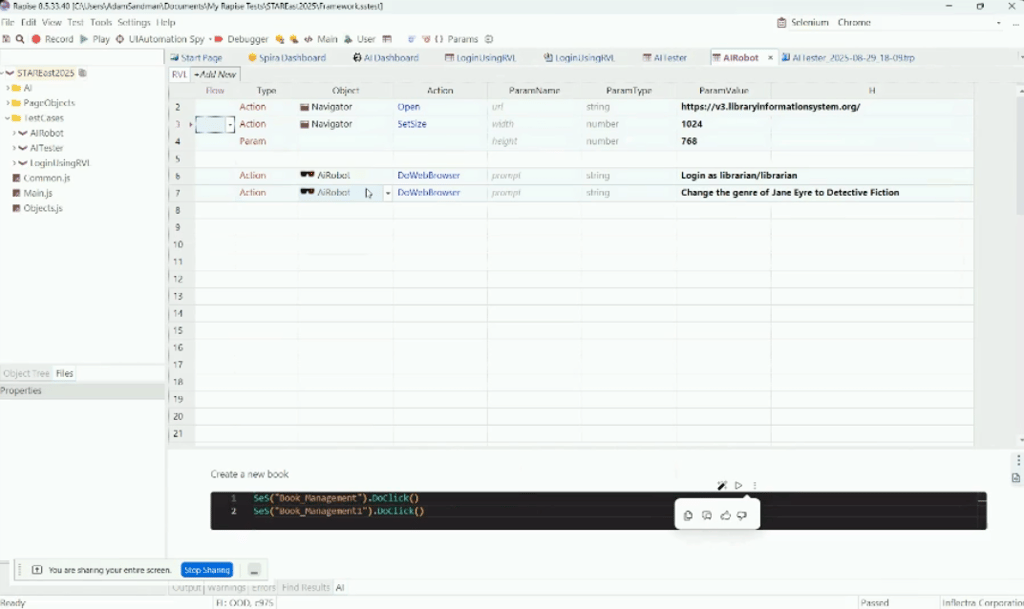
LogiGear
LogiGear has been a long-standing player in QA and test automation, with over two decades of experience helping enterprises build and scale testing programs. Its flagship platform, TestArchitect, takes a keyword-driven, no-code approach that allows teams to create maintainable automation without heavy scripting or specialized development resources. Built for cross-platform use, TestArchitect supports web, desktop, mobile, API, and enterprise systems, including Salesforce.
The platform’s modular design is centered around reusable “actions” that abstract complex steps into clear, natural language components. This structure makes it easier to standardize test creation and minimize maintenance—particularly valuable in dynamic environments like Salesforce, where metadata, layouts, and workflows frequently change.
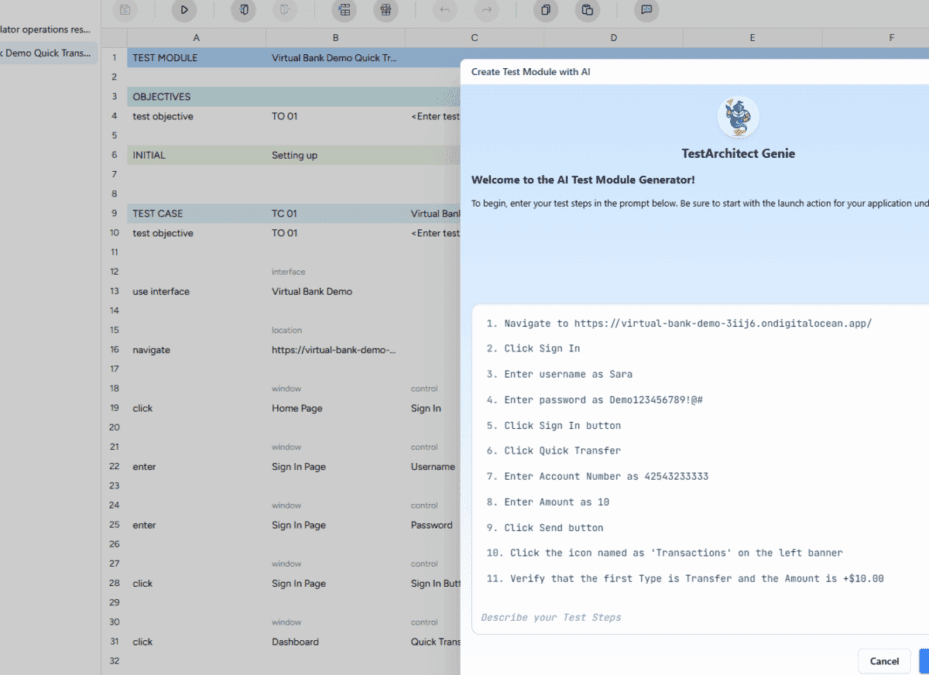
TestArchitect also integrates visual and data-driven testing capabilities, allowing QA teams to validate UI elements, business logic, and system interactions in a single framework. Its recent enhancements include early AI support through TA Genie, which helps users generate and optimize tests in plain language, analyze results, and identify potential defects more quickly.
HIGHLIGHTS
Cross-platform coverage across desktop, web, mobile, SAP, and Salesforce
400+ prebuilt natural-language actions
Built-in OCR and visual validation for complex UIs
TA Genie AI Assistant for test generation and optimization
Supports SaaS, on-prem, and hybrid deployments
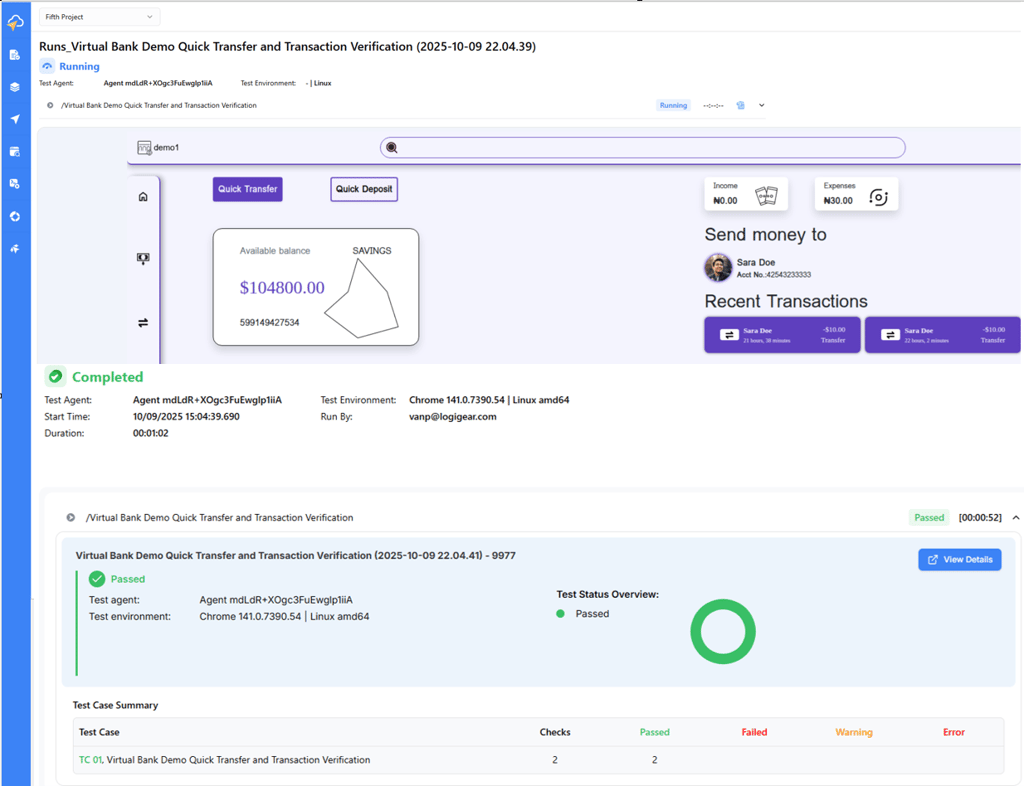
LogiGear’s strength lies in its maturity and focus on consistency. While not Salesforce-specific, TestArchitect appeals to enterprises looking for a stable, proven automation platform that can connect Salesforce testing with broader QA operations. Its balance of no-code design, cross-platform reach, and governance-oriented architecture makes it a practical choice for large organizations modernizing long-standing automation programs.
Provar

Provar has long been one of the most Salesforce-centric automation vendors. It was built from the start to address Salesforce’s unique metadata-driven architecture, dynamic UI, and constant release cycle. That foundation has earned it a reputation as the go-to specialist for teams who need reliability in highly customized Salesforce environments. Provar’s tools have consistently emphasized reducing maintenance costs and keeping pace with Salesforce’s rapid changes, which has been a key differentiator against general-purpose automation frameworks.
More recently, Provar has started to evolve its narrative toward the future of Salesforce AI. The company has been vocal about the challenges of testing Agentforce and similar AI copilots, especially around validating multi-turn conversations and end-to-end agent actions. Provar is positioning itself not just as a testing tool for Salesforce today, but also as one of the few companies addressing how to test Salesforce’s next generation of AI-driven user experiences.
HIGHLIGHTS
Salesforce-first automation specialist
Deep metadata awareness and release alignment
Focus on minimizing test maintenance
Expanding into Agentforce and multi-turn conversational testing
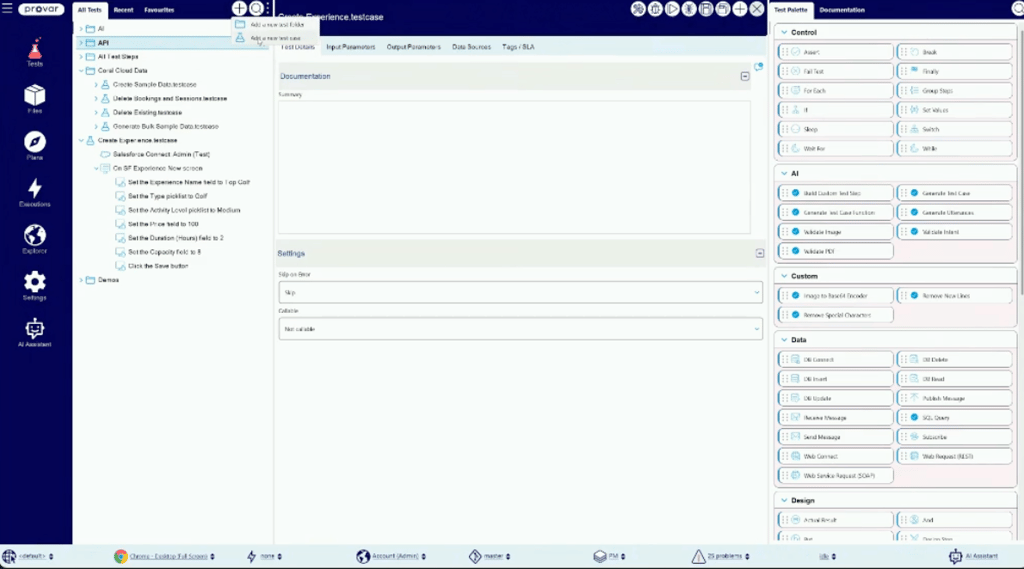
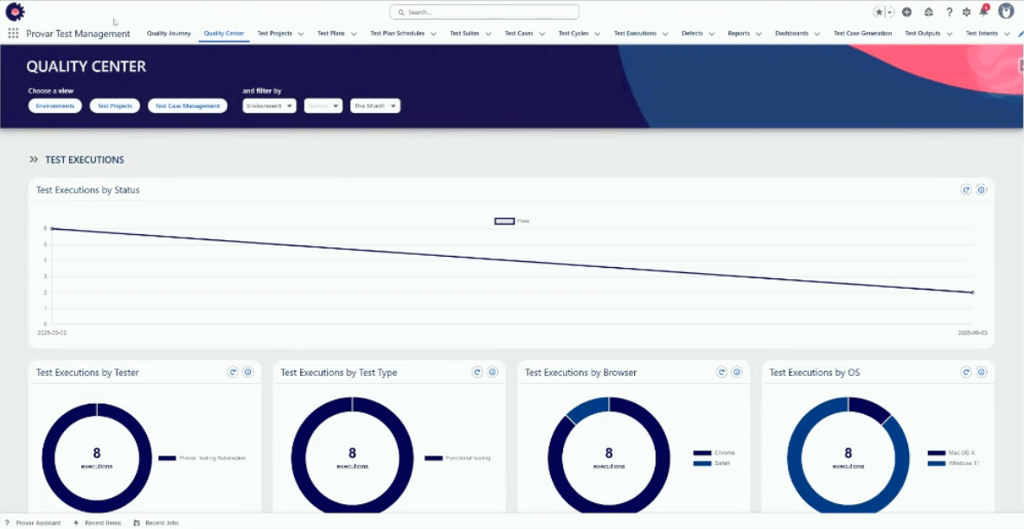
Provar’s strength is its deep Salesforce DNA. Its platform covers areas such as Salesforce CPQ, Vlocity, and other packaged apps that are notoriously difficult to automate reliably. This makes it particularly attractive to large enterprises with complex Salesforce footprints. At the same time, its challenge is broadening perception beyond “just Salesforce,” since competitors with wider end-to-end coverage often appeal to organizations looking for one automation platform across multiple systems.
Sennu.AI

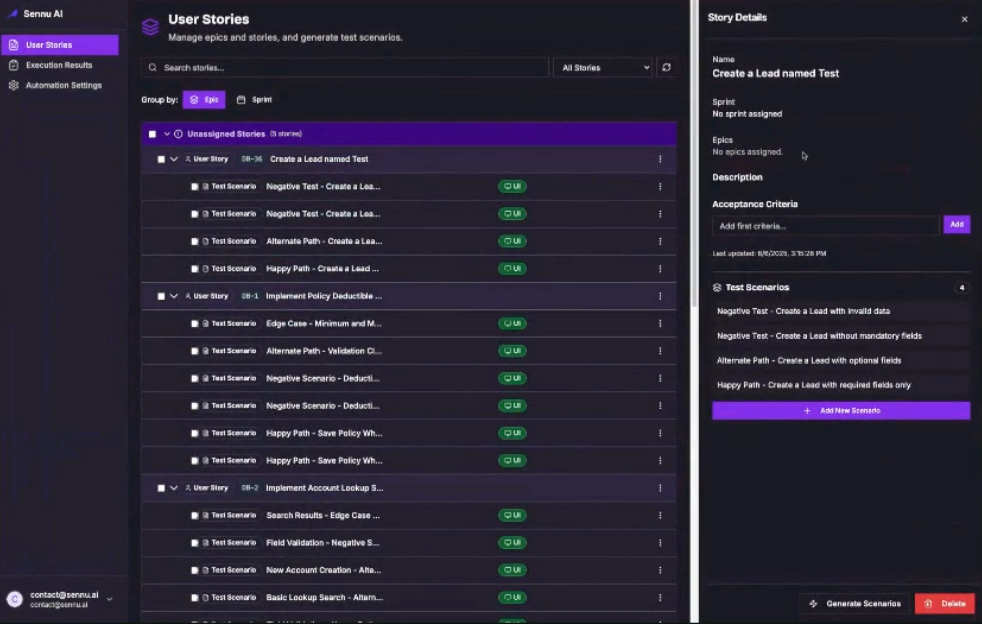
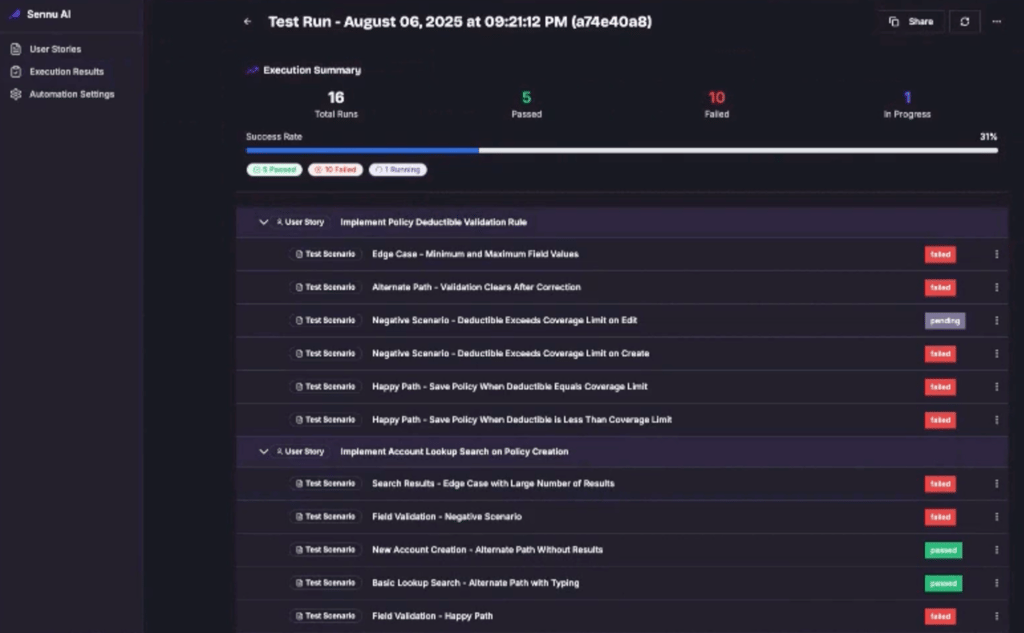
Sennu.AI is one of the newest entrants in the Salesforce testing space, founded out of Y Combinator and built by a team with a Salesforce consulting background. The company’s origin story comes from a simple but common pain point: consulting firms often deliver Salesforce projects without automated regression tests, leaving customers with fragile implementations and no safety net. Sennu.AI’s mission is to change that by making testing simple enough for consultants and admins to adopt directly.
The platform takes a plain-English approach. Instead of building scripts or recording flows, a user describes the scenario they want to test in natural language and the system executes it automatically. This fits into the growing wave of AI-powered tools, but Sennu.AI’s differentiator is that it’s designed for the realities of small firms and project-based delivery, not just large enterprise QA teams. The simplicity is meant to make testing feel less like a specialized discipline and more like a natural part of delivery.
While still early in its journey, Sennu.AI is leaning into Salesforce-specific use cases and the gaps left by heavier-weight platforms. Its challenge will be proving it can scale from early-stage innovation to production-grade reliability in complex enterprise environments. But its YC pedigree and sharp focus on Salesforce give it visibility that many early-stage tools never reach.
HIGHLIGHTS
YC-backed startup with Salesforce consulting roots
Plain-English test authoring and execution
Targets consulting firms and admins, not just QA teams
Aims to fill the gap in regression testing for project-based delivery
Early-stage, still maturing in scale and enterprise reliability
testRigor

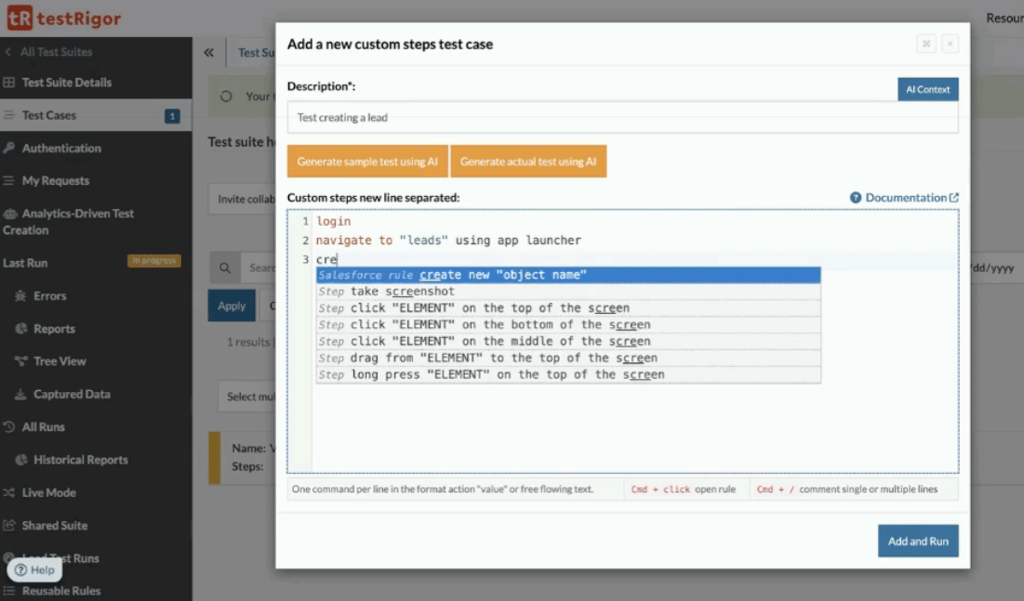
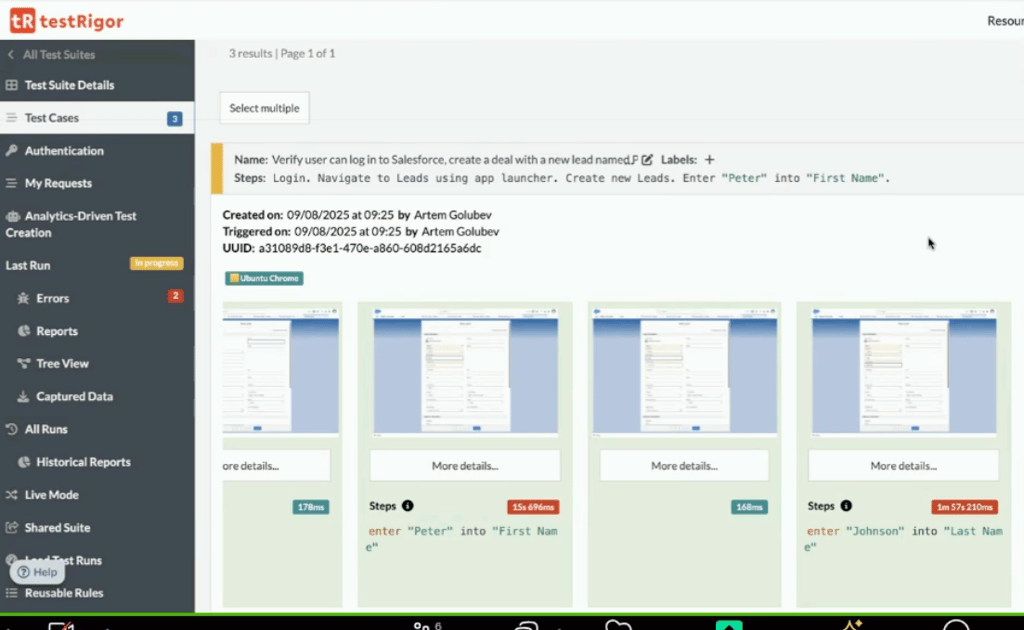
testRigor has built its reputation on making test automation accessible to non-technical users. Its plain-English approach allows anyone to write and execute tests without learning a scripting language or relying on brittle locators. This focus on simplicity has helped it grow quickly, particularly with teams that want to scale automation without the traditional barriers of coding expertise.
In Salesforce, testRigor positions itself as a way to democratize testing. Admins, business analysts, and QA professionals alike can write tests that mirror the exact steps of end users. The platform has also emphasized reduced maintenance, with self-healing capabilities that adapt to UI changes and help teams keep pace with Salesforce’s rapid release cycle. While it lacks the deep metadata-specific accelerators of Salesforce-first vendors, it still offers a compelling story for organizations that prioritize speed and ease of adoption.
testRigor’s strength is speed to value. Organizations often report standing up hundreds of automated tests in weeks, a pace that traditional frameworks struggle to match. The tradeoff is that for highly complex Salesforce implementations, testRigor may not offer the same depth as tools built from the ground up for Salesforce. Still, for many teams, the ability to scale automation quickly without heavy technical investment outweighs that limitation.
HIGHLIGHTS
Plain-English test creation, no coding required
Focus on democratizing automation for non-technical users
Self-healing tests reduce maintenance overhead
Rapid adoption, hundreds of tests in weeks
Less Salesforce-specific depth compared to specialists
TestZeus

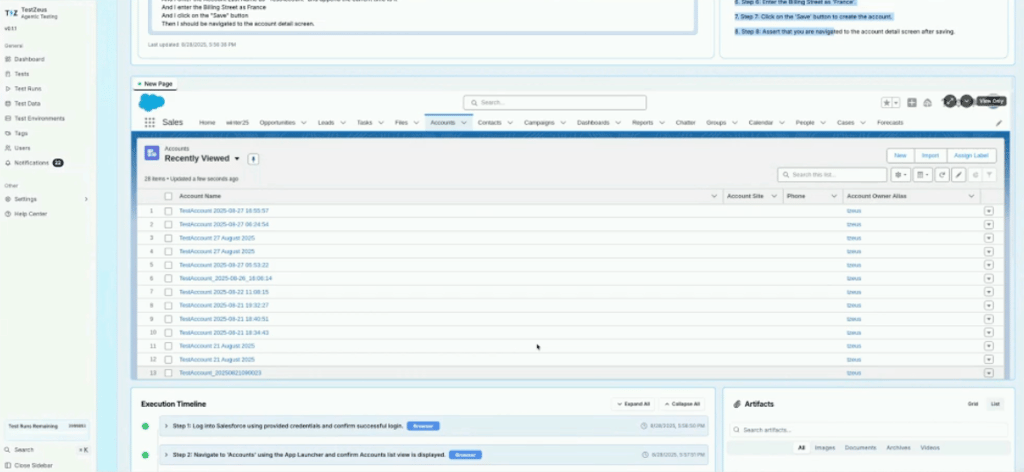
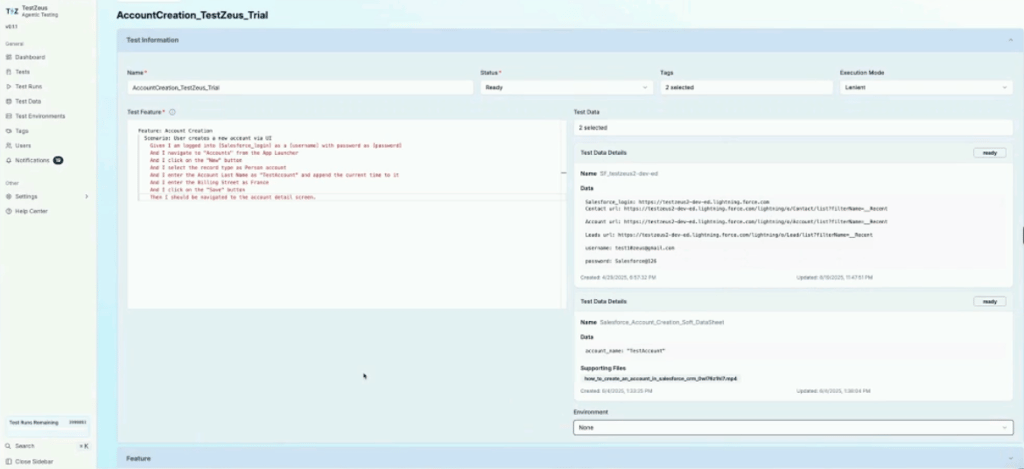
TestZeus is one of the newest and most experimental entrants in the Salesforce QA landscape. The company positions itself not as a tool, but as a system of AI agents designed to work alongside QA teams. Its pitch is that traditional script-based automation is obsolete and should be replaced by natural-language authoring combined with intelligent agents that anticipate and suggest test cases.
The platform allows users to describe a scenario in plain English, then expands on it by recommending edge cases and additional steps. TestZeus likens this to having a “junior tester” that continuously proposes tests until the user decides to stop. This agentic model is intended to cut down on the manual effort of designing and maintaining test suites, while also surfacing gaps human testers might overlook.
While still in an early stage, TestZeus has focused on Salesforce as its proving ground, fine-tuning its models on common Salesforce workflows and customizations. Its biggest challenge is credibility and maturity. The vision is bold, but production use cases are limited, and it remains to be seen whether enterprises will adopt such a radical departure from traditional automation frameworks.
HIGHLIGHTS
Multi-agent AI system positioned as “agents, not tools”
Natural-language test creation with auto-suggested cases
Fine-tuned for Salesforce workflows and customizations
Frames automation as obsolete, replaced by agent collaboration
Early stage, still proving enterprise readiness
Vendor Positioning at a Glance
Salesforce-Native Specialists
- Provar: Deepest metadata integration, Agentforce focus
- Copado: DevOps-embedded, governance-first
Enterprise Platform Players
- ACCELQ: Balanced depth + breadth, Live Behaviors
- ContextQA: Full lifecycle, predictive analytics
- LogiGear TestArchitect: Pragmatic stability, cross-platform
AI-First Innovators
- Functionize: Layered AI, cloud-native scale
- TestZeus: Multi-agent experimentation
- Sennu.AI: Consulting-focused simplicity
Accessibility-Focused
- testRigor: Plain English, rapid deployment
ALM/Governance-Focused
- Inflectra: Broad lifecycle, compliance-heavy
Key Takeaways
Salesforce testing is at an inflection point. The complexity of metadata-driven UIs, constant customization, and three major releases a year has stretched manual and script-heavy testing to the breaking point. Enterprises cannot afford to rely on brittle regression cycles when Salesforce sits at the center of revenue, service, and compliance. Quality has become a core business issue, not just a QA task.
Vendors are responding in two ways with a third “hybrid” approach starting to materialize as well. On one side, Salesforce specialists such as Provar, Copado and ACCELQ have invested deeply in metadata awareness, packaged accelerators, and release alignment. These platforms provide the stability and depth that complex orgs require. On the other side, AI-driven players like Functionize, TestZeus, and Sennu.AI are pushing the market toward agentic automation, where intelligent systems generate, heal, and execute tests continuously. ContextQA sits at the intersection, offering a full lifecycle approach that blends automation with predictive analytics and agent-based workflows.
This trajectory mirrors Salesforce’s own vision of the agentic enterprise. As Salesforce positions intelligent agents to connect and optimize every process, QA cannot remain a manual checkpoint at the end of the cycle. Testing itself must become agentic; it needs to be able to validate human and digital agents alike, adapt to rapid change, and embed quality into the release pipeline. The future of Salesforce QA is not about adding more scripts but about shifting to intelligent systems that work alongside people, keeping pace with the innovation Salesforce is driving into the enterprise.