The AI Paywall Is Breaking: Salesforce’s SMB move reveals a shift toward intelligence as a baseline capability
Eighteen months ago, I wrote that Salesforce had made a fundamental mistake with its AI strategy. The issue was never the models or the long-term vision. It was the way the company chose to introduce AI to its own community. Salesforce was asking Trailblazers to believe in artificial intelligence while placing the on ramp behind license negotiations, consumption credits, and conversations with account executives that nobody trusted. The one feature that could have sparked grassroots experimentation—Prompt Builder—was effectively gated, and the result was predictable. Trailblazers did not experiment, engagement stalled, and AI became something you read about rather than something you used.
That article got Marc Benioff’s attention. What followed in the lead-up to Dreamforce 2024 was a rapid internal correction that produced Foundations and bundled AI credits into Enterprise editions. It was the right instinct, but it preserved the underlying assumption that AI should still be metered. This week’s announcement suggests that assumption has finally broken—at least in one part of the market.
Table of contents
- Agentforce Comes to SMB Suites With No Consumption Pricing
- Why AI Cannot Be Rolled Out Like a Feature
- Competitive Pressure From AI-Native CRM Platforms
- The Hidden Data 360 Architecture Beneath SMB Suites
- The Employee Agent On-Ramp Strategy
- The Trailblazer Ecosystem Problem Remains
- What This Signals for Virtual Employee Economics
- The Beginning of the End for AI Consumption Pricing?
Agentforce Comes to SMB Suites With No Consumption Pricing
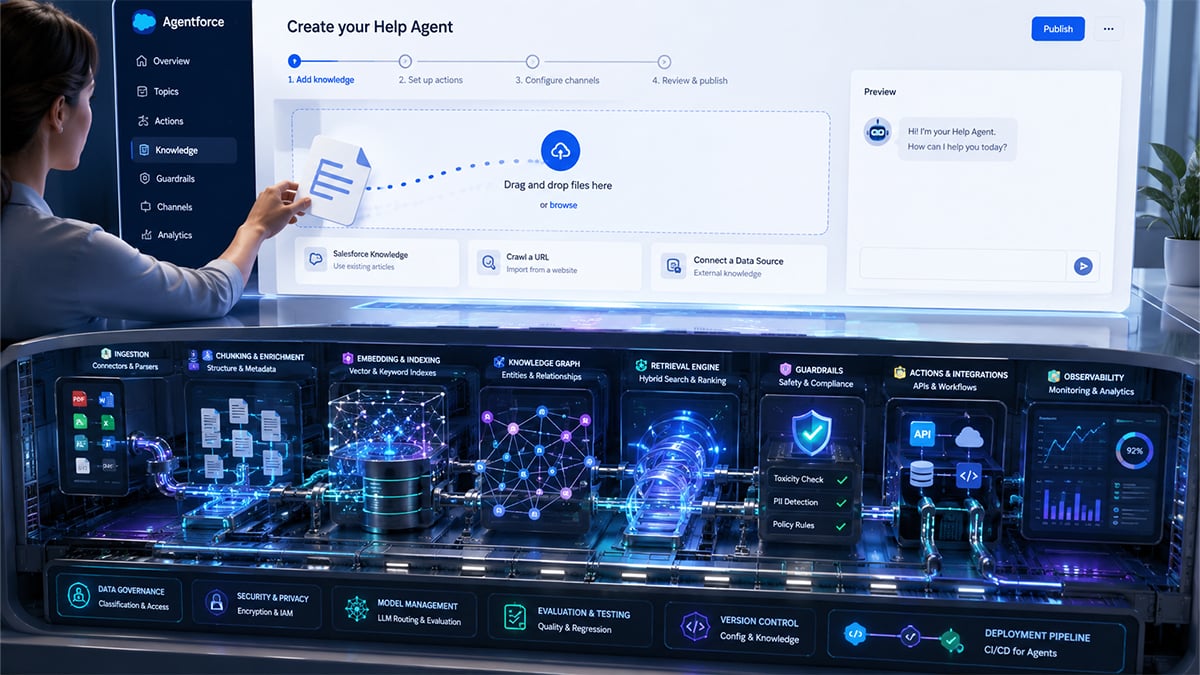
This week, Salesforce announced that Agentforce is now embedded directly into its SMB-tier Suites — Free, Starter, and Pro — with no additional SKUs, no setup, and no consumption pricing. Every existing and new customers at those tiers gets AI record summaries, a “Draft with AI” email feature, and in Starter and Pro, a pre-built Employee Agent. Eddie Cliff, the General Manager for SMB and Growth Products who reports to Agentforce Sales GM Kris Billmaier, confirmed the details in a briefing. “All existing Starter and Pro customers will get it, as well as new ones,” Cliff said. “Non-customers can try these things for free now.”
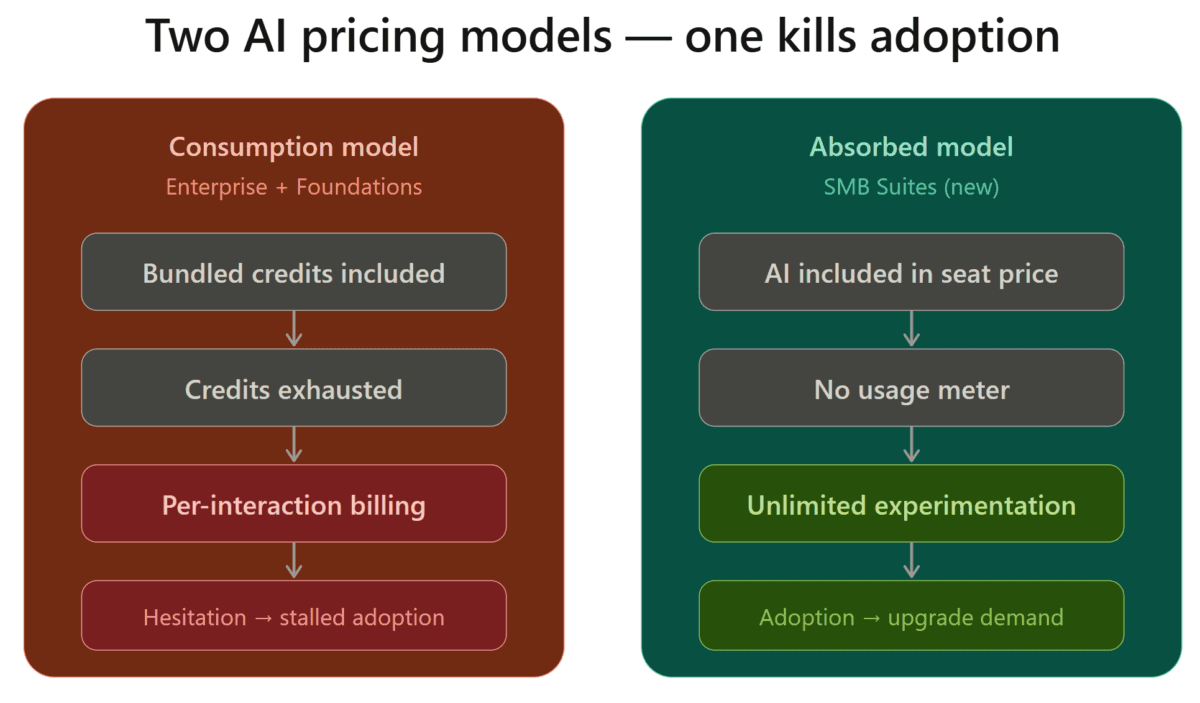
The critical detail is not the feature set but the pricing model. When I asked whether this meant the cost was simply absorbed into the seat price, the answer was direct: “That’s right.”
There is no metering behind the scenes, no credit pool to exhaust, and no moment where usage flips into a billable event. The AI experience is simply there.
Why AI Cannot Be Rolled Out Like a Feature
The broader pattern is becoming difficult to ignore. Across the enterprise software landscape, vendors that initially treated AI as a metered feature are being forced to reconsider as adoption stalls under pricing friction pressures. Atlassian encountered this with its Rovo agent, where usage only accelerated after the pricing barrier was removed.
Salesforce is now following the same path, framing the decision as a response to demand. As Cliff put it, “a lot of this is in response to what we’ve been hearing from our customers.”
That explanation is true, but it points to a deeper structural issue. AI does not behave like a feature that can be incrementally monetized. It behaves like a capability layer. The moment a user must think about cost, they hesitate, and hesitation is fatal to learning. If you want an AI-native user base, you cannot charge for the on-ramp.
Competitive Pressure From AI-Native CRM Platforms
This shift is not happening in isolation. HubSpot, Zoho, and a growing cohort of AI-native CRM startups are not treating AI as an add-on. They are building systems where intelligence is assumed, embedded, and continuously available.
Salesforce’s move into SMB Suites is a defensive response to that change in expectations. By ensuring that even its lowest-tier offerings include AI capabilities by default, the company removes the most obvious argument for switching to an AI-first competitor.
The Hidden Data 360 Architecture Beneath SMB Suites
Underneath these Suites, Salesforce is running a pre-configured data layer—a constrained version of Data 360—modeled against core objects and used to power segmentation and AI workflows. It is not exposed as a product, but it is doing real work behind the scenes.
The design choice is pragmatic. Most small business users will never become data engineers, and Salesforce is no longer requiring them to. The system works because the complexity is hidden, not because it has been eliminated.
The Employee Agent On-Ramp Strategy
The Employee Agent included in Starter and Pro Suites is intentionally limited. It cannot be customized, and that constraint is by design. As Cliff explained, “you can’t customize the employee agent… and that’s intentional.”
This is an on ramp, not a destination. The goal is to expose users to a conversational interface for common tasks, summarizing records, drafting emails, updating opportunities, without requiring configuration. Once that behavior becomes familiar, the demand for customization follows.
That is where the upgrade path begins.
The Trailblazer Ecosystem Problem Remains
The original problem identified in 2024 was never about small businesses. It was about the mid-market admins, developers, and architects who form the backbone of the Salesforce ecosystem. These are the individuals who create AppExchange products, publish technical content, and extend the platform in ways that generate compounding value over time.
They are still constrained.
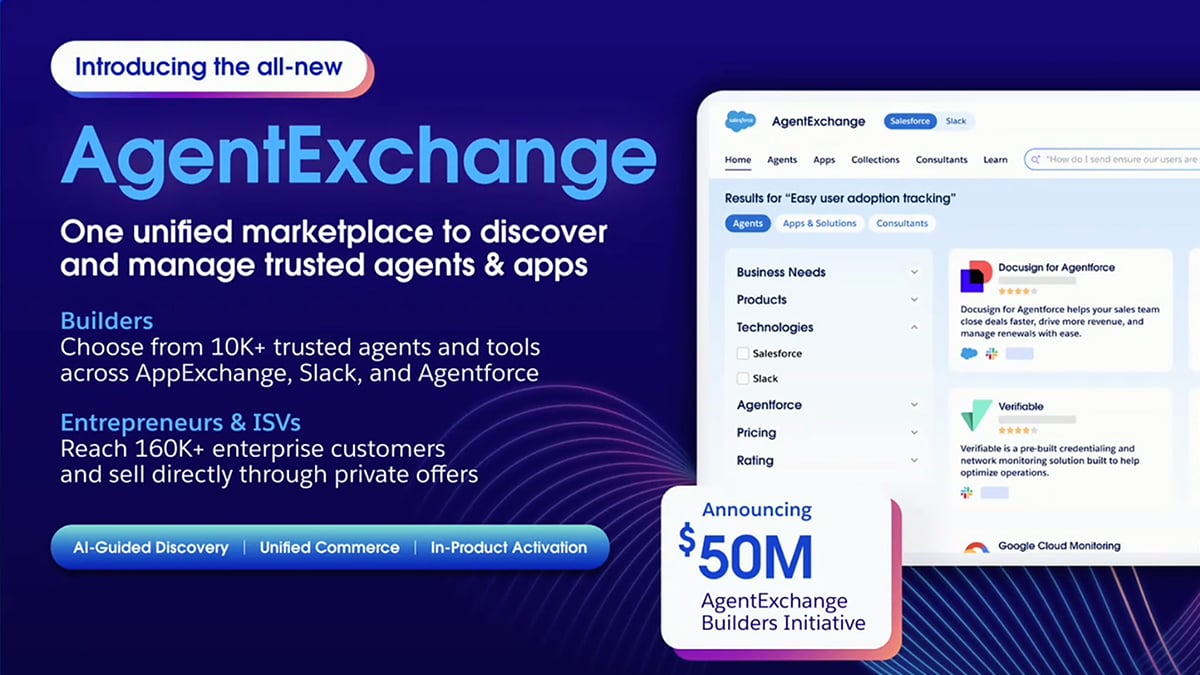
Salesforce has removed friction for demand while leaving friction in place for supply. SMB users can now experience AI without cost anxiety, but the builders who would extend those capabilities remain gated by credits, data complexity, and configuration overhead.
That imbalance can drive adoption in the short term, but ecosystems are not built on usage alone. They depend on continuous experimentation by practitioners who are able to build without friction.
What This Signals for Virtual Employee Economics
There is a deeper signal embedded in this decision. By eliminating consumption pricing at the SMB tier, Salesforce is implicitly acknowledging that the marginal cost of AI interactions is declining rapidly enough that metering creates more friction than value.
In Enterprise tiers, the model still includes bundled credits that eventually “flip into the consumption pricing model.” SMB customers never encounter that transition.
This aligns with the broader dynamics of Virtual Employee Economics. As the cost of generating intelligence approaches zero, pricing models based on per-interaction billing begin to fail. The winning model is absorption—AI becomes part of the seat, part of the platform, and part of the baseline expectation of software.
The Beginning of the End for AI Consumption Pricing?
Salesforce has not removed the AI paywall so much as repositioned it. The company has eliminated it where competitive pressure is most intense while maintaining it in segments that are more stable and less price sensitive.
That is a rational move, but it is unlikely to be the final state. Once customers internalize the expectation that AI should be included rather than metered, pressure will build on Enterprise pricing models to follow.
AI is not going to remain a separately priced feature. It is becoming part of the substrate of enterprise software.
Salesforce has taken a meaningful step in that direction. But until the same philosophy reaches the Trailblazer core that drives the ecosystem, the original problem remains only partially solved.