Salesforce Unleashes Agentforce Commerce as AI Assistants Drive 119% Traffic Surge
Salesforce today introduced comprehensive Agentforce Commerce capabilities as the company reports online traffic volumes driven by AI assistants grew 119% year-over-year in the first half of 2025. Intelligent agents are now projected to influence 22% of global orders during Cyber Week—more than one in five transactions.
“Agentforce Commerce is delivering transformative new capabilities that span the entire agentic shopping journey,” said Nitin Mangtani, SVP and GM of Agentforce Commerce and Retail at Salesforce. “We are powering these agentic experiences across every customer touchpoint—from product discovery all the way to complete checkout—whether on a brand’s website, mobile app, store, or syndicated channels like ChatGPT.”
The platform introduces four capabilities: Guided Shopping for conversational commerce, Order Routing for autonomous fulfillment optimization, Merchandising Actions that execute catalog management through natural language, and Point-of-Sale Actions for store associates. Jewelry retailer Pandora reports a 10% net promoter score lift from automating routine inquiries like order status and product questions.
Table of contents
Agentic Shopping: The Concierge Experience
Guided Shopping transforms traditional e-commerce into conversational experiences. Rather than navigating category trees and multi-step checkouts, shoppers describe what they need in natural language while agents handle discovery, comparison, and purchase completion.
Mangtani emphasized that Salesforce invested heavily in reasoning models and contextually understanding the shopping domain. Building an agent whose primary job functions as an online concierge requires different thinking than generic chatbots, he explained during a media briefing. The company focused on understanding product catalog data, checkout flows, and shopping behavior patterns to create agents that genuinely assist rather than simply respond to queries.
For repeat customers with saved payment and shipping information, the interaction model collapses dramatically. What previously required 15+ clicks across multiple pages becomes a few conversational turns. Salesforce optimized the experience with rich product content, interactive image carousels, and one-click checkout at twice the previous performance speed. The system supports seven languages, enabling global deployment without separate implementations for each market.
The utility metrics validate the approach. Pandora’s 10% NPS improvement came from handling repetitive questions that frustrated customers in traditional support channels. When agents instantly answer “where is my order” without forcing customers through help documentation, satisfaction improves measurably.
Protocol Wars: Commerce Everywhere
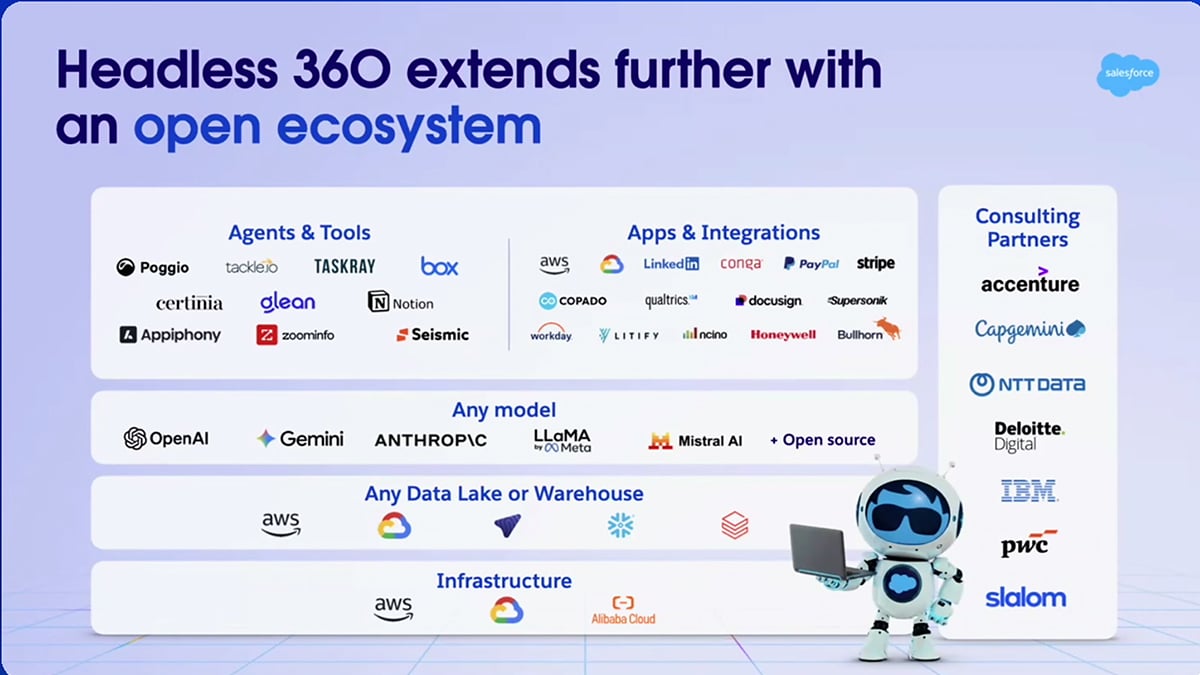
Salesforce positioned Agentforce Commerce at the intersection of emerging integration protocols: the Agentic Commerce Protocol (ACP) for ChatGPT, Stripe partnership for AI-powered instant purchasing, and Google’s Agent Payments Protocol (AP2) for cross-platform transactions.
This marks a fundamental channel shift. Traditional e-commerce required customers to visit owned properties. The emerging model assumes product discovery happens wherever consumers spend time—ChatGPT, Google Assistant, or other AI platforms becoming daily utility interfaces. Salesforce’s strategy federates product catalogs and checkout flows across these surfaces while maintaining brand control and customer relationships.
Every major commerce platform is racing toward similar integrations. Every AI provider is deciding which backends to support. The result: a dense web of bilateral partnerships determining which products surface in which channels under what conditions.
Consumer response remains genuinely uncertain. Does contextual shopping improve convenience or feel invasive when transactions permeate previously non-commercial interactions? Younger consumers accustomed to Instagram and TikTok commerce may find chat-based purchasing natural. Older demographics might prefer clearer boundaries between conversation and transaction.
The Composable Enterprise: Embedded Architecture
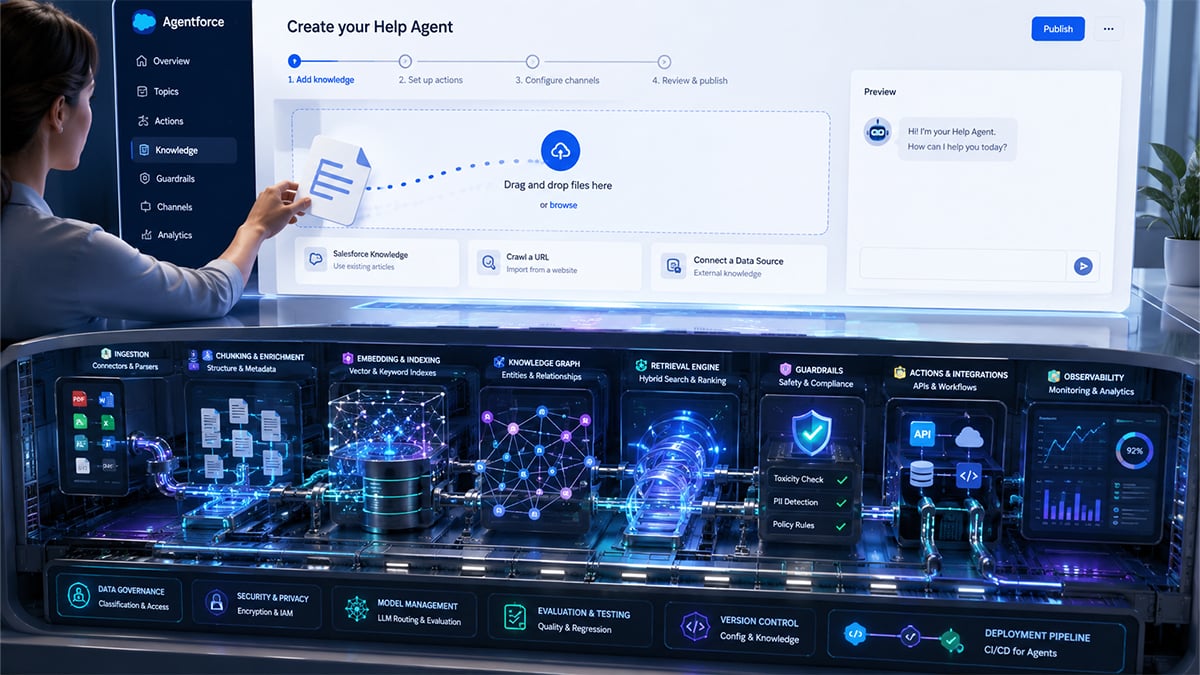
Mangtani described Agentforce Commerce’s three-layer architecture during the briefing: Data Cloud as the foundational layer providing both zero-copy and full-copy data access, the Agentforce platform as the horizontal agent-building layer, and pre-configured domain agents that understand commerce-specific semantics like product catalogs and fulfillment networks.
This architecture collapses integration complexity. For retailers on Commerce Cloud with Order Management, agents access real-time inventory, orders, and customer profiles natively. The platform already understands the data structures and business logic.
The merchandising example illustrates the advantage. Traditionally, configuring product boosting rules required navigating admin screens and understanding rule syntax—15 different clicks, Mangtani noted. Now: the natural language prompt “boost new arrivals” is issued, and the agent executes the configuration. Humans still provide strategic direction, but the system handles tactical execution.
Mangtani explained this as humans and agents working together. The human reviews data curated by the agent and confirmed through a prompt rather than clicking through multiple screens. The agent does the implementation work.
This differs fundamentally from overlay approaches adding agents atop disconnected systems. Those require extensive API development, data mapping, and security traversal—months of services work. For customers already using Salesforce commerce products, Mangtani emphasized, deployment barriers drop significantly because the foundation already exists.
The migration reality for others demands acknowledgment. Organizations not using a Salesforce embedded strategy face substantial transformation work. Moving from legacy platforms isn’t a quick project—it’s multi-quarter data migration and process reengineering. For customers with SAP or Oracle ERP cores, they’ll need to expose order and inventory data to Data Cloud through zero-copy federation or full replication, Mangtani explained. Integration engineering shifts to the data layer but doesn’t disappear.
The delivery timeline matters too. Order Routing reaches general availability Winter 2026. Merchandising actions hit beta then, with POS actions in pilot through Spring 2026. ChatGPT integration remains “near future” without specifics. The complete capability set is 12-18 months out.
The architectural advantage is real for those inside the ecosystem. The switching costs are equally real.
Cyber Week: The Agent Commerce Test
The 2025 holiday season provides the first large-scale consumer test of agentic commerce. With agents projected to influence 22% of Cyber Week orders, the data emerging from Black Friday through year-end will indicate whether conversational commerce reaches mainstream adoption or remains concentrated in early-adopter segments.
Consumers face unprecedented choice: traditional e-commerce sites, conversational agents on retailer properties, social commerce, ChatGPT recommendations, or Google Assistant comparison shopping. Each offers different trade-offs in control, convenience, and cognitive load.
The results will shape commerce platform strategy for years. If consumers embrace agent-mediated shopping at scale, retailers will accelerate platform modernization to syndicate catalogs across AI channels. If adoption remains demographic-specific or category-limited, the transformation becomes optimization rather than revolution.
We’re watching commerce interfaces evolve in real-time. The question isn’t whether AI agents play a role, but how large and how fast that role scales. This holiday season’s data will tell us whether we’re at a major platform transition or another innovation cycle taking longer than projections suggest.
We’ll soon see how consumers respond when chatbots sell them things. The data matters more than predictions.