The Activation Energy Crisis: Why AI Projects Die and What Partners Must Do About It
Understanding why traditional consulting approaches struggle with AI implementation and how to fix it
The AI Success Story We Can’t Find
In 20 years of working with business systems, I’ve never seen a bigger gap between marketing promises and deployment reality than what we’re seeing with enterprise AI projects right now. Our Keenan Vision research team has spent months interviewing CIOs and consultants, searching for that one great AI success story to reference.
We keep finding the same thing: impressive demos, enthusiastic pilots, and a whole lot of projects that somehow never make it to production.
This is unprecedented. In my 15 years working with Salesforce implementation partners, I can’t recall an assessment or PoC that didn’t lead to deployment. Regardless of organizational challenges or technical debt, there was always a path forward (for better or worse).
The gap is striking: Extensive consulting activity around AI solutions. Surprisingly few production deployments deliver sustained business value.
With AI projects, that path seems to disappear somewhere between pilot and production.
Understanding Activation Energy
Our research revealed that generative AI projects face what we call “activation energy”—the significant effort required to coordinate cross-functional teams, define and cleanse enterprise data, build business team enthusiasm for new technology, and handle the technical complexity of deploying agentic workflows.
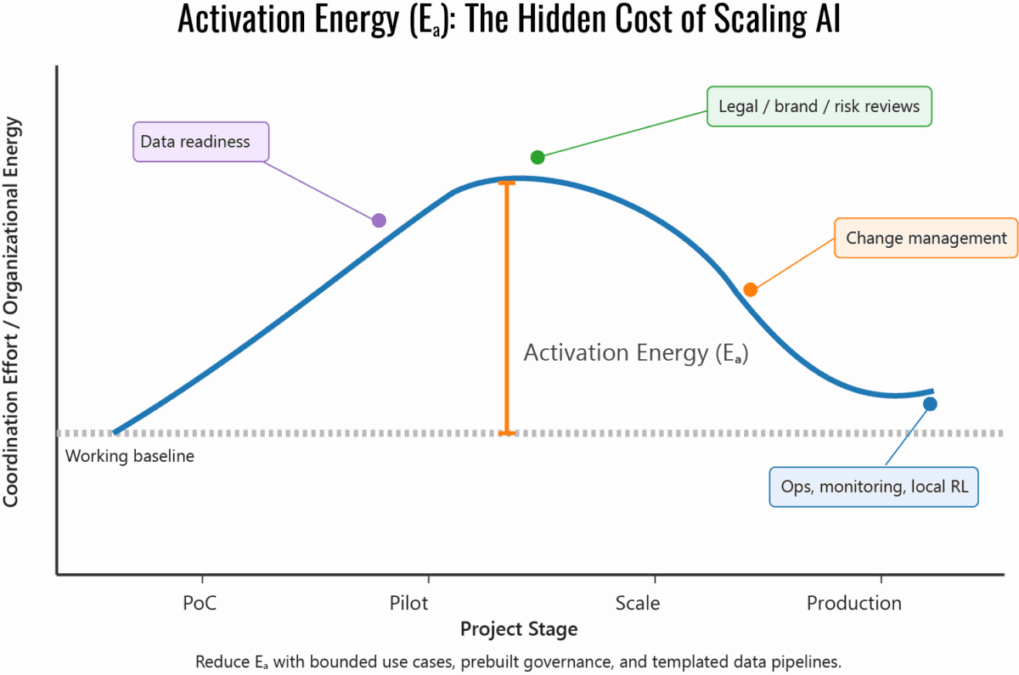
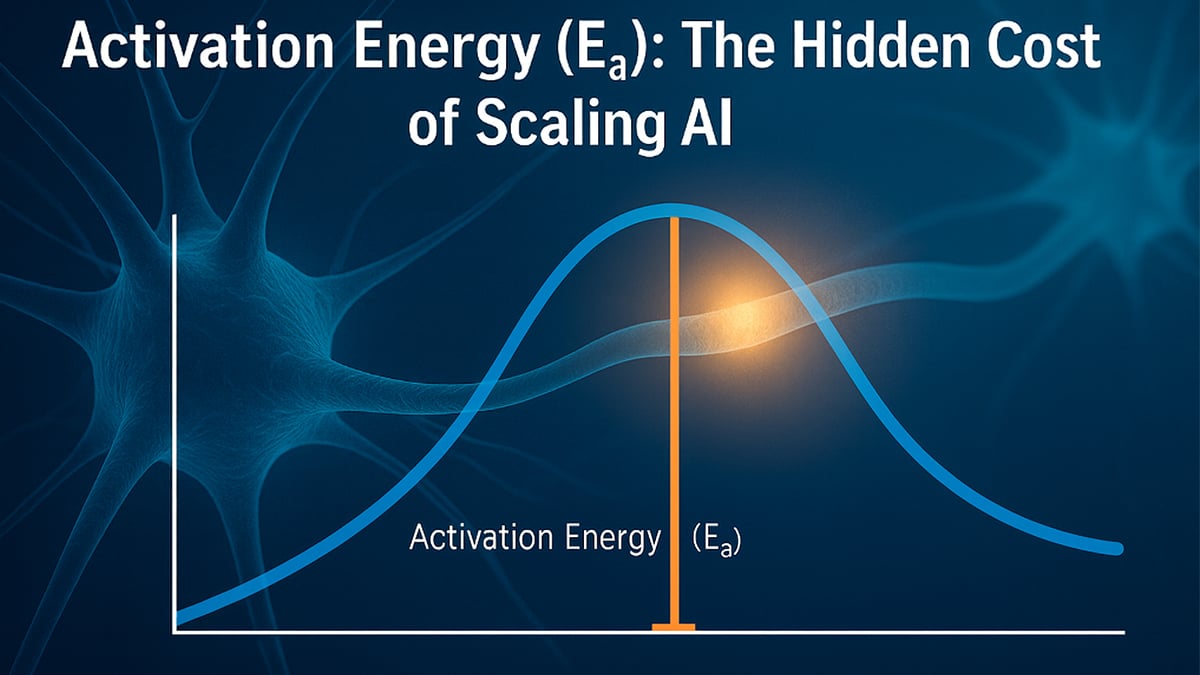
Just like neurons firing or ATP fueling a cell, AI projects only succeed once enough activation energy—data, governance, and organizational readiness—has been built up to cross the threshold into production. Below that threshold, projects remain in exploration mode indefinitely. Above it, deployment becomes achievable.
This energy requirement scales dramatically with organizational size. Each additional stakeholder, system integration, and compliance requirement compounds the complexity rather than simply adding to it.
The challenge intensifies when traditional Time & Materials consulting models meet AI project realities. Hourly billing during the exploration phase—seeking requirement clarifications, iterating on use cases, refining AI responses—can become substantial budget consumption with uncertain outcomes.
The Risk Spectrum: Patterns in Success and Failure
Our research revealed distinct patterns around which AI projects reach production and which stall out.
Higher-risk deployments that frequently struggle: Customer-facing chatbots. While appealing in concept, they carry hallucination risks, brand implications, and support complexity that requires extensive organizational preparation—legal reviews, brand guidelines, escalation procedures, training data curation, ongoing monitoring.
Lower-risk implementations that tend to succeed: Document summarization, contract review, invoice interpretation, internal process automation. These have natural error boundaries, built-in human oversight, and contained failure impact.
The disconnect occurs when partners, following traditional “biggest impact first” methodology, lead with high-activation energy projects rather than building organizational AI capability through manageable wins.
Where Traditional Methods Meet AI Reality
Traditional Salesforce implementations follow a proven path: define requirements → build solution → deploy success. This linear approach works well for systemizing established business processes.
AI projects operate differently: experiment → iterate → discover capabilities → potentially deploy. This fundamental difference creates challenging misalignments.
Clients naturally expect the traditional approach: “Here’s our business challenge, build us an AI solution.” Partners scope based on familiar assumptions about requirements and delivery timelines.
Then AI’s realities emerge. Unlike configured software, AI requires ongoing experimentation, data quality refinement, prompt engineering, and iterative development. Anticipated 12-week implementations can become extended research phases with evolving outcomes.
While T&M models can accommodate this exploration, clients experience budget consumption without proportional progress toward production deployment, eventually leading to project reconsideration.
The Adaptation Opportunity
Implementation partners face a genuine transition challenge. Years of expertise in traditional Salesforce implementations, proven methodologies, and client relationships built on predictable project delivery create natural momentum toward familiar approaches.
AI consulting requires different competencies: acknowledging uncertainty upfront, structuring smaller initial engagements focused on learning, and building new skills around risk assessment, data strategy, and iterative experimentation.
Meanwhile, the market is evolving rapidly. AI-native consulting firms are emerging with different foundational assumptions. Rather than adapting traditional practices, they’re building consulting models designed specifically for AI project realities. They understand that AI implementations require different pricing structures, project phases, and client relationship dynamics.
These firms are securing enterprise clients who need partners who understand how to navigate AI deployment successfully rather than just discussing its theoretical potential.
Building AI Consulting Capability
Successful adaptation requires developing internal AI expertise before offering client guidance. This means creating actual AI competency, not just marketing positioning—understanding which AI tasks work reliably, which ones present challenges, and how to assess activation energy for different implementation types.
Key capability areas include:
- Risk assessment frameworks that guide clients toward manageable initial projects rather than high-complexity implementations that may stall.
- Education-first engagement models that help clients understand AI operational realities before committing to specific solutions, addressing the gap between AI marketing promises and practical deployment requirements.
- Business model evolution from implementation-focused to capability-building approaches—shifting from “we’ll build your AI solution” to “we’ll help you develop AI organizational competency.”
This transition requires viewing AI consulting as a distinct practice area with its own methodologies, rather than an extension of traditional implementation services.
Moving Forward
The implementation partners who recognize this shift have an opportunity to build competitive advantage through early AI expertise development. This involves experimenting with manageable AI projects internally, developing frameworks for assessing project activation energy, and learning to facilitate realistic conversations with clients about AI capabilities and limitations.
For CIOs and IT decision makers, this transition period presents an opportunity to evaluate partners based on their practical AI experience rather than theoretical promises. Partners who can demonstrate successful AI implementations—even small ones—offer more value than those still developing their approach.
The consulting ecosystem benefits when organizations share honest assessments of what works in practice. We need more realistic case studies and fewer aspirational marketing materials.
At Keenan Vision, we’re working with partners who recognize that building AI consulting capability requires structured learning and experimentation. The organizations that master the art of reducing AI activation energy will be well-positioned for the next phase of enterprise transformation.
The question isn’t whether AI will reshape consulting—it’s whether established partners will adapt their approaches or find themselves explaining why they’re still learning while others are already delivering.
Chris Pearson is Director of Salesforce Development at Jostens and Director of Research Programs at Keenan Vision, where he conducts research on AI transformation patterns and helps implementation partners build AI centers of excellence. He has 15 years of experience with Salesforce implementations.