MuleSoft Agent Fabric: Turning AI Agents Into Enterprise Infrastructure
AI Moves from Experiment to Infrastructure
The AI boom has been filled with flashy demos and endless hype cycles. Copilots, generative assistants, and autonomous agents have promised to change the way we work but have largely just resulted in creating agent sprawl. But most enterprises have been stuck in the “experiment” phase, whether it’s sandbox pilots, shadow IT projects, or proofs of concept that rarely make it into production. “There’s no playbook for scaling agents, no ‘Agents for Dummies.’ Enterprises are improvising as they go … only a handful of enterprises are beyond experiments, true agent implementations remain rare,” said Andrew Comstock, SVP & GM of MulesSoft.
Salesforce has made it clear that it intends to move AI beyond the demo stage. With the launch of MuleSoft Agent Fabric, Salesforce is turning AI agents into something enterprises can govern, secure, and run at scale.
Why does this matter? Because integration is the heart of enterprise AI. An AI agent that only chats with a user is nice. An AI agent that can actually take action across Salesforce, ERP, HR, and custom APIs is transformative. Agent Fabric gives enterprises a structured way to make that shift.
Table of contents
What Is MuleSoft Agent Fabric?
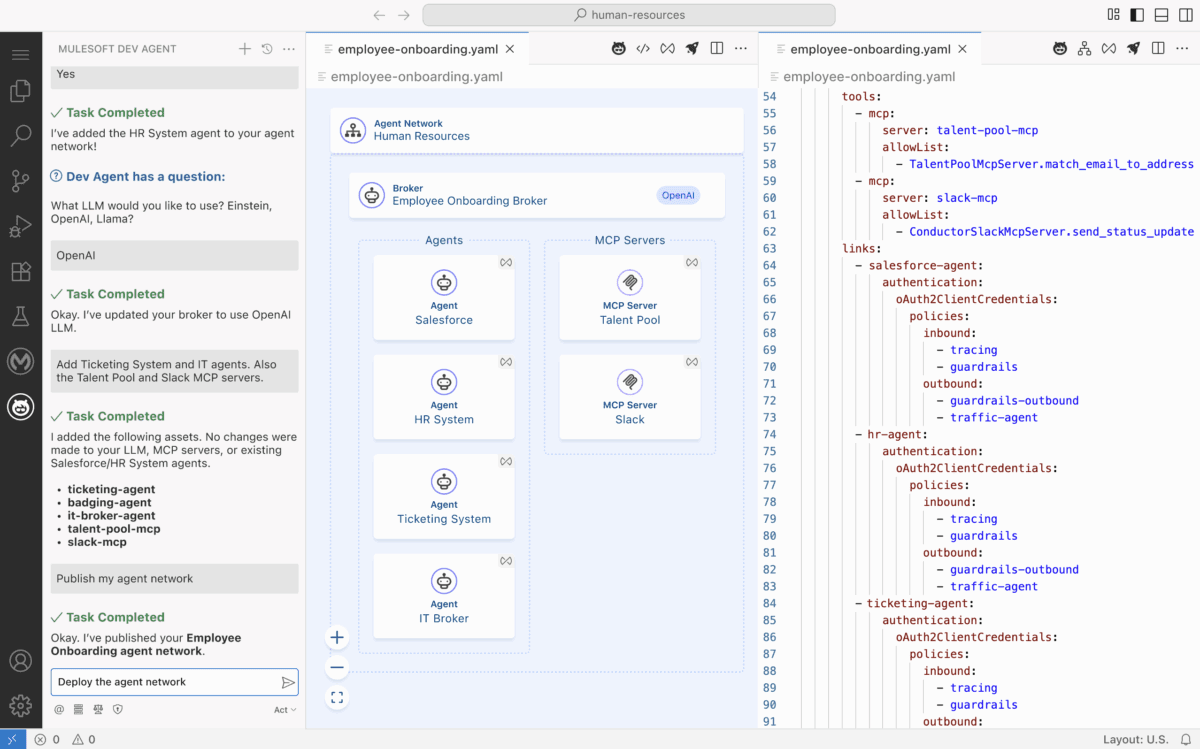
MuleSoft Agent Fabric is a new layer of the MuleSoft platform built to help enterprises discover, orchestrate, govern, and observe AI agents at scale. Rather than leaving agents siloed within individual applications, Fabric turns them into managed, enterprise-ready assets that can work together securely across systems.
Its capabilities center on four pillars:
- The Agent Registry provides a central catalog where every AI agent can be registered, discovered, and reused, preventing duplication and accelerating delivery.
- The Agent Broker acts as an intelligent routing service, powered by Salesforce’s Atlas Reasoning Engine, to connect agents and tools across domains and dynamically match tasks with the best-fit resource.
- Flex Gateway with AI Policies enforces guardrails at every interaction, ensuring security, compliance, and trust as agents scale across the enterprise.
- The Agent Visualizer delivers end-to-end visibility into agent decisions and performance, transforming black-box AI into transparent, auditable systems.
The message is clear: enterprises don’t just need copilots; they need a framework that can orchestrate thousands of agents securely, intelligently, and with the discipline required for mission-critical operations.
Why Agent Fabric Matters for Salesforce DevOps
Agent Fabric is not just another MuleSoft feature, but rather it introduces a new layer to manage. That has big implications for Salesforce DevOps and QA leaders.
1. Agents Become Part of the Release Cycle
AI agents are already emerging as a new class of artifact in enterprise delivery, regardless of whether organizations are ready to manage them. They behave differently from code or APIs, but they still need to move through the same lifecycle; versioned, promoted across environments, validated before release, and rolled back quickly when issues arise. Enterprises are beginning to recognize that agents can’t remain outside their DevOps & CI/CD processes.
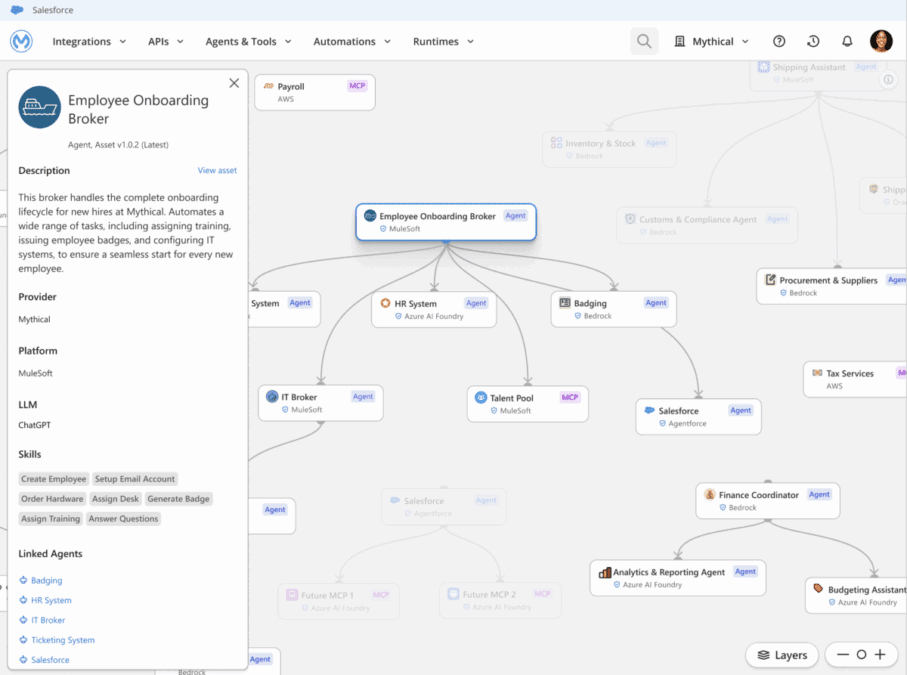
MuleSoft Agent Fabric doesn’t invent this reality, but it does provide a way to handle it. By extending pipelines to account for agent behavior, Fabric helps teams apply governance and testing right alongside their existing release processes. This means agent deployments can be validated and controlled with the same rigor as other assets, reducing the risk of uncontrolled drift in production. Rather than forcing DevOps teams to bolt on new processes, Fabric integrates agent management directly into the existing delivery toolchain, making it possible to operationalize agents as first-class citizens.
2. Quality Engineering Gets Harder AND More Critical
Testing deterministic code is already hard. Testing nondeterministic AI agents is even harder. QA leaders will need to build new test strategies:
- Simulation frameworks that run agents through synthetic scenarios.
- Guardrail testing to ensure agents don’t exceed their permissions.
- Bias and error detection so agents don’t drift into unsafe outputs.
- Regression testing for agents to ensure new model updates don’t break existing workflows.
Continuous testing becomes central here. If agents are embedded in workflows, you can’t afford to only test them after deployment. Testing has to move upstream into the agent development lifecycle.
3. The Shift from Overlay to Embedded AI
Today’s AI tools are mostly overlays: chatbots or copilots that sit on top of systems. The problem: overlays lack deep integration and usually stop at “recommendation.”
Agent Fabric accelerates the shift toward embedded AI; agents that act inside business processes with the same authority as apps and APIs.
For DevOps teams, this creates both opportunity and risk:
- Opportunity to automate end-to-end flows with minimal human intervention.
- Risk of outages or compliance issues if an embedded agent behaves unpredictably.
Competitive Context: Where MuleSoft Fits
Several vendors are moving into the AI agent space, but most approaches remain narrow. ServiceNow copilots embed intelligence into ITSM workflows yet stay confined to the platform, limiting cross-system applicability. UiPath and Automation Anywhere extend RPA with AI, but their bot-first architectures don’t align with the API-first strategies enterprises have invested in, often resulting in brittle automations. Startups like Adept, Cognition AI, and Fixie push ambitious visions of general-purpose agents, but they lack the governance, integration, and lifecycle management required for enterprise-scale adoption. And this is only the beginning; according to Gartner, 40% of enterprise apps will feature task-specific AI agents by 2026 (up from <5% in 2025).
MuleSoft’s positioning is different. It already operates as the trusted integration layer across CRM, ERP, HR, and custom systems. Its API-first model enables agents to orchestrate processes across silos rather than just automate clicks, and its Salesforce ecosystem tie-in grounds Agent Fabric within an existing governance framework. This makes it less an experiment and more an extension of Salesforce’s broader Agentforce and Einstein Copilot strategy.
Implications for Enterprises
Enterprises adopting MuleSoft Agent Fabric will face decisions that cut across DevOps, QA, and governance. The first is how do they measure success. Efficiency gains like speed and cost will still matter, but enterprises will also look at whether agents can reduce human escalations, improve their SLA performance, or keep them in compliance.
The second is how to test for trust. With nondeterministic agents, “enough testing” is a moving target. Simulation and boundary testing can help before deployment, but ongoing production monitoring will likely become a requirement to catch drift or bias early. This is a problem for an organization adopting any flavor of AI, but those rolling out agentic AI will also need to make sure problems are caught as early as possible due to the next challenge.
Third, governance must be operationalized. Security and compliance teams will demand runtime visibility into agent actions. Policies must be auditable and enforceable, not just written guidelines. Agent Fabric adoption will force organizations to integrate governance into everyday DevOps practice.
Finally, DevOps pipelines will need to evolve. Agents become new release artifacts, requiring versioning, validation, and controlled promotion across environments. Treating them as first-class assets in CI/CD is necessary to prevent downstream failures.
Agent Fabric and the Cognitive DevOps Model
From a Cognitive DevOps perspective, Agent Fabric represents a shift in operating models:
Overlay AI → Embedded AI: Agents move from sitting “on top” of apps to running inside them.
Experimentation → Operationalization: Enterprises now need repeatable processes for agent lifecycle management.
Ad-hoc Guardrails → Formal Governance: Guardrails are no longer code snippets or best practices. They’re policies enforced by the runtime.
This aligns with the emerging Cognitive DevOps stack, where agents are treated like any other software artifact—subject to pipelines, testing, and governance.
Final Take
MuleSoft Agent Fabric is more than a new product release. It signals where enterprise AI is heading and how Salesforce intends to lead that shift. The real battleground is not copilots or chat interfaces but rather the operationalization of AI agents inside mission-critical workflows.
Salesforce’s bet is that MuleSoft, already the backbone of enterprise integration, provides the foundation to make that possible. By transforming agents into governed integration assets that can be orchestrated, secured, and observed across not just environments, but also entire ecosystems, Agent Fabric positions itself as the safe path for enterprises to adopt AI at scale. Availability begins now, with governance capabilities live today and the registry, broker, and visualizer rolling out in October 2025.
For DevOps, QA, and IT leaders, the takeaway is direct: agents are no longer experimental. They are becoming first-class components of the enterprise stack, and the time to prepare for their lifecycle management is already here.