Two Axes, Three Big Bets: Inside Salesforce AI Foundry
Salesforce AI Research announced AI Foundry last week. It is an initiative designed to accelerate how the company moves foundational research into production-grade product capabilities. The announcement was previewed in a press briefing yesterday, where Chief Scientist Silvio Savarese, VP Itai Asseo, EVP Yacov Salomon, and Senior Director Sridhar Raghavan walked through the vision, the investment areas, and a live demo of an ambient intelligence prototype, which is a conceptual version of a Salesforce in-meeting AI assistant.
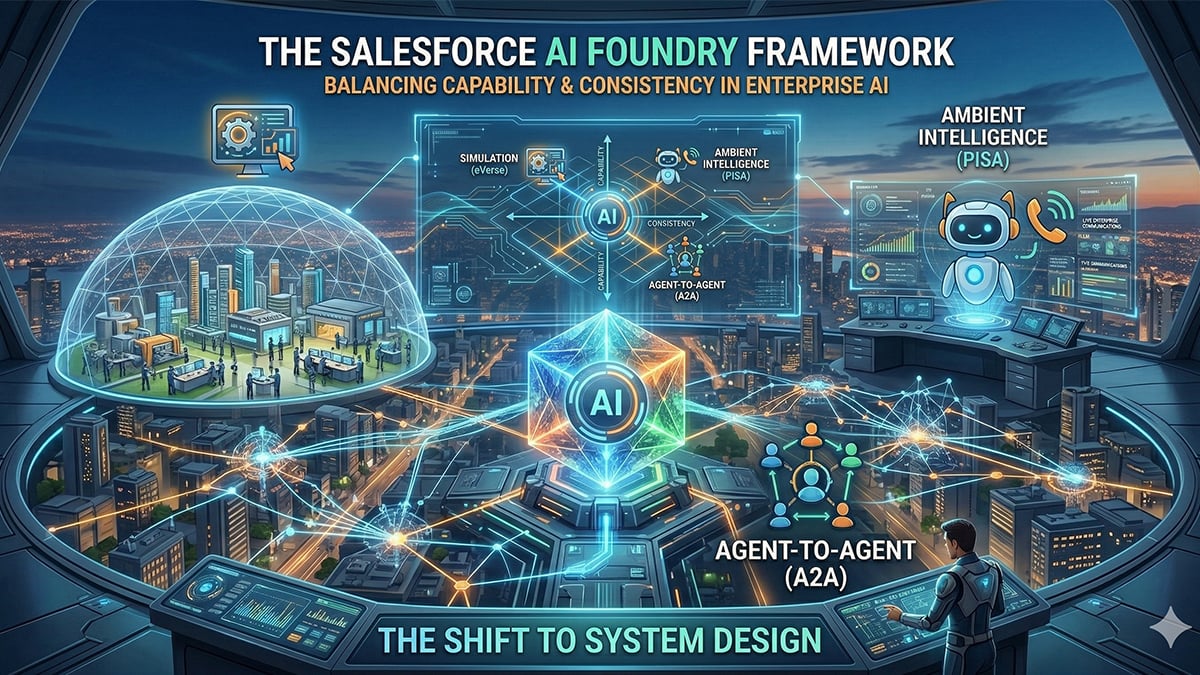
The framing was deliberate. As Savarese put it early in the briefing: “We need to ensure that not only we are making progress in terms of new capabilities along the axis of capabilities, but also we have to move away along the axis of consistency, accuracy, and trust.”
That “two axes” framing should sound familiar. We made a version of the same argument on this site last month: agents will continue to improve, but the more consequential question is whether governance scales at the same pace as capability. Savarese is describing the research-side version of that exact tension.
Capability without consistency is a demo. Consistency without capability is a flowchart. The industry needs both, and the fact that Salesforce’s chief scientist is anchoring an entire initiative around that balance is significant.
Table of contents
What Is AI Foundry?
If the structure sounds similar to the existing Forward Deployed Engineer engagement model — where Salesforce works hands-on with strategic customers to drive new use cases, then builds those capabilities into the product roadmap — that’s because it partially is. AI Foundry formalizes that approach with a more intentional research orientation: work closely with customers as “customer zero,” validate in real workflows, then ship as platform-wide functionality. Asseo described this directly: “AI Foundry connects foundational research to real business problems by collaborating closely with our strategic customers in rapid iteration cycles.”
The repackaging isn’t inherently a problem. What matters is the declared shift in where they’re pointing the effort.
For the past two years, Salesforce has been overwhelmingly focused on AI as a product — shipping Agentforce as a platform for customer-facing agents, the kind of “super chatbot” deployments you see in retail and support case studies. Those use cases are real, but they treated the LLM as the centerpiece rather than a component.
I’m glad they’re making this turn. It’s overdue.
Three Big Bets
AI Foundry is organized around three investment areas that Salesforce believes will define enterprise AI in FY27 and beyond.
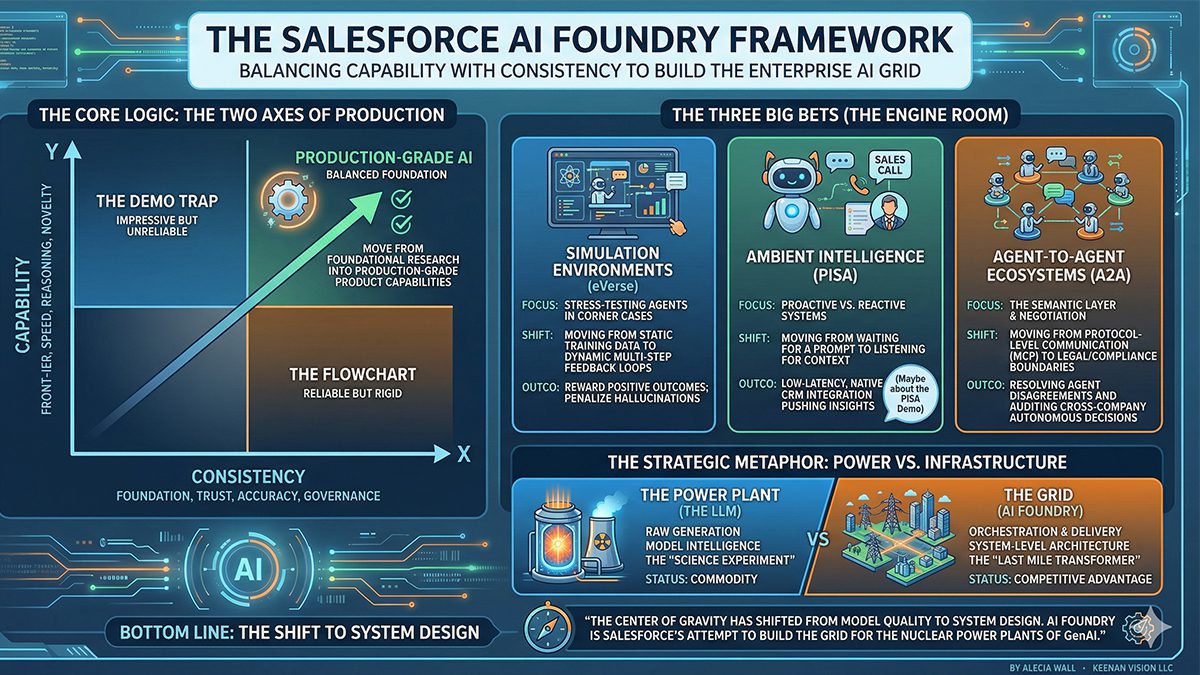
Simulation environments address the problem that agents trained on static data fall apart at the edges. Savarese described how even large, capable models show inconsistent performance on multi-step operations and corner cases not well represented during training. AI Foundry’s simulation platform, eVerse, exposes agents to thousands of realistic business scenarios and uses feedback loops to reward positive outcomes and penalize mistakes. It’s already been used to stress-test Agentforce Voice and pilot UCSF Health’s contact center billing agents.
Ambient intelligence moves agents from reactive to proactive. Rather than waiting for a prompt, ambient systems continuously monitor the context of a workflow and surface insights at the moment they’re relevant. Savarese described the vision as agents that are “seamlessly integrated, embedded in the background… proactive and capable of delivering insight, assistance, information without being specifically prompted.”
Agent-to-agent ecosystems are where things get genuinely complex — and genuinely important. As agents proliferate within and across organizations, the question shifts from “can my agent do the task?” to “can my agent negotiate with your agent without creating a compliance incident?”
Savarese described this as moving beyond protocol-level communication (A2A, MCP) to a semantic layer: rules of conduct, legal boundaries for autonomous negotiation, and mechanisms for achieving productive outcomes in situations of ambiguity. He and Salesforce’s Chief Legal Officer recently co-authored a piece in Fortune addressing these challenges directly.
This is the investment area I’m watching most closely. Who decides when two agents disagree about a discount threshold? Which agent’s playbook takes precedence in a cross-company negotiation? How do you log and audit a decision chain that spans multiple autonomous systems with different owners? These aren’t theoretical questions — they’re the governance problems that will define whether multi-agent systems are deployable or just demonstrable. Salesforce is right to invest here, and the fact that they’re involving legal counsel in the research design suggests they understand the stakes.
The PISA Demo
The briefing included a live demo of PISA — Proactive In-Meeting Support Agent — an ambient intelligence prototype for sales conversations. During a simulated call, PISA listened in the background, identified topics in real time, and pushed relevant talking points to the rep without being prompted. Asseo noted that insights arrive within roughly one second of a relevant utterance, grounded in the rep’s CRM data and account history.
It’s a compelling use case, but one that tools like Fireflies and Gong have offered as overlays for years. Having it built natively into Salesforce — connected directly to CRM rather than bolted on — would reduce latency and improve accuracy.
But the demo also highlighted a persistent gap: the content feeding these systems (playbooks, agendas, competitive positioning) still has to be maintained manually, and there’s no governance framework guaranteeing an ambient agent won’t serve up last year’s conference schedule. Salesforce is adding sandboxing and SDLC support, which is the right direction — but in environments where accuracy is non-negotiable, LLM-based systems remain exploratory.
The Power Plant Needs a Grid
Which brings us back to the bigger-picture thesis we’ve been developing.
As Salesforce CTO Muralidhar Krishnaprasad offered an analogy in a January interview worth extending: “You have these nuclear power plants. You can build all these awesome transmission engines, but if you don’t have that last mile transformer down to your house with all the right sockets, it’s not going to work.”
The LLM is the power plant. Orchestration, governance, and observability are the grid. AI Foundry is Salesforce saying, publicly and with organizational backing, that they’re now building the grid.
Asseo reinforced this when asked about system-level AI. He pointed to OpenClaw — the open-source agent that went viral in February — as a case in point: “OpenClaw did not actually point to any one specific new innovation. It was actually a combination of a lot of different things that were put together in a specific way to create a system-level AI that created new types of possibilities.”
A power plant without transmission infrastructure is a science experiment. OpenClaw demonstrated that the combination of components, not any single breakthrough, is what creates new capability. AI Foundry is Salesforce’s bet that enterprise AI needs the same kind of systematic infrastructure buildout.
The Orchestration Thesis, Continued
This announcement reinforces what Keenan Vision has been arguing on this site since January: the center of gravity in enterprise AI has shifted from model quality to system design. The questions that matter are about orchestration maturity, deterministic controls, observability, and what happens when the agent hits an edge case.
Other platforms have been ahead on this dimension. Atlassian’s Rovo is a useful reference — intelligence woven throughout the product, working invisibly in the background. That’s what “system-level AI” looks like when it’s done well: not a feature you invoke, but infrastructure and usability you rely on.
Salesforce is making the right bet. The execution will determine whether this is a strategic inflection point or a rebranding exercise. But the intent is correct, and the timing — after two years of learning what production actually requires — is about right.
Alecia Wall is Director of Ecosystem Development, Enterprise AI at Keenan Vision LLC and a UC Berkeley Haas School of Business alum. She is co-author of “Architecture as Strategy,” research documenting enterprise AI deployment patterns and why 95% of GenAI pilots fail. She covers platform orchestration, multi-agent governance, and enterprise AI ecosystem dynamics for SalesforceDevops.net, with a lens that extends beyond Salesforce to the broader market of vendors, integrators, and alliances shaping how organizations deploy AI at scale.