Salesforce Launches Agentforce in ChatGPT to Head Off ‘Homegrown MCP Servers’
Salesforce last week announced the open beta of Agentforce Sales as a native ChatGPT app, extending its AI agent platform into OpenAI’s consumer interface. The integration enables sales reps to query leads, update opportunities, and delegate prospecting tasks to AI agents directly from ChatGPT conversations. Available immediately to customers with Agentforce for Sales Add-on or Agentforce 1 Edition licenses. Any edition of ChatGPT will work with the app.
“With the Agentforce Sales app in ChatGPT, we’re bringing Salesforce into the tools sellers already use,” said Kris Billmaier, GM and EVP of Agentforce Sales at Salesforce. “Now conversations with the Agentforce Sales app in ChatGPT understand your customers, move deals forward, and get real sales work done.”
The development timeline tells its own story. Salesforce built and shipped this integration in approximately four weeks; a velocity that signals strategic urgency rather than routine product expansion.
Table of contents
The Real Story: Defensive Positioning
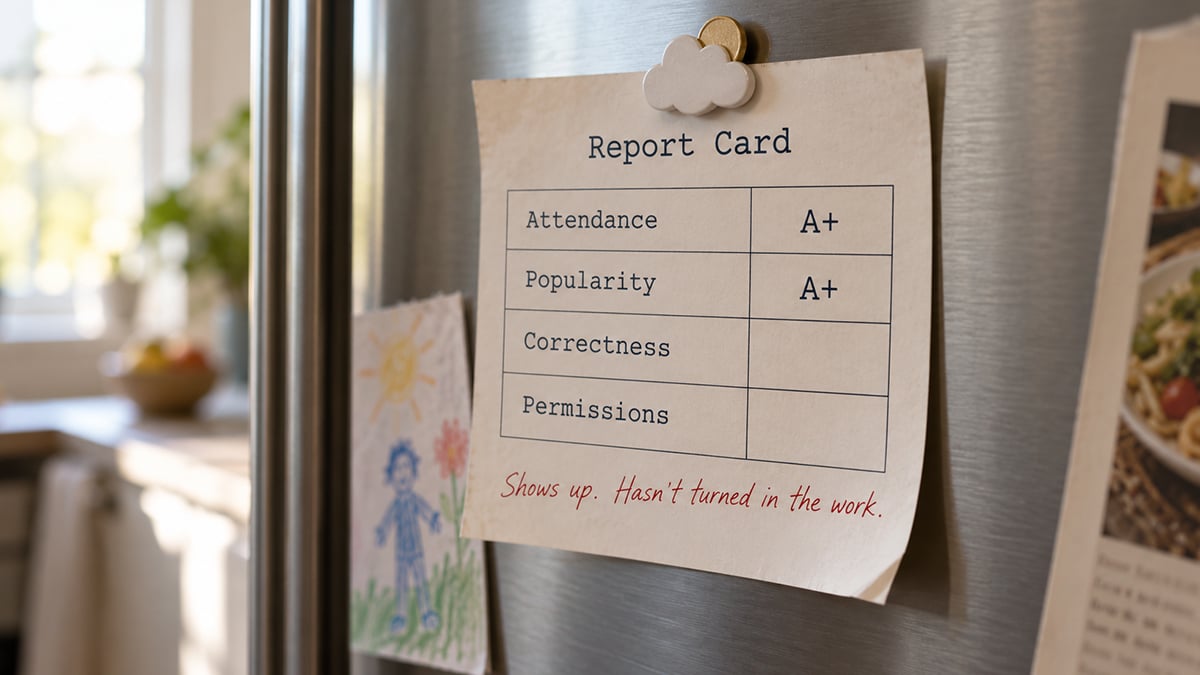
In an interview with SalesforceDevops.net, Billmaier was candid about the motivation behind the rapid launch. The concern wasn’t missing a market opportunity. It was preventing customers from routing around Salesforce’s governance layer entirely.
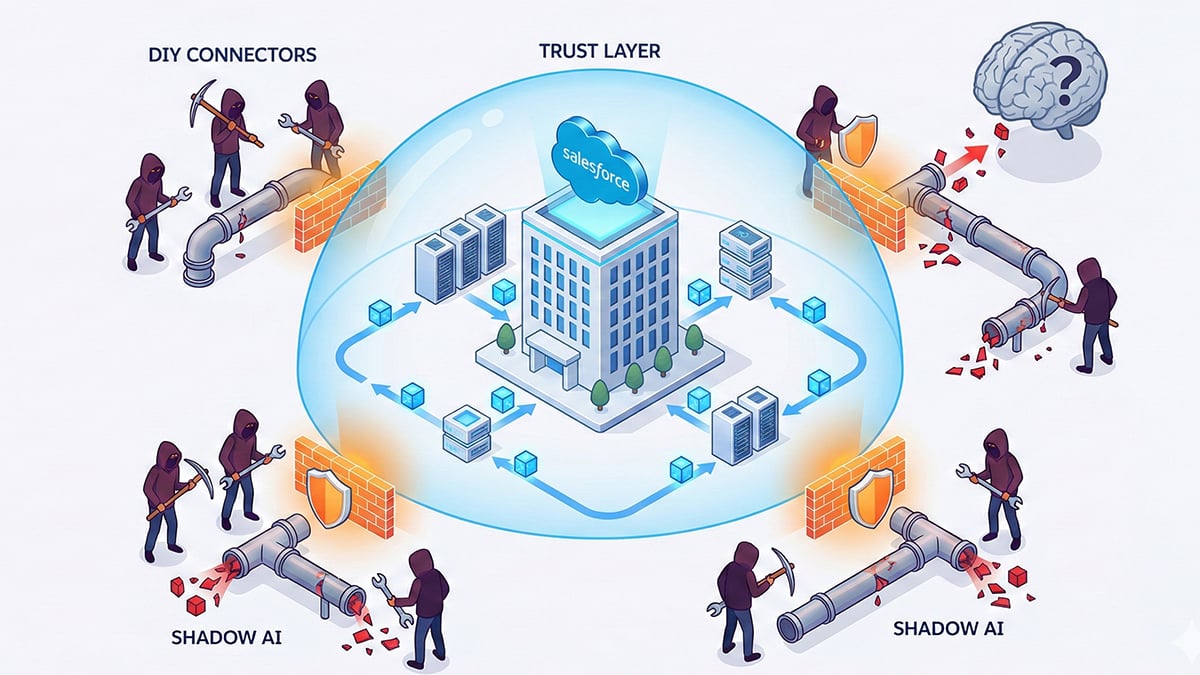
“The thing that I worry about, and what I wanted to get ahead of, was homegrown MCP servers from customers just spitting out data to OpenAI around the trust boundary,” Billmaier said. “And with this, we’re actually kind of being full of our destiny as we think about other players emerging in this space.”
The Model Context Protocol, or MCP, is the open standard that enables applications to connect to ChatGPT and other AI platforms. Since OpenAI released the Apps SDK in October, developers have been building independent MCP servers that expose Salesforce data to frontier models—with or without official blessing. These DIY connectors bypass Agentforce, bypass the Trust Layer, and bypass Salesforce’s consumption metering.
Billmaier framed the ChatGPT integration not as a departure from Salesforce’s embedded AI strategy but as its natural extension. “I actually don’t think it’s any different than our strategy in the past. You think about we’ve always had an Outlook integration, we’ve always had a Teams integration, we’ve always had a Google integration. This just becomes the next layer in which we have to work, because it’s where eyeballs are.”
The subtext is clear: if Salesforce doesn’t provide the official ChatGPT connection, customers will build their own. And those homegrown connectors won’t respect the security, audit, and governance controls that enterprise customers require.
Architecture Deep Dive: System of Intelligence, Not Data Pipe
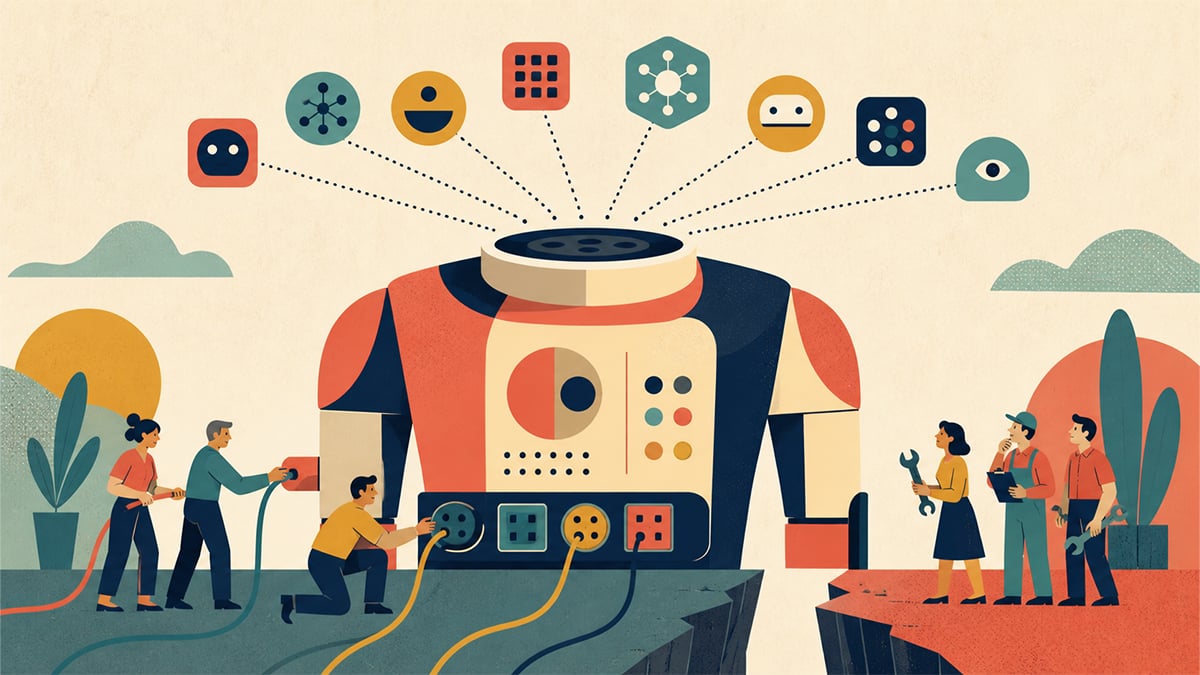
Technical architecture reinforces the strategic intent. Salesforce isn’t simply exposing CRM data to ChatGPT. The platform maintains its role as the intelligence layer while treating ChatGPT as a presentation surface.
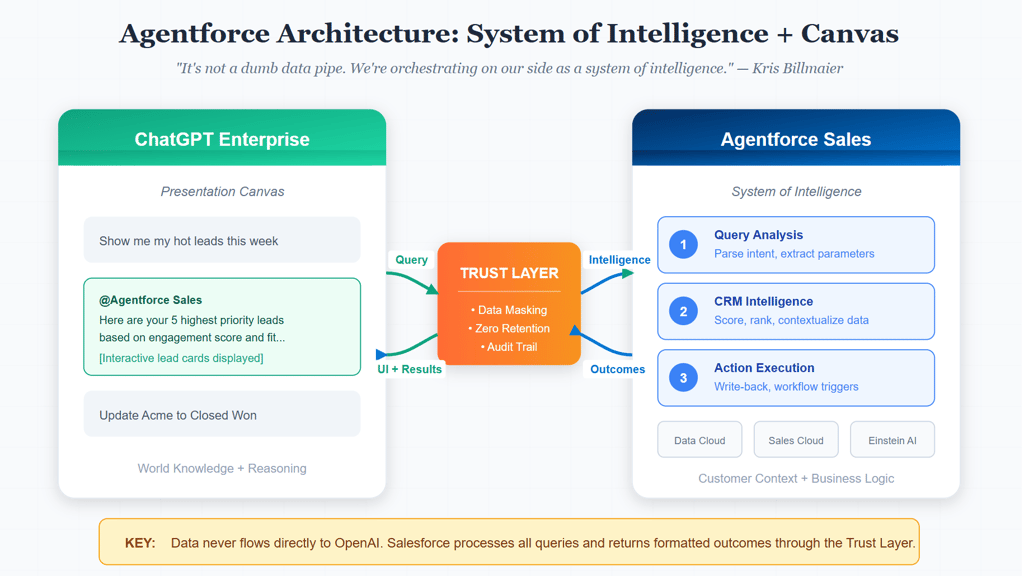
“It’s not a dumb data pipe,” Billmaier explained. “We’re actually orchestrating on our side as a system of intelligence and returning outcomes to effectively ChatGPT as a canvas.”
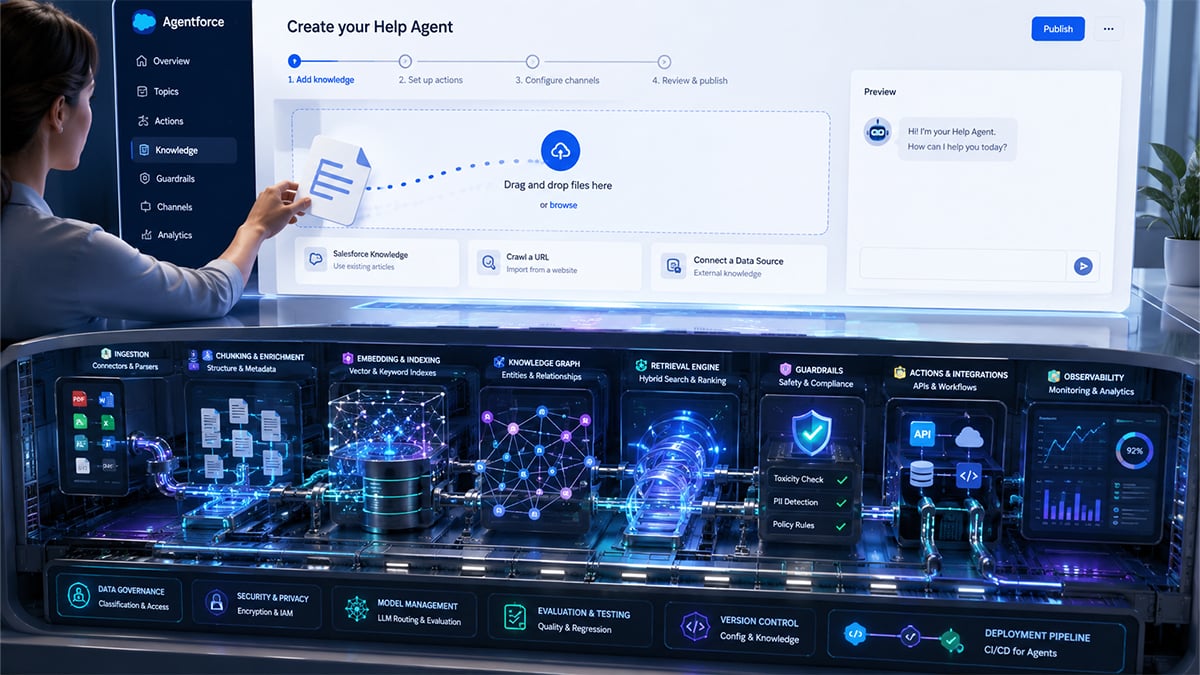
When a user queries their hot leads through the ChatGPT app, the request routes to Agentforce. Salesforce’s AI evaluates the leads using its own scoring models, contextual data, and business logic. The formatted results return to ChatGPT for display, which then may be analyzed with ChatGPT. ChatGPT provides the conversational interface and general reasoning capabilities. Salesforce provides the CRM intelligence and action primitives.
“ChatGPT understands the knowledge of the world, but until this point, they haven’t understood the knowledge of your CRM unless you’re cutting and pasting it in,” Billmaier said. “This is the context from CRM on ChatGPT based on the context we have and the knowledge we have and the intelligence we create on our side.”
The integration supports bidirectional operations. Users can create leads, update opportunities, and trigger agent workflows from ChatGPT conversations. Write-back capabilities currently focus on standard Salesforce objects, with custom object support expected as the platform matures toward general availability in early 2026.
Critically, the Agentforce Trust Layer governs data handling even within the ChatGPT environment. Enterprise customers retain their existing security controls, permission models, and audit capabilities. Data flows through Salesforce’s infrastructure rather than transiting directly to OpenAI.
Industry Context: Salesforce Isn’t Alone
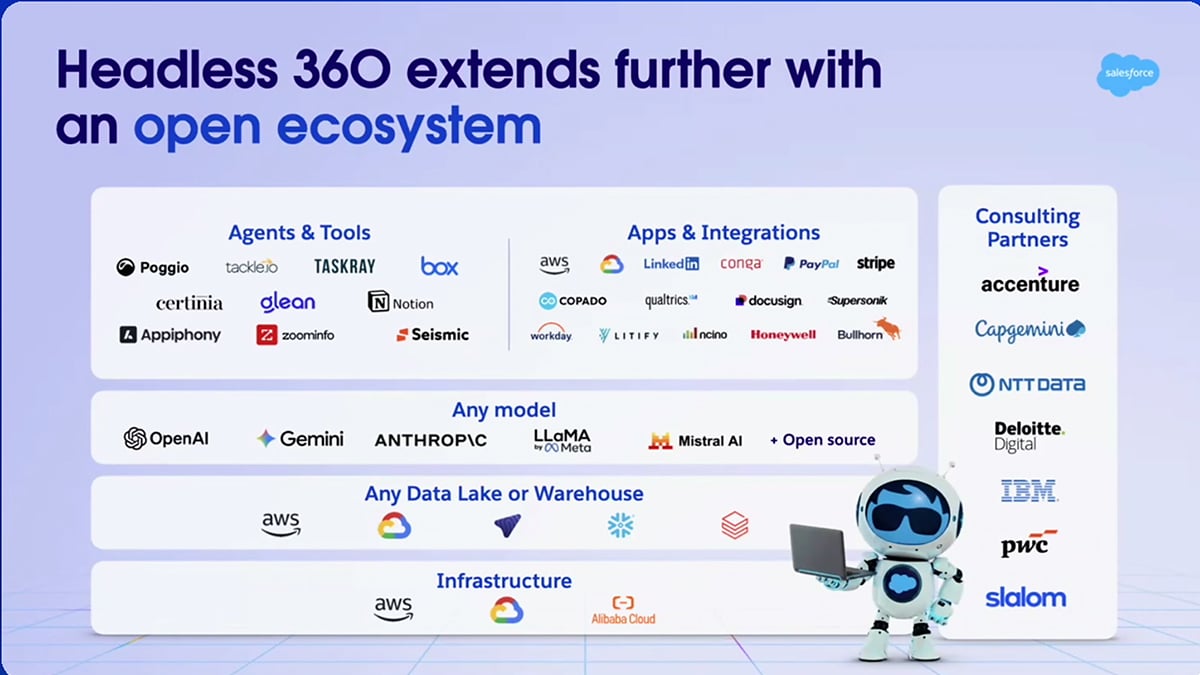
Salesforce’s defensive calculus reflects an industry-wide phenomenon. Since OpenAI’s Dev Day announcement on October 6, more than 35 enterprise software vendors have launched ChatGPT integrations. The pattern suggests a collective response to the same disintermediation threat.
Box, Dropbox, Atlassian, and Adobe all announced ChatGPT apps in the past sixty days. Each emphasized security, permissions, and governance, which is the same trust layer positioning Salesforce articulated. ServiceNow notably avoided the ChatGPT SDK entirely, instead routing all OpenAI access through its proprietary Now Assist interface. SAP uses OpenAI models but channels them through Joule, maintaining interface control.
SaaS vendors are concerned that their customers may start to see them as mere data repositories. If customers can access enterprise data through standardized MCP connectors, the differentiated value shifts to whoever controls the AI interface, and that is currently OpenAI. Enterprise software vendors risk becoming interchangeable data sources rather than systems of intelligence.
Research validates the urgency. Shadow AI adoption has grown 485 percent year-over-year, with 48 percent of employees uploading sensitive company data to public AI tools. Many use personal ChatGPT accounts that bypass corporate security controls entirely. The DIY connector risk isn’t hypothetical.
Single Player vs. Multiplayer: The Slack Differentiation
The ChatGPT integration raises obvious questions about Slack’s positioning within Salesforce’s AI strategy. Some users were excited to see a Slack-first philosophy for organizing enterprise agents emerge at Dreamforce. Wasn’t this announcement letting ChatGPT take that role instead? Nick Johnston, Senior Vice President of Strategic Partnerships at Salesforce, who joined the Billmaier interview, made some points for Slack as a tool for working with agents.
“We are seeing tools like ChatGPT today being very much the single player experiences,” Johnston said. “People are working in these tools to help themselves. Slack is multiplayer experience. If you think about where people are doing work with teams, with multiple groups, cross functional organization, plus bringing in agents from all different tools—that is where Slack shines. None of these AI tools are doing that yet.”
The strategic logic positions ChatGPT for individual productivity while Slack becomes the enterprise coordination layer. Sales reps might query their pipeline in ChatGPT, but cross-functional deal reviews happen in Slack channels with embedded Agentforce capabilities.
Billmaier signaled that Slack integration remains the priority. “I still focus first and best on Slack,” he said, referencing upcoming capabilities for January that will deepen Agentforce’s presence in Salesforce’s collaboration platform. The ChatGPT app extends reach; Slack remains the enterprise work surface where Salesforce intends to dominate.
VE Economics Implications: When Account Planning Just Happens
The Agentforce Sales capabilities surfacing through ChatGPT illustrate a broader transformation in knowledge work. Tasks that previously required senior expertise are becoming agent-executable.
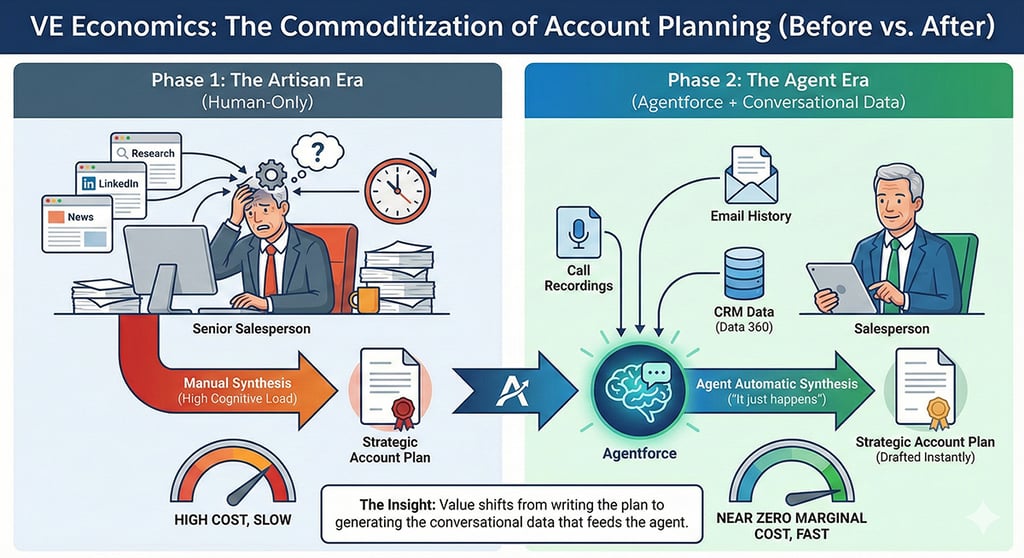
“Nobody has a job to build an account plan anymore,” Billmaier observed. “It just happens.”
This represents the Second Law of Virtual Employee Economics in action: cognitive commoditization. Account planning traditionally required understanding of customer politics, competitive dynamics, historical context, and strategic priorities. When an agent armed with sufficient structured and unstructured data as context can generate a strategic plan from a natural language prompt and save it directly to Salesforce, the expertise bar for that function drops significantly.
The conversational data capture strategy amplifies this effect. Salesforce has deployed its conversational intelligence product across internal sales teams, recording calls by default and generating insights automatically. A pipeline management agent now surfaces deal progression suggestions based on email content and conversation history.
“The capturing of data from those conversations is going to power 90 percent of our AI scenarios,” Billmaier said. “As we think about the unified sales intelligence layer that we build in Data 360, that’s going to be what we build all of our new experiences on—prospecting, nurture, engagement, account planning, quoting—it all needs that conversational contextualization.”
The implication for sales organizations is significant. The value increasingly concentrates in the conversational data that trains and contextualizes agents, not in the human labor of translating that context into CRM updates and account plans.
What This Means for Trailblazers
The Agentforce Sales app in ChatGPT is available now in open beta. General availability is expected in early 2026. Eligibility requires an Agentforce for Sales Add-on or Agentforce 1 Edition license plus ChatGPT.
For Salesforce administrators and architects, the immediate action item is assessing shadow AI exposure. Are your sales reps already using ChatGPT with copy-paste workflows? Are developers in your organization building unofficial MCP connectors? The answers inform whether Salesforce’s official integration addresses a real governance gap or solves a problem you don’t have.
The broader strategic question concerns embedded versus overlay AI architecture. Salesforce is betting that customers want their CRM vendor to control the intelligence layer, even when the interface lives in ChatGPT. Overlay vendors building AI capabilities atop Salesforce data are betting otherwise. Both can’t be right for every customer.
Billmaier framed the decision in competitive terms: “We wanted to be first there. We wanted to have our experience out there, learning and knowing that this is a different paradigm for us.” The race to control enterprise AI workflows is accelerating. Where your organization places its bets matters more than it did six months ago.
[Correction Note: The Agentforce Sales App for ChatGPT works will all editions of ChatGPT; Jan. 16, 2026]
Vernon Keenan is a senior industry analyst covering the Salesforce ecosystem, enterprise AI, and Cognitive DevOps for SalesforceDevops.net.