Salesforce and Informatica: Context Is the New Currency in Race for Agentic AI Dominance
With the $8 billion Informatica acquisition now closed, Salesforce this week detailed its strategy for building what executives call the “unified data foundation” for enterprise AI agents. The announcement positions Data 360, Informatica, and MuleSoft as an integrated trio designed to solve what the company identifies as the primary cause of AI project failures: lack of trusted enterprise context.
Table of contents
The Core Message: Context Is the New Currency
In a press briefing earlier this week, Krish Vitaldevara, Chief Product Officer at Informatica, and Rahul Auradkar, EVP & GM of Unified Data Services at Salesforce, introduced “Trusted Context” as the organizing principle for the combined company’s data strategy. Salesforce cited industry research showing approximately 80% of AI projects fail, with data fragmentation and poor data quality as primary causes.
Auradkar framed the problem bluntly: “Models are incredibly intelligent, but they tend to be corporate stupid. Without the shared understanding of the enterprise, the AI agents are forced to guess.” He elaborated that “AI without context is just guessing, or hallucinating. By combining Salesforce and Informatica’s enterprise metadata with Data 360’s harmonized sub-sec real-time context and MuleSoft’s integration strength, we replace guessing with reasoning.”
Vitaldevara positioned context as “the digital equivalent of AI’s working memory and situational awareness. It is institutional knowledge. The magic really happens when we use products like Informatica Data Management Cloud to turn raw data into trusted context.” He emphasized Informatica’s multi-cloud positioning: “We are the only data management platform that operates across different clouds. When we talk about Switzerland of data, we are very much vendor neutral.”
CEO Marc Benioff reinforced the message: “You have to get your data right to get your AI right. Data and context is the true fuel of Agentforce, and without clean, connected, trusted data there is no intelligence—only hallucination.”
Why Context Matters: A Day in the Life
Priya Sharma started in marketing ops at ACME Corp., a fictional mid-market manufacturer with 12,000 SKUs and 200 distributors. She was good at reports, so she became “the Salesforce person.” Five years later she manages three orgs and an Agentforce deployment she didn’t ask for.
Before: The Fragmented Enterprise
Monday morning, a service agent flags an urgent case: a distributor claims they never received industrial pumps worth $47,000.
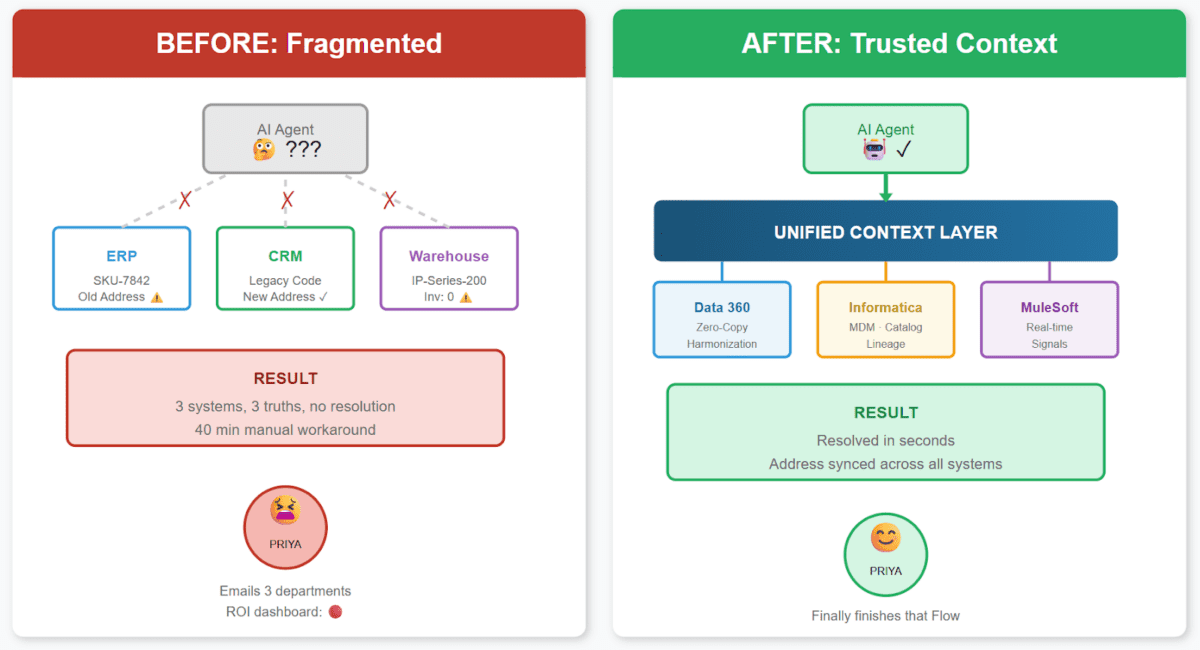
Priya watches the agent stumble. It pulls the order from the ERP, which was shipped five days ago. It checks the CRM, and the customer is marked “satisfied” last month. It queries the warehouse and the inventory shows zero. Three systems, three truths, no resolution.
She knows this dance. The “industrial pump” in the order system maps to SKU-7842, but the warehouse calls it “IP-Series-200” and the CRM logged it under a legacy code from an acquisition three years ago. The shipment went out, but to the distributor’s old address in the ERP that nobody updated when the CRM got the new one last quarter.
Priya spends 40 minutes on workarounds and emails. The distributor waits.
After: Trusted Context
Same scenario, different architecture. The agent queries the unified context layer. MDM resolved the product codes during onboarding. Data quality flagged the address discrepancy. The integration layer pulls the carrier’s proof of delivery.
The agent responds in seconds: “Your order shipped to your previous facility. I’ve initiated a redirect and expedited reshipment. Arrival: Wednesday. I’ve updated your address across all systems.”
Priya’s Monday? She reviews the resolved case and finishes the Flow she’s been putting off for three weeks. The difference isn’t the AI model. It’s whether the agent operates from fragments or from unified enterprise truth.
Technical Architecture and Scale
Salesforce outlined a three-component architecture: Data 360 combined with Informatica provides enterprise understanding through MDM, catalog, and lineage capabilities; MuleSoft delivers real-time operational signals including inventory changes and shipment delays; and Data 360’s zero-copy architecture harmonizes enterprise data without movement costs.
Salesforce also revealed its internal “Customer Zero” deployment with Informatica and Data 360, reporting a 98% reduction in tax adjustments and 20% fewer duplicate accounts. Auradkar noted that “Marc Benioff says we have not really earned the right to ship our products to our customers until we have made customer zero successful. Salesforce has been a customer of Informatica even before Informatica was acquired.”
Customer Validation
Scott Strickland, Chief Commercial Officer at Wyndham Hotels & Resorts, described the practical impact: “At our scale, inconsistent definitions across systems used to slow decision-making and limit what AI could automate. The combination of Informatica, Data 360, MuleSoft, and Agentforce is giving us a clear, trusted view of hotels, guests, and franchisees.”
Andy McCann, Digital Transformation Architect at Yamaha Motor Corporation USA, explained how the integration supports their “One Yamaha” strategy: “By bringing these platforms together, we can finally break down long-standing data silos and give every business unit—from Motorsports to Marine to Watercraft—access to clean, governed, consistently modeled data.”
Competitive Landscape: Same Problem, Different Architectures
Every major platform vendor now agrees that AI agents need enterprise context to function. The differentiation isn’t in the diagnosis—it’s in the architectural approach to solving it.
Palantir
Palantir builds context through “Ontology,” a semantic layer constructed custom for each deployment by Forward Deployed Engineers. This consulting-intensive model delivers deep integration but requires significant professional services investment. Palantir’s October 2025 NVIDIA partnership adds GPU-accelerated reasoning, but the approach remains bespoke rather than productized. Best fit: organizations with complex operational environments and budget for custom development.
Microsoft
Microsoft layers “Fabric IQ” and “Foundry IQ” atop its existing ecosystem—Dataverse, M365, Azure. The bet is that enterprises already running on Microsoft infrastructure gain context “for free” through existing data relationships. The tradeoff: context stays within Microsoft’s boundary. Heterogeneous environments with significant non-Microsoft systems face integration gaps. Best fit: Microsoft-committed shops seeking incremental AI capabilities.
Snowflake
Snowflake approaches context from the data warehouse outward. Cortex Agents add AI capabilities to an analytics platform, but Snowflake doesn’t own MDM, integration middleware, or business applications. Context must be assembled through partnerships and customer effort. The MCP Server announcement signals openness but not completeness. Best fit: analytics-heavy organizations where the warehouse is already the system of record.
Google treats “grounding” as a retrieval problem—connecting Gemini to data sources to reduce hallucination. Vertex AI Agent Builder excels at document retrieval and search but lacks native business semantics. It answers “can we find relevant data?” rather than “what does this data mean?” Best fit: organizations prioritizing search and document intelligence over transactional workflows.
Amazon
AWS Bedrock provides infrastructure primitives—Knowledge Bases, AgentCore Memory, session management—without prescribing architecture. Maximum flexibility, maximum assembly required. Enterprises must design their own context layers using AWS building blocks. Best fit: engineering-heavy organizations with platform teams capable of custom development.
Salesforce is betting that vertical integration wins. By owning the business application layer (Sales/Service/Marketing Cloud), the integration layer (MuleSoft), the customer data platform (Data 360), and now enterprise MDM, catalog, and data quality (Informatica), Salesforce controls the full stack from data foundation to agent action. The tradeoff: deeper platform commitment and reduced flexibility to swap components.
The strategic question for enterprises isn’t which vendor talks about context most convincingly—it’s which architectural model matches their existing investments, technical capabilities, and tolerance for platform dependency.
Assessment: Industry Convergence with Differentiated Assets
The competitive analysis reveals clear industry convergence on the premise that enterprise data context is essential for production AI agents. The terminology differs—Trusted Context, Ontology, IQ layers, Grounding, Knowledge Bases—but the underlying value proposition is consistent.
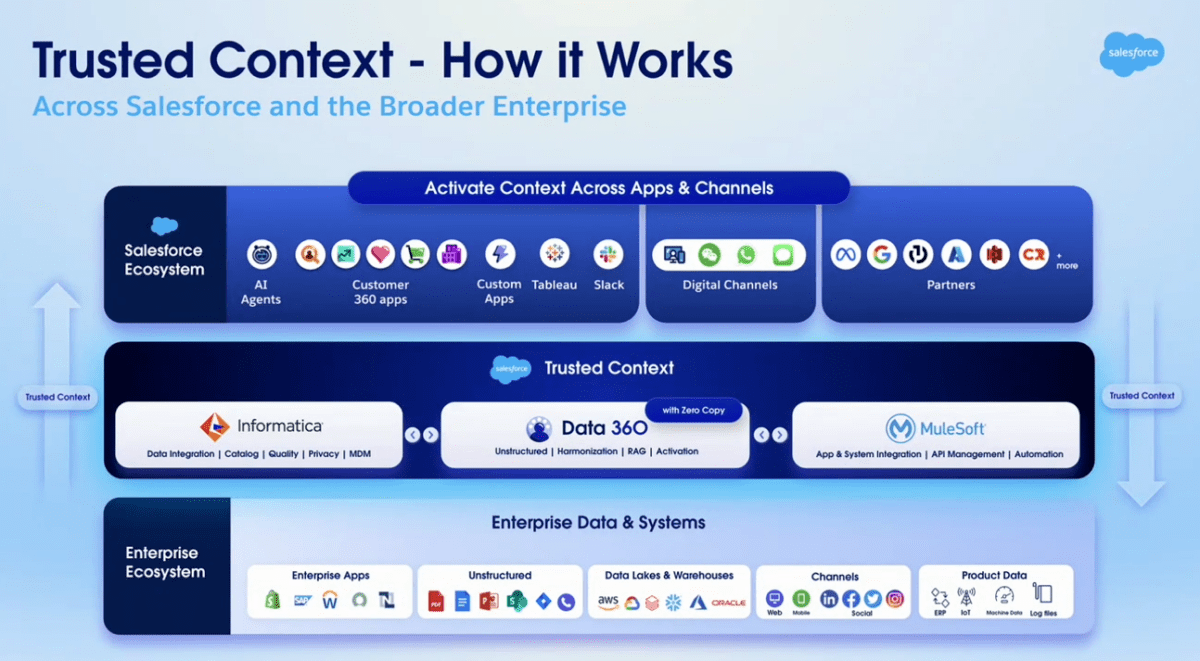
What differentiates Salesforce’s approach is the vertically integrated stack combining market-leading MDM, catalog, data lineage, and real-time integration under unified governance. Informatica holds leadership positions across multiple Gartner Magic Quadrants, bringing market-validated capabilities rather than net-new development. The multi-cloud neutrality addresses hybrid enterprise reality in ways hyperscaler-owned solutions cannot. And thousands of existing joint customers means the integration removes friction in established workflows rather than requiring new adoption.
Bottom Line
Salesforce has assembled the pieces. The question now is orchestration.
“Context is the new currency” reflects genuine industry consensus—every major platform vendor recognizes that AI agents fail without enterprise data foundations. But owning Data 360, Informatica, and MuleSoft is not the same as synthesizing them into a coherent context layer. Each product emerged from different architectural philosophies, serves different personas, and operates on different metadata models. Today’s announcement describes the destination; the implementation roadmap remains unwritten.
For Salesforce ecosystem practitioners, this announcement signals a fundamental shift in required competencies. The administrators and architects who thrived in the CRM era optimized around objects, fields, and flows. The agentic era demands fluency across MDM hierarchies, catalog semantics, lineage graphs, and real-time event streams—simultaneously. The skill gap is substantial, and Salesforce has not yet articulated how partners and customers will bridge it.
The enterprises most likely to capture value from this stack are those who treat context architecture as a discipline, not a product deployment. That means mapping business objects across systems before touching configuration, establishing governance frameworks that span all three platforms, and designing for the agent’s reasoning process rather than retrofitting existing integrations. The technology is available. The methodology for applying it is where competitive advantage will emerge.
Salesforce is betting its future on trusted context. The bet is sound. But the winners in this transition won’t be determined by who buys the stack—they’ll be determined by who learns to operate it as an integrated whole.