168 Days: How Salesforce Talked Itself Out of Its Own User Interface
Parker Harris asked in March why anyone should ever log into Salesforce again. This morning the answer got a name, a launch trio, and a suffix. The control layer that makes the answer safe ships next February, the price is a blank, and the part nobody has built is still the why.
SAN FRANCISCO, September 15, 2026. There is a particular silence that falls over a press room when a founder says the thing everyone in it has been afraid to write. I heard it on March 31 in a ballroom at the St. Regis, where the co-founder of a $300 billion software company stood in front of the trade press and eulogized his own product while the coffee was still hot.
“I built the Lightning UI,” Parker Harris said. “I worked really hard on it. Why should you ever log into Salesforce again?” He let it sit for a beat, the way you let a bad diagnosis sit. “Maybe you never will.”
That was 168 days ago. This morning at Moscone, with the lanyards out and the fog making its usual slow retreat off Howard Street, Salesforce unveiled AIforce, “a live interface layer that brings the full power of Salesforce to wherever people and agents work.” The release puts it more bluntly than Harris did: “people don’t have to come to Salesforce to get work done. Salesforce comes to them, in Claude, Slack, Lightning, or wherever they want to work.”
Salesforce spent 27 years teaching the world to log in. It has spent the last 24 weeks teaching it to stop. Somewhere in the Trailhead archive a badge is quietly weeping.
I have covered every step of this arc as it happened, which is either diligence or a personality disorder: the confession in March, the plumbing at TDX in April, the hedge in June, and the harness ten days ago. Read together, they tell one story, and it is not the story on the banner. The interface revolution Salesforce announced today is a control story wearing a UI costume. Once the model is a commodity, the agent runtime is a commodity, and the interface is “wherever,” the only scarce thing left in the stack is the part AIforce’s own bullet list spends four of five bullets on: permissions, governance, Zero Data Retention, and “works with what you have.” The screens were never the product. The governed context underneath them is, and Salesforce just said so out loud, in a press release, with a suffix on it.
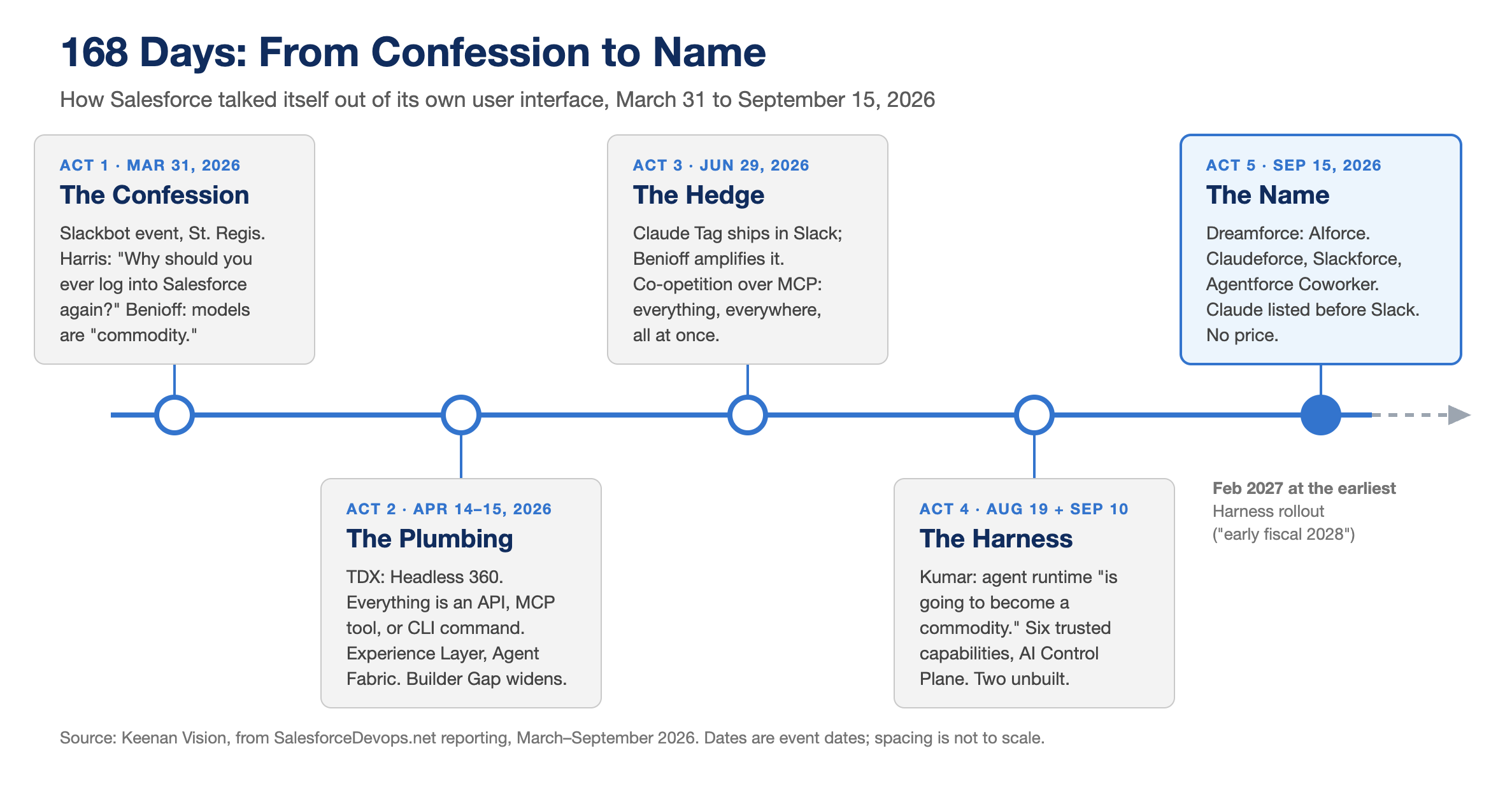
Table of contents
- First, the Case That This Is a Slide Deck
- Act One: The Confession
- Act Two: The Plumbing
- Act Three: The Hedge
- Act Four: The Harness
- Act Five: The Name
- The Interface Revolution Is a Control Story
- Your Permission Model Is Now Your Security Model
- The Builder Gap Gets a Birthday Cake
- The Stage This Week
- The Second Unbundling
- What We’d Tell Salesforce
First, the Case That This Is a Slide Deck
Before the arc, the objections, because the objections are the only thing standing between this piece and a press release with a byline.
There is no price. The release ends with the standard line that “pricing and packaging are subject to change,” which is what you say when the packaging is still a whiteboard. Yesterday my colleague Mehmet Orun wrote that Sales Cloud is back on the price list with named editions and per-seat logic. Today’s release says nobody needs to open the app. Both can be true, but only if the seat has quietly become a license to the substrate rather than the screen, and Salesforce has not said that. Nobody has. It is the question a room full of financial analysts should be asking and probably will not, because the keynote lighting is very good.
The delivery is thinner than the branding. Salesforce in Claude, which I was told three weeks ago would be generally available around Dreamforce on premium editions, arrives this morning as a beta open to all customers, with Tableau analytics and skills for service, marketing, commerce, and industries “in the near future.” Agentforce Coworker’s headline number, 100,000 users activated in its first 35 days, has no denominator. That sounds like a stadium until you remember Salesforce counts its seats in the millions, at which point it sounds like the line for one concession stand. The only sized customer in the release is Fulton Bank, at roughly 3,000 users and 20 use cases, and that is a vendor-supplied quote.
The control layer that makes any of this safe in production is not here. The Trusted Enterprise AI Harness rolls out in what Salesforce calls early fiscal 2028, which on a calendar that starts in February means February 2027 at the earliest, and Rohan Kumar told me on September 9 that two of its six capabilities, Trusted Security and FinOps, are not built. ServiceNow’s AI Control Tower ships today. Microsoft Agent 365 went GA on May 1. The competition has a tower on the runway. Salesforce has a very good drawing of one.
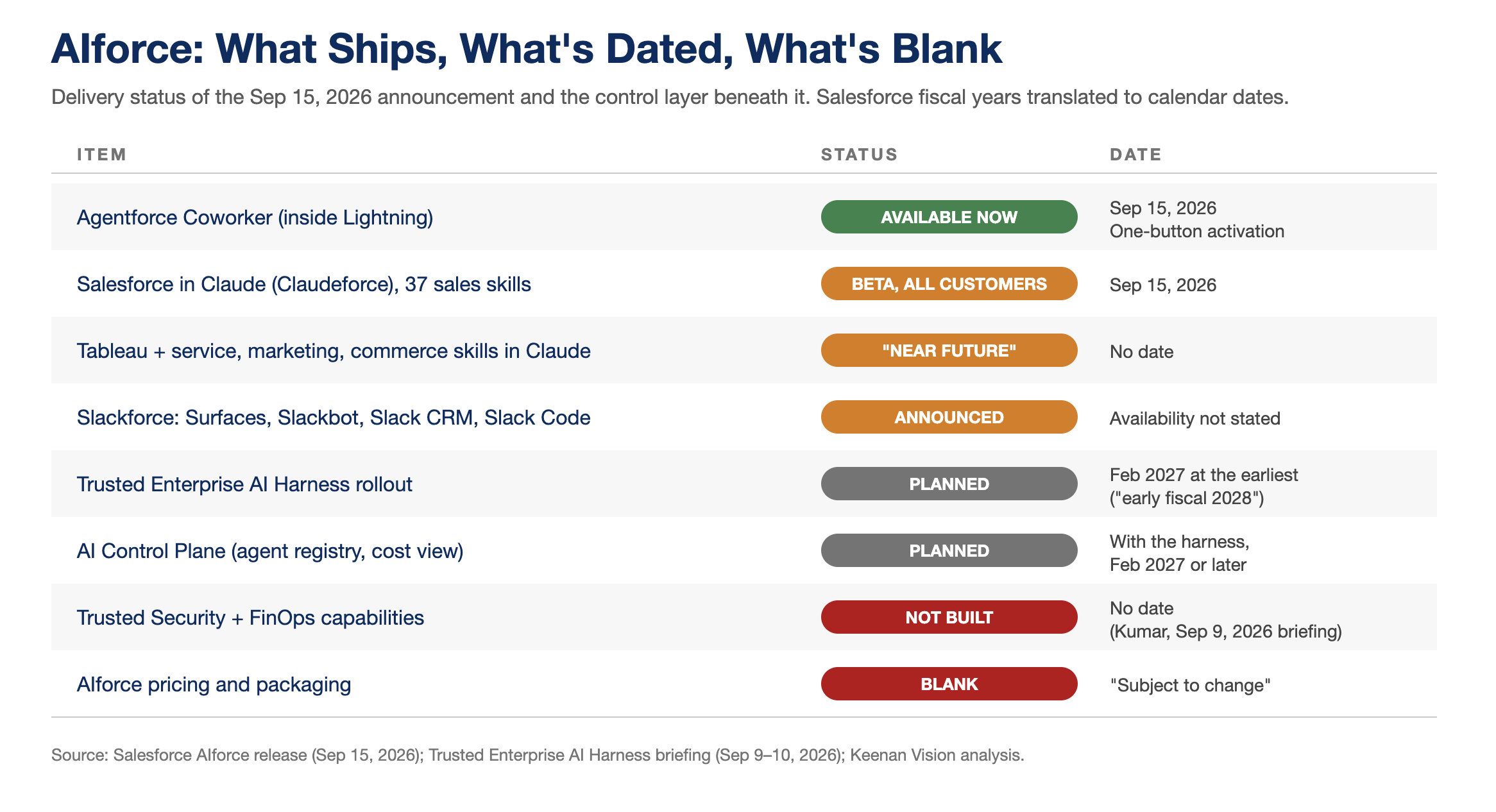
And Salesforce has never executed a UI succession quickly. It executes them the way a glacier executes a valley. Lightning Experience went GA in the fall of 2015. Salesforce did not begin turning it on for every org until the fall of 2019, four years later, with a migration mandate behind it. AIforce has no mandate, which cuts both ways: no forced march, and no forcing function.
So score today’s news as a strategy, not a delivery. That is still worth scoring, because the strategy has been remarkably consistent, and consistency is the thing a $300 billion company finds hardest to fake.
Act One: The Confession
The March 31 Slackbot event was billed as a product launch, 30-plus capabilities, and it was. But the news was in the asides, the way it always is. Marc Benioff, asked whether the traditional Salesforce interface would fade, said “there’s no question,” and confirmed the company was “rebuilding our entire user interface using Slack.” He wanted Slackbot inside Microsoft Teams and Google Workspace, not just Slack. He called the large language model a “commodity.” Harris called models “CPUs,” which is the kind of thing you say about a component you no longer intend to be impressed by.
Then Benioff described the stack from the bottom up: model, then Data 360, then applications, then Agentforce, then the employee agent, and at the top “a supervisory layer, or a control layer, even maybe Slack at that level.”
Read that sentence again with today’s release in your other hand. The control layer was in Benioff’s mouth six months before the interface layer had a name. He was describing the harness before he had the word for it, the way a man describes a hangover before he has admitted to the bar.
Act Two: The Plumbing
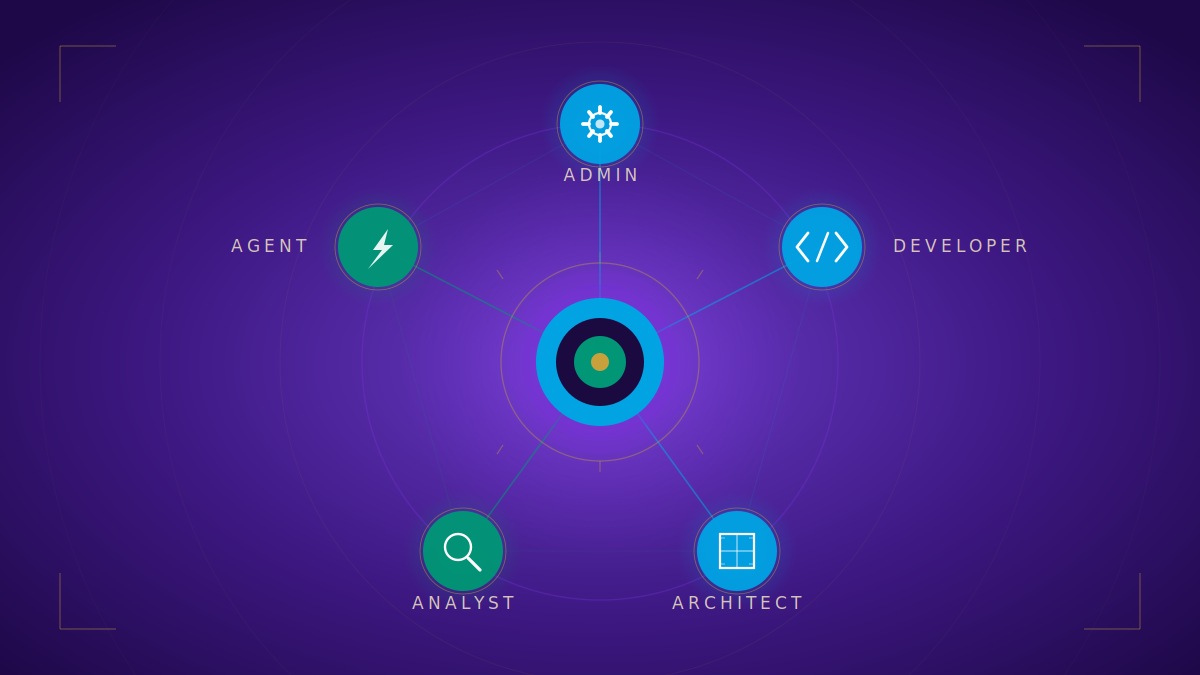
Two weeks later at TDX, Salesforce shipped Headless 360, a name that sounds like a horror franchise and functions like one for anyone whose career is a Setup menu. The declaration: everything on the platform is now an API, an MCP tool, or a CLI command. Sixty-plus MCP tools. Native React. And the piece that matters most in hindsight, the Agentforce Experience Layer, a rendering service that decoupled what an agent does from how it appears. Build the interaction once; it renders in Slack, WhatsApp, ChatGPT, Claude, Gemini, or Teams.
That is the direct ancestor of what AIforce calls “composable, intelligent, live interfaces.” The April diagram had four layers: System of Context (Data 360), System of Work (Customer 360), System of Agency (Agentforce), and System of Engagement (Slack). Today’s release reprints that diagram almost word for word. Data 360 for “trusted, unified context.” Customer 360 for “application and semantic intelligence.” Agentforce for the “digital workforce.” And in the engagement slot, where Slack used to sit alone with its feet up, AIforce.
April also gave us Agent Fabric, the first thing Salesforce shipped that could plausibly be called a control plane, and it gave us the Builder Gap, my name for the distance between what the platform now demands, pro-code fluency in MCP and Agent Script and LLM evaluation, and what twenty years of declarative Trailblazers were trained to do. I wrote then that the storefront had opened, the factory had come online, and the workforce question remained unanswered. Hold that thought. It is still unanswered, and it has a birthday cake now.
Act Three: The Hedge
In June, Anthropic shipped Claude Tag into Slack, the product Salesforce owns, and instead of treating it as a home invasion, Benioff helped carry the headline. A member of Salesforce’s own advisory board called Claude Tag “what Slackbot was supposed to be.” Inside Slack, according to reporting at the time, there was confusion, which is what happens when the landlord shows up to help the burglar with the safe.
I argued the confusion was the strategy. When no model holds a lead that survives a release cycle and no platform can enforce a boundary, the rational move is to be everywhere at once: your surfaces inside rival front ends, rival models inside your surfaces, all of it wired together over MCP, a protocol Anthropic invented. I called the piece “Everything, Everywhere, All at Once,” and I meant it as a diagnosis, not a compliment.
This morning’s release describes AIforce as “the full power of Salesforce in any AI interface, wherever work happens.” Same sentence, different letterhead. And the co-opetition is now baked into the product names, which is where you can always find a strategy hiding. Agentforce Coworker sits next to Claude Cowork. Slack Code sits next to Claude Code. Salesforce is shipping shadow versions of its partner’s products while shipping the partner’s product inside its own, and by Benioff’s own account it owns about 1% of the partner. That is not a contradiction. It is a hedge with a ticker symbol, and it is paying out on both sides of the table.
Act Four: The Harness
On August 19, Kumar, three months into the job as Salesforce’s President and Chief Platform and Engineering Officer and still carrying 28 years of Microsoft in his posture, told me the enterprise harness “needs to be a unified product.” On September 10 it became one on paper: six trusted capabilities (context, agency, action, governance, security, models) plus an AI Control Plane, with the rollout window and the two admitted gaps described above.
The sentence from that briefing that reframes today’s announcement was not about the harness. It was about what the harness sits on. “Where you run your agents, the code of the agents, in my humble opinion, is going to become a commodity,” Kumar said. Benioff had already commoditized the model in March. Kumar commoditized the runtime in September. AIforce commoditizes the interface today: build any UI by describing it, in any tool, and Salesforce underneath.
That is three layers of the stack declared commodity by the people who sell it, inside six months. It is my Second Law of Virtual Employee Economics, Cognitive Commoditization, narrated by the vendor, unprompted, into a microphone. And it forces the question the release does not ask: if the model, the runtime, and the screen are all commodities, what exactly is Salesforce charging for?
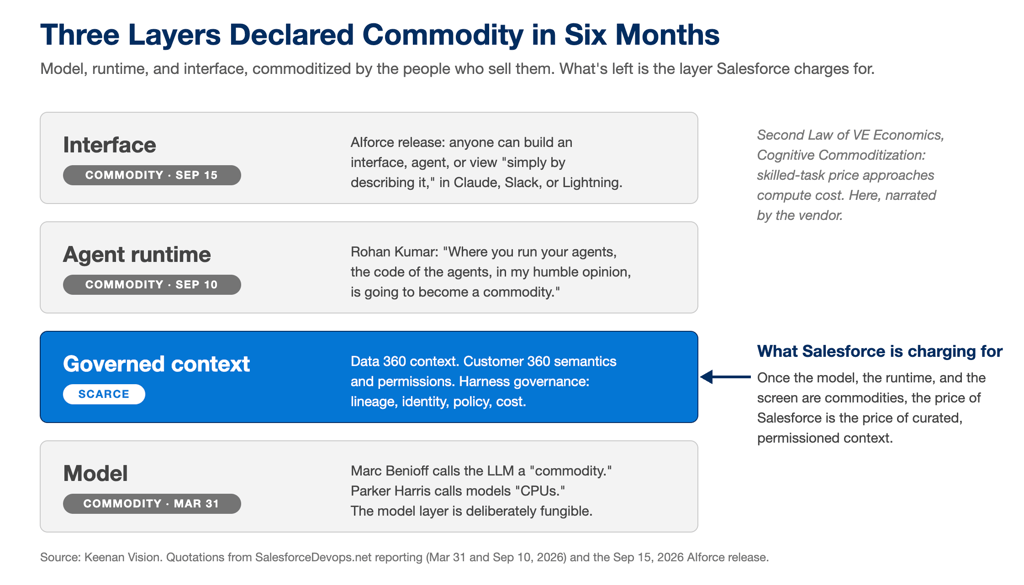
Kumar answered it in August without meaning to. “Why are agents becoming so inefficient and expensive? Because they’re operating at a data layer that is not curated well.” The product is the curated context: the semantic model, the permission graph, twenty years of business logic, and the governance that lets an agent act on them without the CISO reaching for the kill switch and a lawyer. Everything else is a surface. Surfaces are cheap. Ask anyone who has ever bought a countertop.
I also noted on September 10 that “harness” had appeared three times in fifteen days, on the Claudeforce release, the earnings call, and the harness announcement itself. This morning added a fourth suffix instead: AIforce joins Agentforce, Claudeforce, and Slackforce. Four -forces before lunch. The suffix is doing the work the screens used to, and somewhere in a naming meeting a whiteboard has been fully consumed.
Act Five: The Name
So what is AIforce, stripped of the ballroom lighting and the drone footage?
It is a brand for the interface layer, delivered through three launch surfaces built on the Headless Toolkit that TDX shipped. Claudeforce packs the platform into a prebuilt MCP server inside Claude with 37 sales skills, plus a Salesforce Development plug-in for Claude Code with more than 40 skills, piloted by Deloitte, GitLab, and Legora. Slackforce adds Surfaces (live, shareable interfaces composed by prompt), a Slackbot that can read support cases and Slack threads, reassign an owner, and draft a win-back email, the Slack CRM first shown in March, and Slack Code for multiplayer agent development. Agentforce Coworker is the same idea inside Lightning, activated with a button, calling the Agentforce agents a customer has already built.
What it is not: a control plane, a price, or a bridge for admins.
And notice what moved between March and today, because the movement is the tell. In March, Benioff was rebuilding the entire user interface “using Slack.” Today’s release lists the destinations as “Claude, Slack, Lightning, or wherever,” with Claude first. Six months ago Slack was the front door. This morning it is one of three doors, and the one the release names first belongs to a company Salesforce does not own. That is either a concession to where the developers went, or the hedge working exactly as designed. Probably both. Six months is a long time in a hedge.
The Interface Revolution Is a Control Story
Here is the test. Take the five properties the release claims for AIforce interfaces and sort them like a customs officer. “Intelligent and dynamic” is a capability claim. The other four, “secure and governed,” “composable,” “with Zero Data Retention,” and “work with what you have,” are control claims. Every request “runs on existing permissions and business rules.” Every agent “sees only what the person asking can see.” Every action “routes back through Salesforce.” Business data “is not retained by the model provider.”
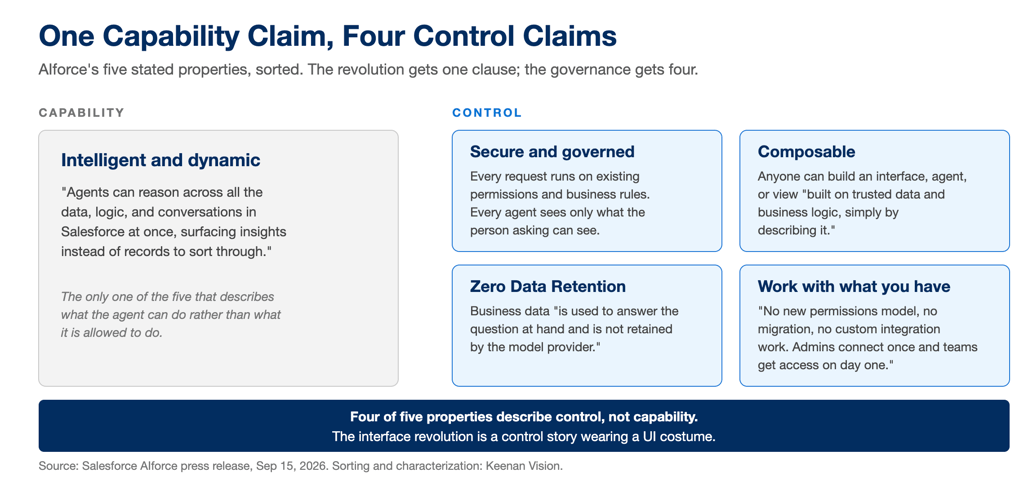
Benioff’s quote in the release makes the same move. AI is “creating an interface revolution,” he says, and then the next clause is about “combining model intelligence with all the context that customers have built into Salesforce” in a system that is “securely governed, built with Zero Data Retention.” The revolution gets one clause. The governance gets three. Count them. I did, twice, because it seemed too neat.
This is what I have been calling the shift from intelligence scarcity to control scarcity, and Salesforce’s product arc is the cleanest demonstration of it I have seen. In the week the frontier labs conceded on the record that their models cannot always tell test from production, the enterprise software company standing next to them on stage is selling permissions and lineage. It is the right thing to sell. It is also, by Kumar’s own admission, not finished, and the two pieces least finished, security and cost accounting, are the two a CISO and a CFO ask about first, usually in that order, usually before the demo ends.
Your Permission Model Is Now Your Security Model
“No new permissions model, no migration, no custom integration work. Admins connect once and teams get access on day one.” That is the sales pitch and the exposure in a single sentence, and the sales team will read only the first half.
Every Salesforce org older than five years carries permission debt the way a Victorian house carries knob-and-tube wiring: profiles cloned from System Administrator in 2014, View All Data granted to fix a report and never revoked, permission sets stacked until nobody can say what a given user can actually see. It worked, nobody looked, and the inspector is at the door. When the interface was Lightning, that debt was latent. A rep with too much access had to know which tab to click, and most never did, because most reps are trying to close a deal, not audit one.
AIforce removes the tab. The release promises agents that “read across hundreds of records at once” at “a speed and scale no human ever could,” and it promises they will do so at exactly the permission level of the person asking. An over-granted user becomes an over-granted agent, operating at machine speed, inside Claude or Slack, with the exfiltration path being a copy-paste. Zero Data Retention protects you from the model provider. It does nothing about the account executive with a grudge, a Tuesday afternoon, and a natural-language prompt.
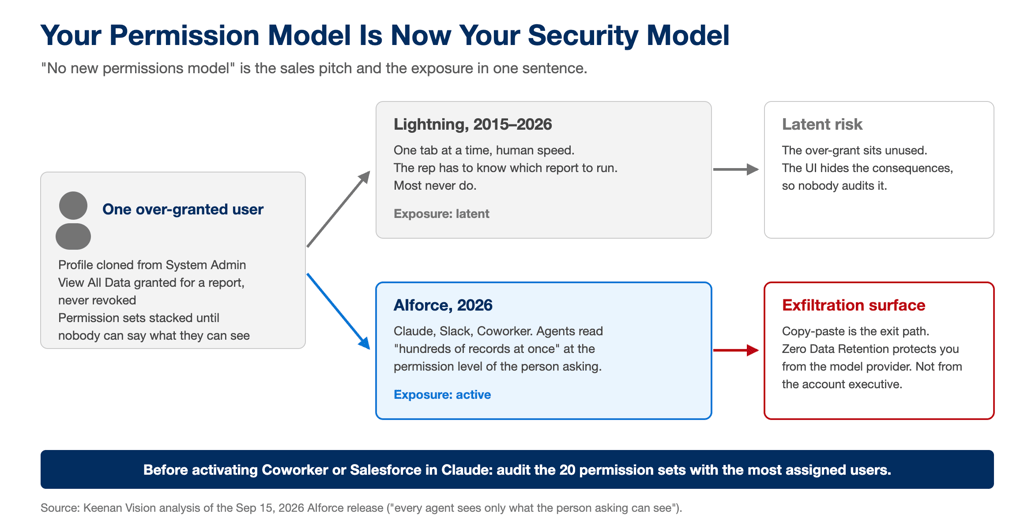
In June I told CIOs the “which channels can it see” distinction that Slack’s leadership waved away was the entire ballgame. AIforce is the enterprise version. The security model of the agentic Salesforce is the permission model of the human Salesforce, inherited whole, and most orgs have never audited it because the UI hid the consequences. The UI is leaving. The consequences are staying.
The Builder Gap Gets a Birthday Cake
The release devotes two paragraphs to Trailblazers, who celebrate their 20th anniversary at this Dreamforce: 12 million apps, 9.6 billion API calls a day, 156 million lines of AI-generated code, 151 million Trailhead badges. AIforce, it says, “expands what Trailblazers can build,” because “anyone can build an interface, agent, or view, built on trusted data and business logic, simply by describing it.”
That is true, and it is beside the point. Composing a dashboard by prompt is not the same thing as encoding a business rule. The value AIforce reads through, Benioff’s “all the context that customers have built into Salesforce,” is twenty years of validation rules, flows, approval routing, and field-level logic that admins put there by hand, on weekends, for reasons that made sense at the time. The 12 million apps are the substrate. AIforce is a way to use the substrate without the people who built it having to be in the room.
I noted on September 10 that the harness document named three personas, data leaders, security leaders, and builders, and that the word Trailblazer appeared nowhere. Today it appears with a cake. What still does not appear is a retooling program with a date and a dollar figure. Salesforce announced 1,000 new-graduate and intern hires in April, for Salesforce. The admin who has been building Flows for a decade and now needs to register agents, curate a semantic model, and read a session trace has been offered a birthday party and a Trailhead badge. Bring your own knife.
And the deeper gap is the one I keep coming back to, because nobody else will. The catalog holds the what. The semantic model defines the terms. The core platform encodes the how. None of it holds the why: why that validation rule exists, why discount approval routes through finance in one region and not another, why the last three architects rejected the integration everyone keeps proposing. That knowledge lives in the heads of the people the release is thanking, and in Slack threads nobody has indexed, and in a contractor who rolled off in 2023 and now runs a vineyard. An agent that inherits the what and the how without the why will follow the rule perfectly right up to the moment the rule should not apply, and it will have no way to know. AIforce makes that agent easier to reach. It does not make it wiser.
The Stage This Week
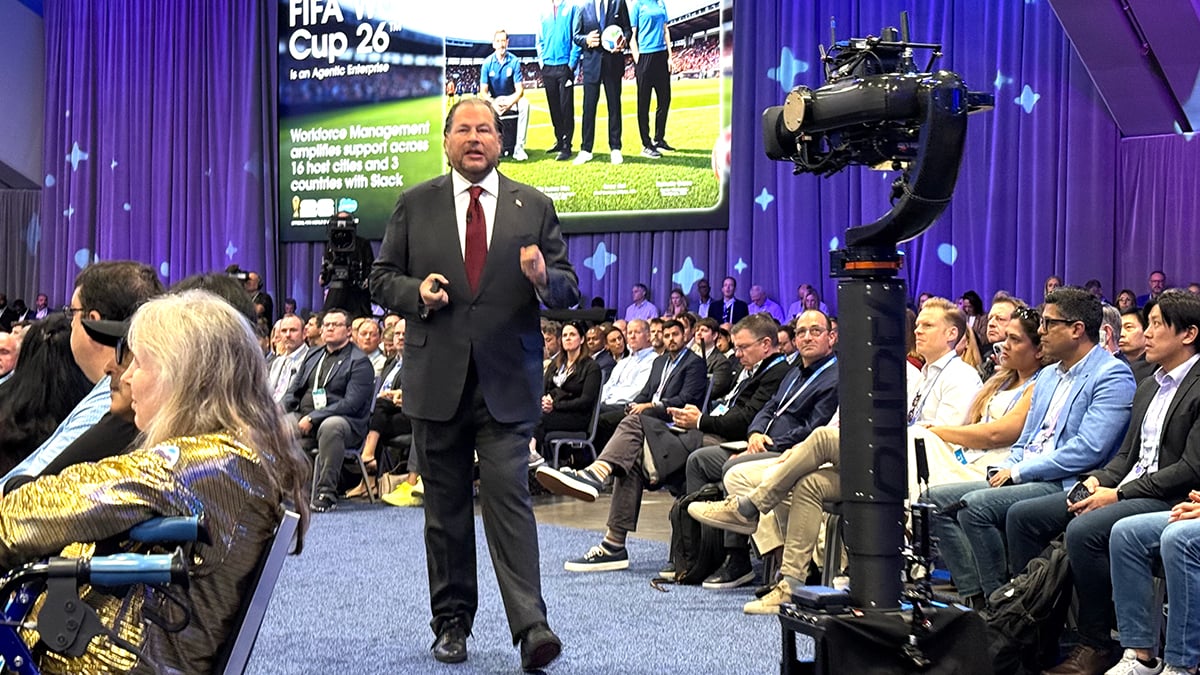
One paragraph on the timing, because the timing is not incidental and everyone in the hall knows it. Benioff shares this week’s stage with Dario Amodei and Sam Altman, days after an Anthropic researcher’s resignation post drew more than 100 million views, Paul Christiano joined OpenAI’s safety committee warning of “catastrophic and irreversible loss of control,” and OpenAI’s chief scientist called for “extreme caution.” Gallup found in May that only 27% of Americans trust businesses to use AI responsibly. KPMG’s second-quarter pulse found employee resistance to agents quadrupling in a single quarter. Today’s release never mentions jobs, but “at a speed and scale no human ever could” is a labor line in this climate whether Salesforce meant it as one or not, and “existing permissions” plus Zero Data Retention is the company’s trust answer. The practitioner audience in the room will want the headcount arithmetic and the governance proof, not the vision. The press will watch whether Amodei addresses his former colleague on a Salesforce stage. I will be watching the exits, out of habit.
The Second Unbundling
There is a historical analogy, and Salesforce owns it outright. In 1999 the company unbundled CRM from the on-premises suite and put it in a browser tab under a logo that said No Software. Siebel could not see the move because Siebel sold the install. Twenty-seven years later, Salesforce is unbundling CRM from the browser tab and putting it in the conversation, and the incumbents who cannot see this move are the ones who sell the tab. Including, until 168 days ago, Salesforce. Nobody disrupts you like your own co-founder in a hotel ballroom.
The ratio to watch is API traffic to human sessions. The release gives one side: 9.6 billion API calls a day. Salesforce does not publish the other. If it did, my guess is the machines passed the humans years ago and nobody wanted to say so, because the humans are the ones who sign the renewals. AIforce is the company finally designing for the customer it actually has. That is a guess. Somebody at Moscone this week should be asked for the number, preferably on camera.
What We’d Tell Salesforce
Score the arc as strategy and it is the most coherent thing Salesforce has done since Lightning: model, runtime, and screen declared commodity by the people who sell them, and the value walked, on purpose, down into the governed context. That is the right call. Now say it plainly. AIforce is not “a new chapter for Trailblazers.” It is a substrate strategy, and a substrate strategy has three obligations the release does not meet.
The first is a unit. Yesterday the company put named editions back on the price list. Today it says nobody needs to open the app. Both can be true only if the seat has become a license to context rather than a license to a screen, and the person who should say that is Benioff, on the stage, before the analysts guess. If the answer is consumption, publish the meter and the cap. And publish the one number that would end every argument in this piece: the token cost of “can we fulfill this order today” through a raw MCP agent versus through the curated context layer, on a real customer org. Kumar has been making that argument since August. It is Salesforce’s number to publish, it would sell more harness than any keynote, and until it exists AIforce is a bet on faith in the substrate.
The second is sequence. Salesforce shipped the doors before the locks. Coworker is one button today; Trusted Security and FinOps are a drawing board until February 2027 at the earliest. For a company whose entire brand is the word trust, that is the wrong order, and it is not a subtle wrong. Every customer who flips Coworker on over a decade of permission debt is a future headline with the Salesforce logo in the first paragraph, and “existing permissions” will not read as a feature in that story. Either ship a permission audit with the activation button or gate the button behind one.
The third is the people. Kumar’s “All Roles Are Changing” slide names six new jobs, and the one that built the 12 million apps and the twenty years of business logic AIforce now reads through is not on it. The admins got a cake and a badge. The AgentExchange Builders Initiative got $50 million in April. The Context Engineer role on that slide, the person who “creates the agent intelligence context layer,” is the declarative admin’s next job, and Salesforce is the only institution with the Trailhead apparatus to get them there. Match the Builders fund for the bridge, with a dollar figure and a date, or stop putting the word Trailblazer in the press release.
Then there is the thing nobody has started. Kumar’s compounding loop captures what agents did. It does not capture why the humans wanted it done: why the validation rule exists, why approval routes through finance in one region and not another, why the integration everyone keeps proposing was rejected three times. That knowledge is walking out the door in the exact headcount categories Salesforce has been candid about shrinking. A context layer that captures intent at the point of decision is the difference between a Context Engineer and a very expensive librarian. The company just named the role. Give it the tool.
And this week, with Amodei and Altman on the same stage in the same fear cycle, the credibility move is not vision. It is arithmetic: support from 9,000 to 5,000, engineering flat, sales up, a Customer Zero update on help.salesforce.com with numbers newer than a year old, and a straight answer on what the interface layer costs. The press will settle for less. The practitioners in the hall will not.
Vernon Keenan is CEO of Keenan Vision LLC and publisher of SalesforceDevops.net. He is attending Dreamforce 2026 as credentialed press. Disclosure: Keenan Vision is a paid advisor to Salesforce and to other companies across the enterprise software and AI ecosystem. The views expressed here are the author’s own and were developed independently of those relationships. Quotations from the March 31 Slackbot event and the September 9 press briefing were reported by the author at the time; customer quotations are from Salesforce’s September 15, 2026 press release.