The $400 Million Admin Tool
Sweep grew up on the AppExchange. ServiceNow saw what the ecosystem missed.
On Thursday, September 3, Calcalist’s CTech reported that ServiceNow is acquiring Sweep, the Tel Aviv and New York company that builds an agentic metadata layer for go-to-market systems, for a sum in the hundreds of millions of dollars. The same day a ServiceNow spokesperson confirmed the acquisition to Geektime, which reported it as completed and, citing its own sources, put the price at approximately $400 million. ServiceNow declined to discuss terms and has issued no press release; its statement to both outlets says Sweep will strengthen its AI-native development capabilities and “advance agentic deployment for CRM.” So: the acquisition is confirmed, the price is not, and what follows is a reading of the tea leaves by a man in Oakland with forty years of stains on the cup. Here’s a clue: start looking for how ServiceNow has figured out how to use AI to extend its reach beyond its traditional ITSM roots.
If the price for Sweep is anywhere near right, it is the strongest valuation signal for Salesforce metadata and DevOps tooling since Copado’s financing approaching $1.2 billion in September 2021 (Salesforce’s own $1.9 billion purchase of Own in 2024 was a backup and data-protection deal, a different category). Over eighteen months ServiceNow has announced or completed acquisitions carrying more than $11 billion in disclosed headline value while assembling a platform whose stated purpose is to govern every AI agent in the enterprise regardless of where the data lives. What that platform did not have, on the public evidence, was a dependency-resolved view of the interior of a Salesforce org. Sweep’s specialty is exactly that. That is my reading of the deal, and the rest of this piece is the argument for it.
Table of contents
Sweep grew up in the Salesforce ecosystem
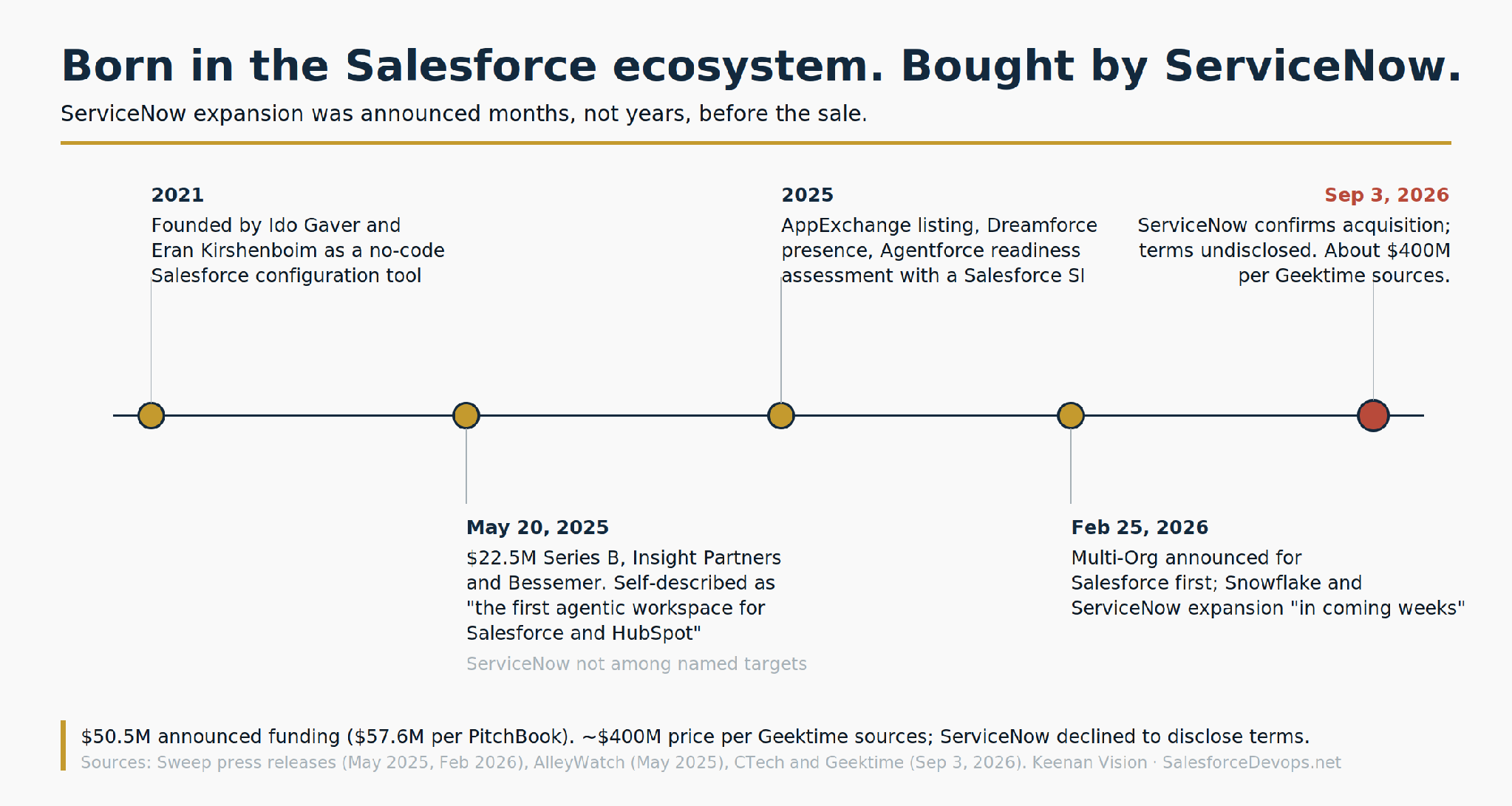
I have spoken with Sweep CEO Ido Gaver several times, and if you had asked me in the spring whether Sweep was a Salesforce ecosystem company I would have said obviously. The record agrees. Gaver and Eran Kirshenboim founded Sweep in 2021 and emerged from stealth in December 2022 with $28 million and a no-code Salesforce configuration tool. When it raised a $22.5 million Series B in May 2025 led by Insight Partners with Bessemer, bringing the two funding announcements to $50.5 million (PitchBook, as cited by Geektime, counts about $57.6 million; CTech says $46 million; the discrepancy is unreconciled), it called itself the first agentic workspace for Salesforce and HubSpot.
ServiceNow was not among the publicly named expansion targets for Sweep. It listed on the AppExchange, showed up at Dreamforce, and co-marketed an Agentforce readiness assessment with a Salesforce consultancy. On February 25, 2026, Sweep announced Multi-Org for Salesforce first, with Snowflake and ServiceNow expansion promised “in the coming weeks.” A company that grew up on Salesforce’s marketplace has gone to the vendor whose CEO has said out loud that he intends to take Salesforce’s CRM franchise.
What ServiceNow bought: a Delivery Digital Twin
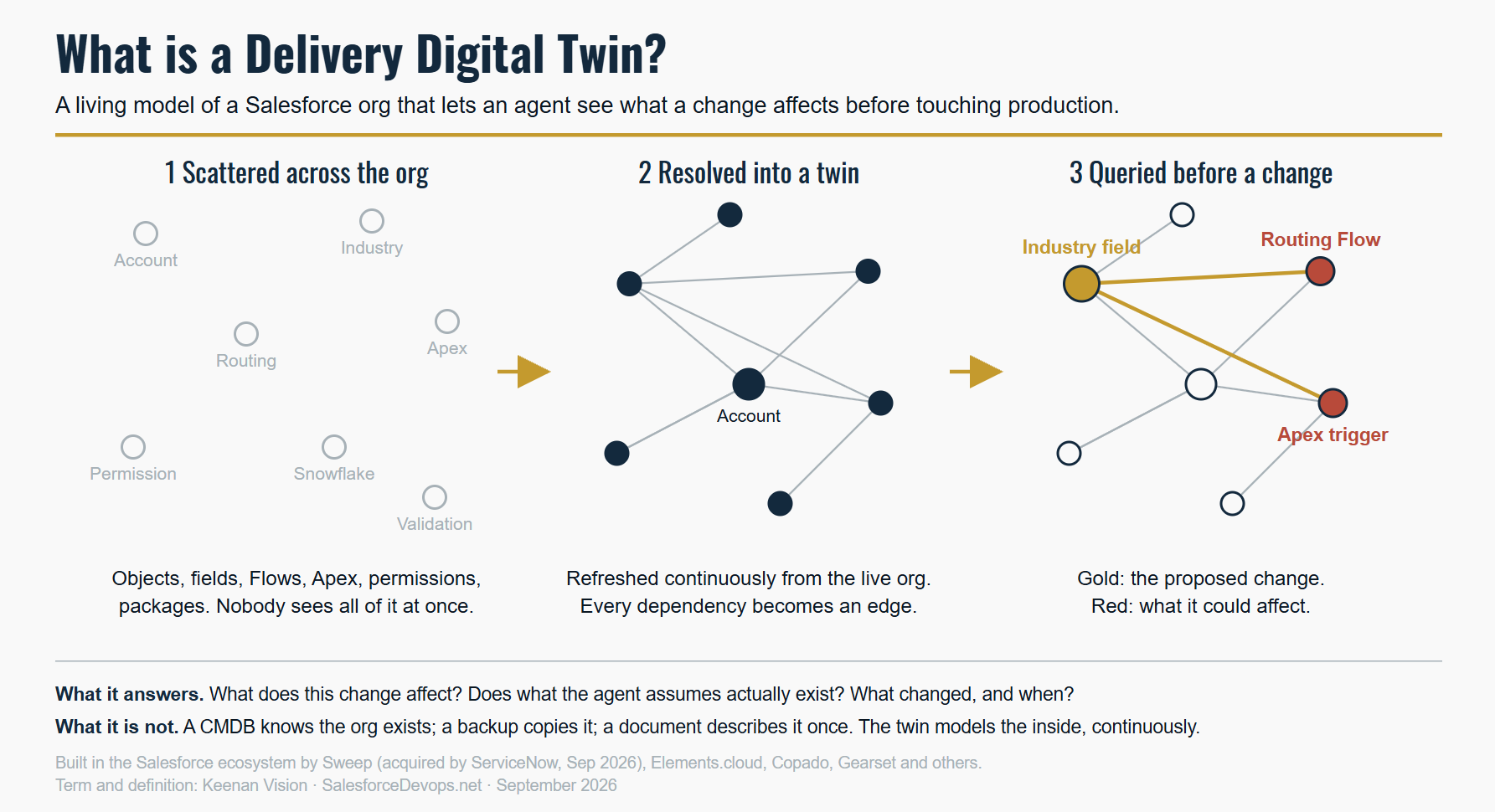
Sweep says it continuously ingests metadata across connected systems and builds what it calls a Unified Metadata Graph: objects, fields, automations, permissions, code and the dependency logic connecting them, exposed to AI agents so they query rather than guess. Readers of this site know my term for that class of artifact. A Delivery Digital Twin is my category, not Sweep’s, and it has four tests: it is refreshed continuously from the live system rather than written once; it resolves dependencies among components rather than listing them; it covers code, configuration and permissions, not only objects and fields; and agents can query it directly. Meet all four and an agent can plan a change against the twin and see the potentially affected components before touching production.
The Salesforce DevOps ecosystem has been building the foundations of Delivery Digital Twins for most of a decade under a dozen product names, and the outside world filed them under “admin tools,” the way a tourist files a nuclear submarine under boats. Elements.cloud’s metadata dictionary and impact analysis, Copado’s deployment history and its live architecture and dependency map, Gearset’s org comparison engine: each holds part of the picture, and I have not verified any of them against all four tests. The sophistication was always there. What changed this week is that a platform vendor paid, by Geektime’s account, about $400 million for a company built around one, and the market can now see what that class of asset might be worth.
Two capabilities Sweep describes on top of its twin matter. Build Mode, documented in February 2026 in Sweep’s own account and its own scenario test, queries the live org, refreshes the twin, verifies dependencies, resolves ambiguities with a human, then performs an atomic deployment with rollback. If it works as described, that is an agent changing production Salesforce orgs against a plan checked on the twin first; I have not tested it independently and a vendor scenario is not a benchmark. And Sweep’s MCP Server exposes the twin to Claude, Cursor or any other Model Context Protocol client, so the intelligence travels to wherever the developer or agent already lives. Anyone who still has Sweep filed under release automation needs to move the card.
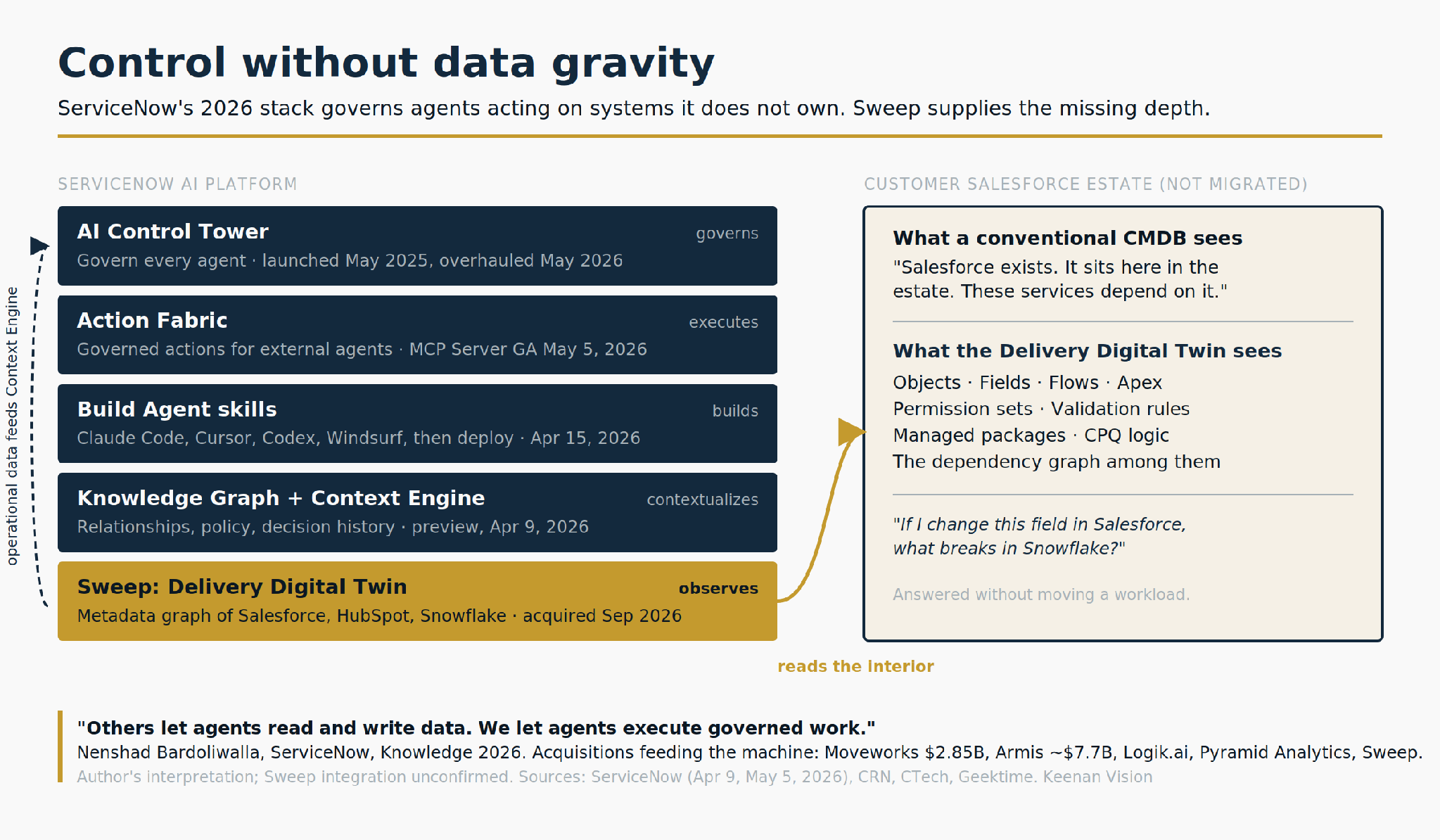
Control without data gravity
My read is this acquisition makes sense as a missing piece of a specific machine. On April 9, 2026, ServiceNow declared its portfolio AI-native and introduced Context Engine, an enterprise context layer carrying the relationships, policy and decision history behind agent decisions, in preview with selected customers at the time; I have not confirmed its current availability. On April 15, Build Agent skills let developers build in Claude Code, Cursor, Codex or Windsurf and deploy to ServiceNow without leaving the harness. On May 5, in Las Vegas, which is the correct city in which to announce that you are in the control business, ServiceNow unveiled Action Fabric, exposing workflows, approvals and business rules to external agents; the underlying MCP Server was generally available, with more features due later in 2026, and Anthropic was named first design partner. ServiceNow’s AI product chief Nenshad Bardoliwalla gave a Knowledge media briefing, reported by CRN, the line every Salesforce strategist should pin to the wall: “Others let agents read and write data. We let agents execute governed work.” Behind it sit AI Control Tower, launched in May 2025 and overhauled this year, and the acquisitions that fed the machine: Moveworks at $2.85 billion, Armis at about $7.75 billion, Logik.ai at $506 million per ServiceNow’s 10-Q, Pyramid Analytics, Traceloop, ai.work, and now Sweep.
Call the strategy control without data gravity: governing the work without first migrating the business records the work runs on. It is a beautiful, predatory idea, and it deserves to be admired before it is resisted. ServiceNow is not trying to move your Salesforce data. It is telling the CIO that applications do not need to live on ServiceNow for ServiceNow to govern the agents operating them. Its own release describes the flywheel: every agent acting through the platform generates operational data that flows back into process mining, analytics and the configuration management database, or CMDB, the ITIL-era inventory of configuration items and their relationships that has been ServiceNow’s backbone since its founding. That data feeds Context Engine, which makes every agent more effective. The records stay where they are; the operational intelligence about them accumulates on ServiceNow.
What the machine lacked was depth inside the largest CRM estates on earth. Bill McDermott described the CMDB on the Q2 2026 call as a trusted system of record for infrastructure, applications, services and dependencies, and a conventional CMDB deployment does exactly that: it knows that Salesforce exists, where it sits in the enterprise estate, and which business services depend on it. What it does not normally model is the interior dependency structure of a Salesforce org. That interior, the objects, fields, Flows, permission sets and the dependencies connecting them, is the Delivery Digital Twin, and Sweep, by its own description, built one. And the statement says CRM: this is a company that launched Sales and Order Management in March 2024, told analysts on its Q1 2025 call it intended to be the leader in CRM, and on the Q2 2026 call reported a $2 billion ACV CRM business and said partners increasingly position ServiceNow as an operational CRM platform. Whether Sweep becomes a migration instrument as well as an X-ray machine is my inference; the stated rationale does not say so. But the X-ray machine was built by people who spent four years inside the patient.
Cognitive DevOps valuation impact
Cognitive DevOps is the term this site uses for AI agents taking over the configuration, release and governance work that Salesforce admins, developers and consultants used to do by hand. Sweep sits squarely in it, so the question is what the reported price says about the category. One illustration of scale, on the back of a napkin: $400 million, if Geektime’s sources have it right, is roughly eight times the $50.5 million in Sweep’s two funding announcements. That is a ratio, not a return and not a revenue multiple. Terms, preferences and structure are unknown, and the price covers a company: ninety people, a customer list that includes LG Electronics and Brex, distribution, and whatever ServiceNow expects in synergy. Public information does not isolate what was paid for the metadata graph, so the deal does not price the twin separately. The rest is fog, and anyone quoting you a multiple this week is selling something.
What can be said is what the price signals. ServiceNow’s stated rationale is agentic deployment for CRM, not release automation, and at anything near $400 million it is evidence that a strategic platform buyer assigns substantial value to metadata-grounded CRM context plus the agents that act on it. That is the first strategic price signal I have seen attached to what I call a Delivery Digital Twin. It is a signal, not a comparable: one reported price with no revenue, margin or terms attached cannot set a multiple for anyone else.
It does put a question to every vendor holding the same class of asset: Copado, with its deployment history and its live architecture map; Elements.cloud, with its metadata dictionary; Gearset, with its comparison engine and an MCP server it lists as in progress. Sweep’s own arc is instructive if the chronology is kept honest. Its positioning changed at the May 2025 financing, from release automation to an agentic workspace with the metadata graph at the center; the product additions that made the story credible, Build Mode and MCP access, were documented in 2026. Whether the market prices another vendor’s twin as a twin will depend on whether the vendor makes that case before an acquirer makes it for them. My judgment, and only that, is that those conversations happen inside the next twelve to eighteen months.
Bottom Line
Strip it down to what can be stood behind. A company that grew up on the AppExchange and was still shipping Salesforce first in February has gone, with ServiceNow’s confirmation, to the vendor most openly pursuing Salesforce’s CRM franchise, for a reported $400 million, and ServiceNow’s own statement says the reason is agentic deployment for CRM. Read against the platform ServiceNow assembled this spring, the Delivery Digital Twin is the piece that lets a control layer govern agents operating on Salesforce without first migrating Salesforce. That is control without data gravity, and it is the first strategic price signal I have seen for a class of asset the Salesforce ecosystem built over a decade and undersold the entire time.
So do not mourn the twin going to ServiceNow. More twins will be built, and this week put a public number on a company built around one. Build the layer above it. Capture the intent while the people who hold it are still in the building and make every agent that touches a Salesforce org answer to a record of what the org is for. Governance, context and approved intent are not rival businesses; they are three layers that must work together. ServiceNow supplies the first two and just bought deeper Salesforce context for the second. The third is still open. Dreamforce opens September 15, which is the natural stage for Salesforce to say which of the three it intends to own. The ecosystem that built the twins can build this too. It is the same people, one altitude higher, and this time they should know what it is worth before somebody from out of town tells them.
The Salesforce ecosystem spent a decade building X-ray machines and calling them admin tools. Somebody from out of town finally noticed. That is how it always starts.
Disclosure: Keenan Vision LLC provides strategic advisory services to Salesforce, Copado, and other Salesforce ecosystem companies.