Taking Back the Transformation: Why Forward Deployed Entrepreneurs Will Kill the Consulting Industrial Complex
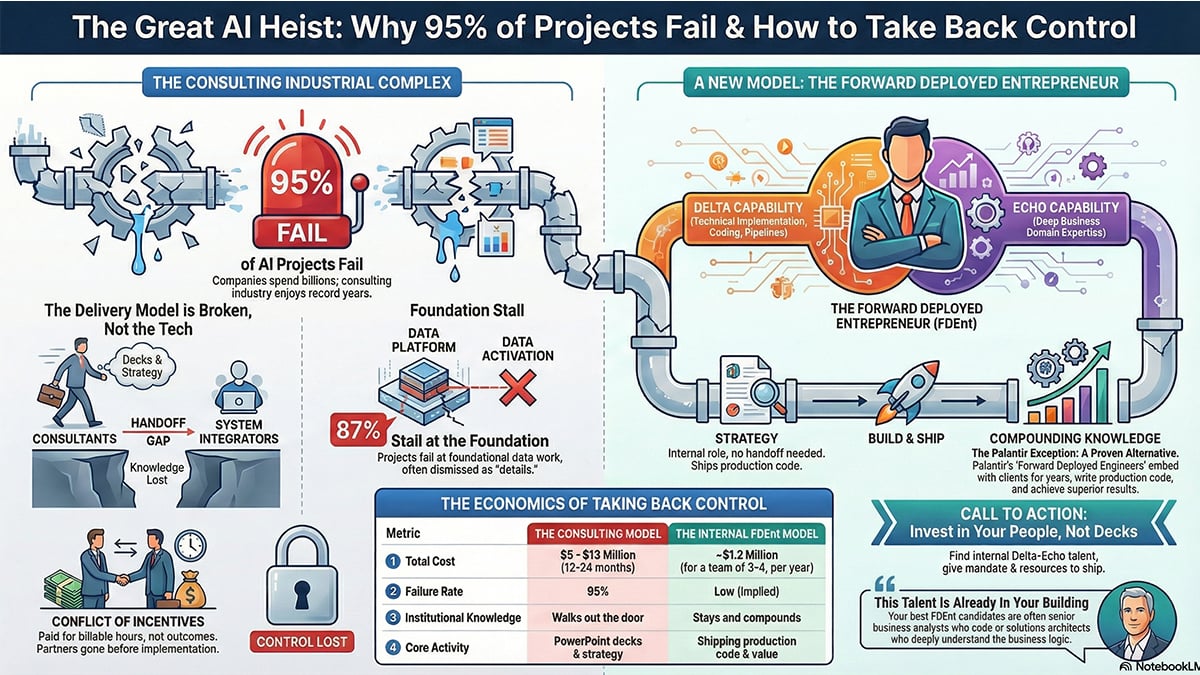
Here’s an uncomfortable truth that every CIO knows but few will say out loud: the consulting industry is having record years while 95% of AI projects fail to provide measurable revenue impacts.
Let that sink in. Companies are spending billions on transformation initiatives. Consulting firms are cashing checks. And almost nothing actually works.
This isn’t a technology problem. The AI models are fine. The cloud infrastructure is fine. What’s broken is the delivery model itself—and 2026 might be the year companies finally do something about it.
The Consulting Industrial Complex
The traditional consulting engagement follows a predictable script. A Big Four firm sends in partners for the pitch, associates for the analysis, and offshore teams for the PowerPoint production. They deliver a strategy deck. They hand it off to a systems integrator. The SI brings in contractors who’ve never seen your business before. Eighteen months later, you’ve spent $10 million and have a pilot that “needs more refinement.”
Sound familiar?
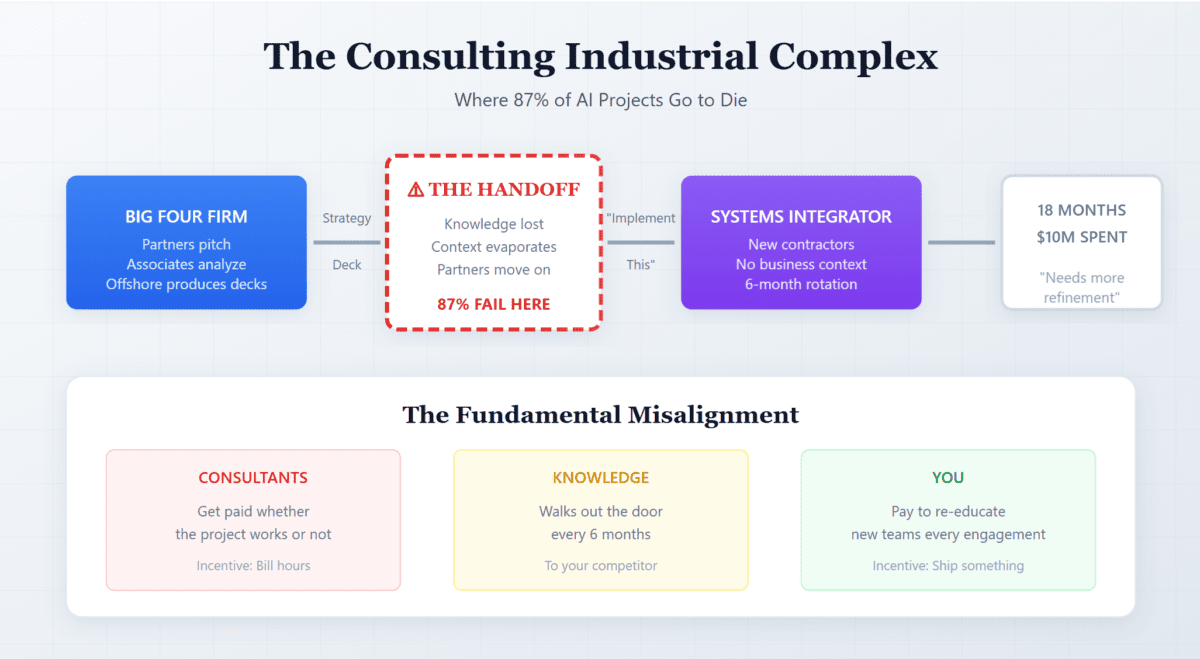
The fundamental problem is incentive alignment. Consulting firms get paid whether the project works or not. The partners who sold the engagement are onto the next sale before implementation begins. The people doing the actual work cycle off after six months, taking whatever institutional knowledge they’ve gained to the next client—or to your competitor.
Our research with UC Berkeley Haas documented this pattern across 48 interviews with enterprise AI leaders. The failure point isn’t where most people think it is. It’s not the AI models. It’s not the strategy. It’s the handoff that’s the problem. It’s the moment when consultants deliver their recommendations and someone else has to make them real.
Eighty-seven percent of Agentforce deployments stall at data activation. Not at the AI layer. At the foundational work of connecting systems, cleaning data, and encoding business logic that consultants deemed “implementation details.”
Those details are where projects go to die.
The Palantir Exception
While most enterprise technology companies struggle to escape the consulting gravity well, Palantir built something different. Their Forward Deployed Engineers don’t just advise—they embed. They write production code on customer infrastructure. They stay for months, sometimes years. They understand both the technology stack and the business problem deeply enough to actually solve it.
The market noticed. Palantir commands 70% gross margins while traditional consulting firms scrape by at 30-40%. They trade at 20x revenue while the big consultancies languish at 1-2x. Investors aren’t paying for billable hours. They’re paying for outcomes.
The talent market noticed too. Job postings for Forward Deployed Engineers grew 800% between January and September 2025. OpenAI, Anthropic, Ramp, and dozens of AI-native companies adopted the model. The best technical talent wants to build things that ship, not write decks that sit in SharePoint.
But here’s the catch: at $1-1.7 million per year for an embedded FDE, only the largest enterprises can afford to rent this capability from vendors. Everyone else is stuck with the consulting model that doesn’t work.
Unless they build it themselves.
The Forward Deployed Entrepreneur
The Forward Deployed Entrepreneur is the internal version of what Palantir proved externally. It’s not a new job title—it’s a recognition that the skills required to transform a business are different from the skills that consultants sell.
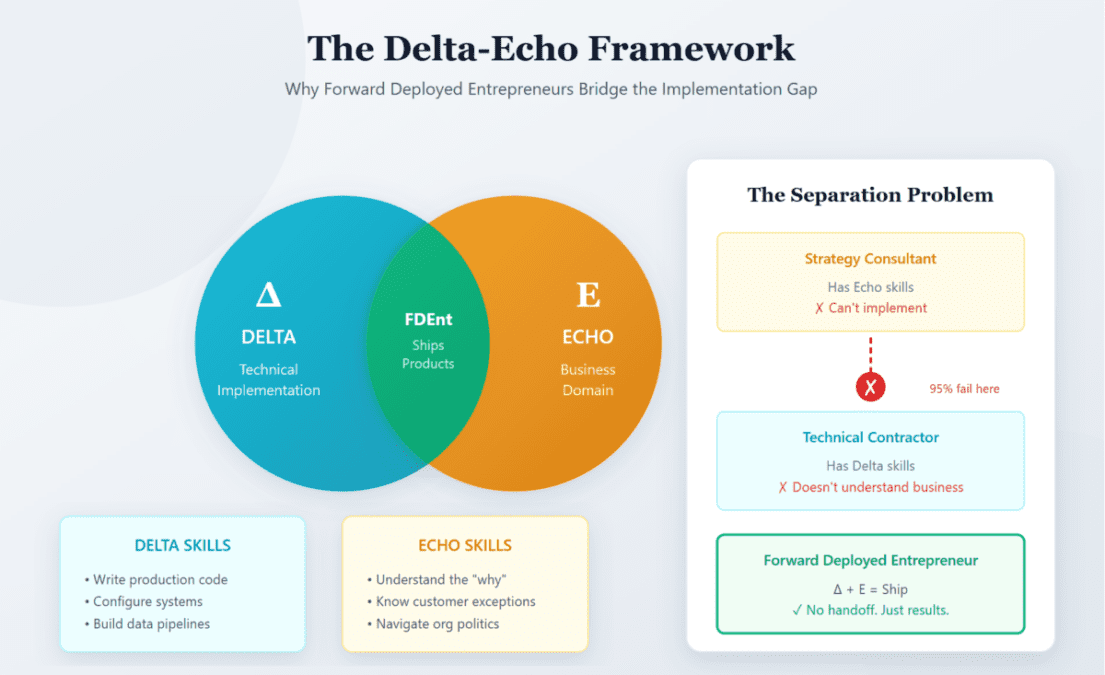
An FDEnt combines what I call “Delta” capability (technical implementation—writing code, configuring systems, building pipelines) with “Echo” capability (business domain expertise—understanding why the revenue recognition rules exist, knowing which customer exceptions matter, grasping the politics of the org chart).
Traditional consulting separates these. The strategy consultant has Echo skills but can’t implement. The technical contractor has Delta skills but doesn’t understand the business. The handoff between them is where 95% of projects fail.
The FDEnt is one person—or a small team—that carries both. They don’t hand off. They ship.
More importantly, they stay. The institutional knowledge compounds instead of walking out the door. The second project goes faster than the first. The third faster still. You’re not paying to re-educate a new consulting team every engagement.
The Economics of Taking It Back
Let’s do the math that consulting firms don’t want you to do.
A fully-loaded internal FDEnt—senior technical talent with business acumen, including salary, benefits, and overhead—costs $250,000 to $400,000 per year.
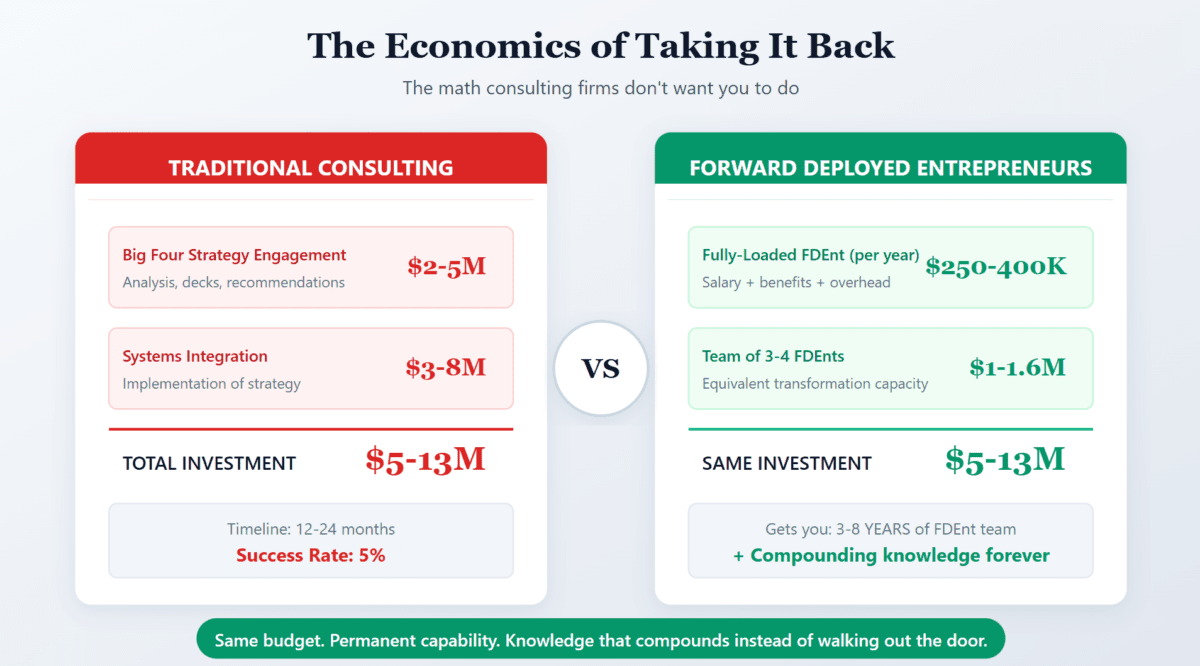
A mid-sized AI transformation engagement from a Big Four firm runs $2-5 million. A systems integration project to implement their recommendations adds another $3-8 million. Total: $5-13 million, spread across 12-24 months, with a 95% chance of failure.
For that same investment, you could build a team of three to four FDEnts who stay forever, accumulate institutional knowledge, and ship projects continuously.
The consultants will tell you that you can’t find this talent internally. That you need their expertise. That building capability takes too long.
They’re protecting their business model, not solving your problem.
The truth is that many of these people already work for you. They’re the senior business analysts who taught themselves Python. The solutions architects who actually understand why the data model looks the way it does. The operations managers who’ve been quietly automating their own workflows for years.
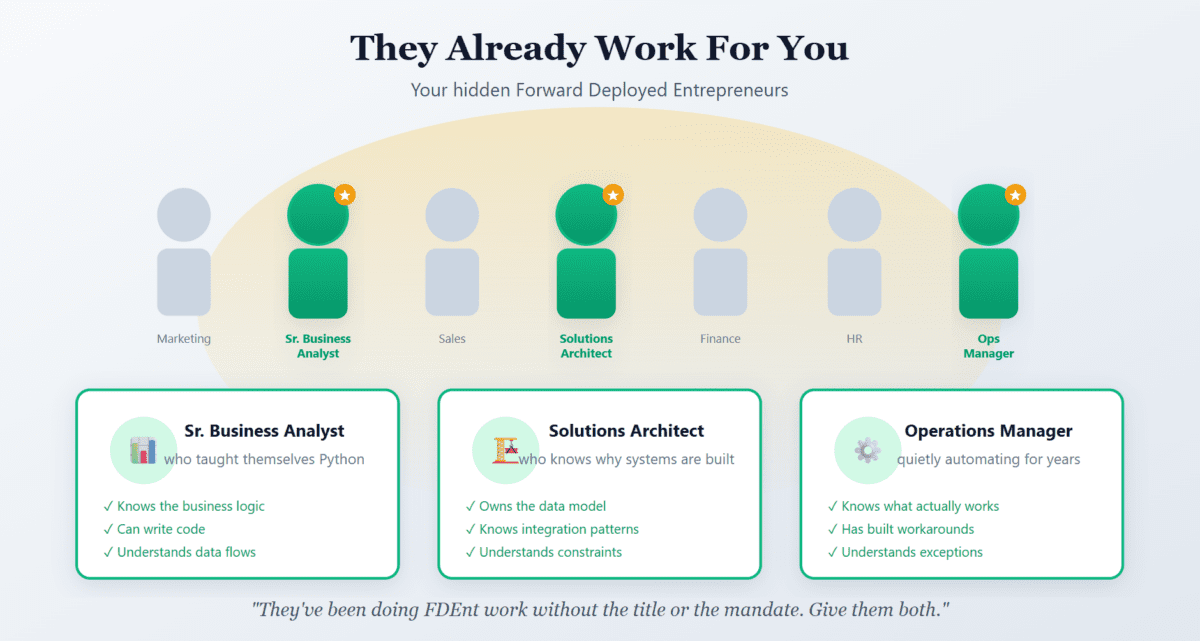
They’ve been doing Forward Deployed Entrepreneur work without the title or the mandate. Give them both, and watch what happens.
Why This Moment Matters
Something shifted in 2025. The gap between AI capability and AI implementation became impossible to ignore. Models that can write code, analyze data, and generate insights are now commodity infrastructure. The bottleneck moved downstream—to the people who can translate capability into business value.
This is exactly the work that consultants are worst at and FDEnts are best at. Consultants excel at pattern-matching from other clients. They’re terrible at the specific, contextual, deeply-embedded work of making AI actually function inside your particular mess of legacy systems, tribal knowledge, and organizational politics.
FDEnts live in that mess. They understand that “revenue” means something different in Sales than in Finance. They know which customer exceptions override standard policies. They’ve sat in the meetings where the real decisions get made.
This isn’t knowledge you can transfer in a consultant’s discovery phase. It’s knowledge that accumulates over years of embedding. And it’s the knowledge that separates the 5% of AI projects that work from the 95% that don’t.
The Uncomfortable Implication
If I’m right, the next few years will be brutal for the consulting industrial complex. Not because companies will stop needing help—they’ll need more than ever. But because the help that matters can’t be bought by the hour from people who leave.
The companies that win won’t be the ones with the biggest AI budgets. They’ll be the ones who stopped outsourcing their thinking.
This means investing in people differently. It means creating career paths for technical talent that don’t force them into management. It means valuing institutional knowledge as a strategic asset instead of treating employees as interchangeable with contractors.
Most of all, it means recognizing that transformation isn’t something you buy from outside. It’s capability you build inside—and the firms that figure this out first will leave their competitors writing checks to consultants and wondering why nothing ever ships.
The Call to Action
If you’re a CIO still budgeting seven figures for consulting engagements that have a 95% failure rate, ask yourself: what would happen if you invested that money in Forward Deployed Entrepreneurs instead?
Find the people in your organization who already bridge the Delta-Echo gap. Give them resources, authority, and air cover. Let them ship something small. Then something bigger.
The consulting firms won’t tell you this is possible. They have $50 billion reasons not to.
But the math doesn’t lie. And neither do the results.
Vernon Keenan is CEO of Keenan Vision LLC and runs SalesforceDevops.net. His research on enterprise AI adoption, conducted in partnership with UC Berkeley Haas School of Business, documented why 95% of GenAI pilots fail—and what the 5% do differently.