Why Business Alignment Is the Guardian Agent Category That Matters Most
Gartner’s inaugural Market Guide for Guardian Agents validates a new category — and Wayfound’s recognition points to the competitive moat most vendors are missing.
Gartner published its first-ever Market Guide for Guardian Agents on February 25, 2026, formally recognizing that AI agent oversight has graduated from a platform feature to a standalone enterprise category. The report catalogues vendors across six segments — from risk and security specialists to AI content governance. Moreover, it lays out the mandatory capabilities organizations should demand: visibility, continuous assurance, and runtime enforcement.
For anyone tracking the Salesforce ecosystem and the broader agentic AI landscape, this is a milestone worth paying attention to. But the most interesting signal in the report is not the categories that dominate the vendor table. It’s the one that barely occupies it.
Table of contents
The Category That Points Forward
Among the six vendor segments Gartner identifies, one stands apart: Business Alignment and Outcome Optimizers. Where most guardian agent categories focus on security posture, identity management, or compliance monitoring, this segment targets a fundamentally different problem. Specifically, it ensures AI agents truly accomplish what the business designed them to do.
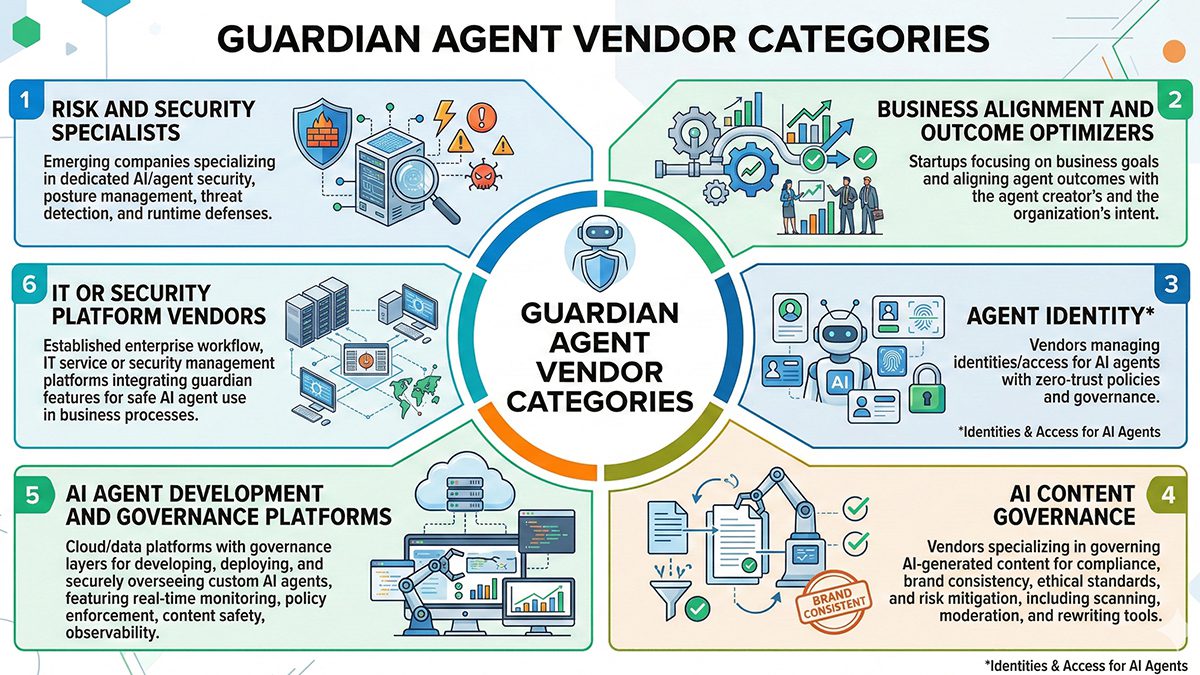
Wayfound, the AI agent supervision platform led by CEO Tatyana Mamut, was named as a representative vendor in this category. That recognition is well-earned. Since 2023, Mamut and her team have been building a thesis that the rest of the market is only now catching up with. The most dangerous AI agent failures are not security breaches. Instead, they are agents that confidently execute the wrong business outcome at scale, for weeks, before anyone notices.
Wayfound deals with real risk. Enterprises deploying Salesforce Agentforce, Microsoft Agent 365, and custom-built agents are already encountering it. The agent doesn’t get hacked. It doesn’t leak data. It just optimizes for the wrong metric, interprets an ambiguous instruction in a way no human would, or drifts from intended behavior so gradually that the deviation becomes invisible to engineering teams. Only the subject-matter experts, the people who designed the business process, can tell that the output is, as Mamut puts it in a recent blog post, AI slop.
What Gartner Gets Right
The Market Guide establishes several important points that CIOs should internalize.
- First, guardian agents are not optional bolt-ons — they are becoming essential infrastructure as enterprises move from single-agent pilots to multi-agent deployments spanning multiple clouds and platforms.
- Second, no single hyperscaler or platform vendor can provide complete coverage. Organizations need independent oversight that operates across their entire agent portfolio.
- Third, Gartner projects spending on guardian agents is projected to grow from less than 1% of agentic AI budgets today to 5–7% by 2028. This reflects the escalating governance demands of autonomous systems.
These are sound observations, and Gartner’s emphasis on cross-platform independence is particularly well-placed. The report correctly argues that embedded platform controls stop at their own cloud borders. Only a neutral, independent guardian layer can enforce policy across providers.
The Exponential Learning Blind Spot
Where the analysis falls short is in treating guardian agents as a static governance layer rather than a learning system. This is where the Third Law of VE Economics — Exponential Learning — reframes the competitive dynamics of the guardian agent market in ways the Gartner report does not address.
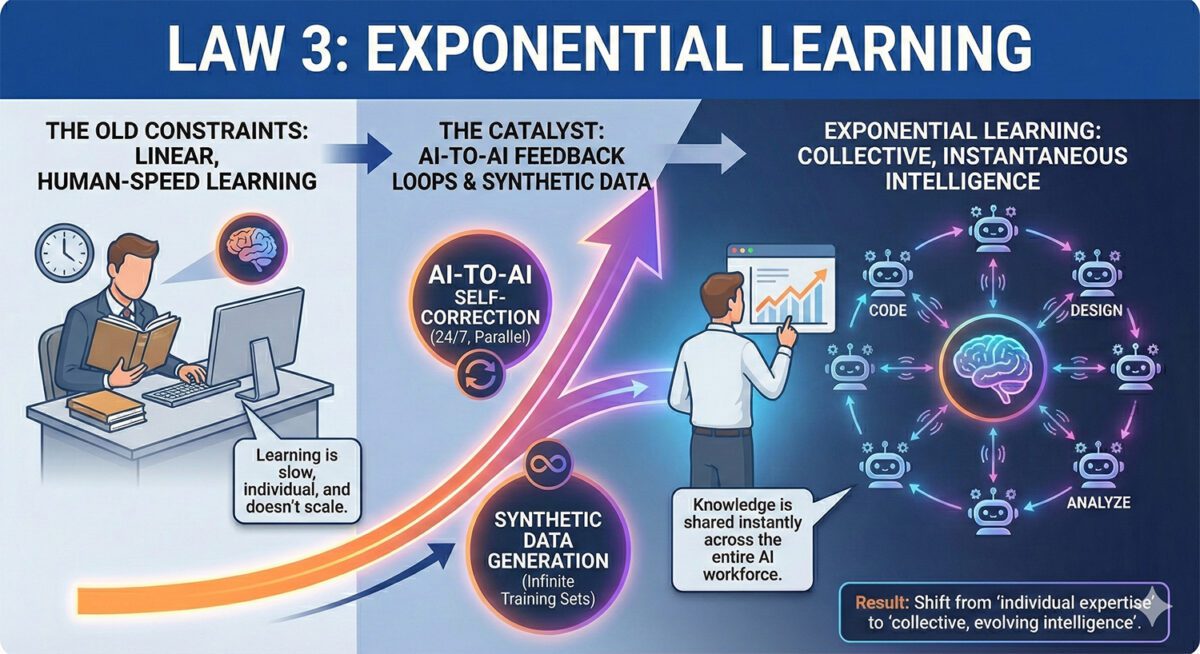
The Third Law, part of the Virtual Employee Economics framework developed through Keenan Vision’s research partnership with UC Berkeley Haas, holds that AI systems improve through compound functions. Each deployment learns locally, shares insights across instances, and incorporates feedback at accelerating rates. Unlike human workers who learn linearly through individual experience, networked AI creates capability growth that compounds with every interaction.
Applied to guardian agents, this principle has a specific and consequential implication. The guardian agent platform that observes the most agent interactions, across the most platforms, will accumulate behavioral intelligence at rates that narrower or platform-locked alternatives cannot match. For example, a guardian agent monitoring traffic across Salesforce Agentforce, Microsoft Agent 365, Google Vertex, and AWS Bedrock simultaneously is building a cross-platform behavioral corpus. This corpus compounds in value with every transaction it supervises.
This is why Gartner’s Business Alignment category matters disproportionately. Security-focused guardian agents can identify known threat patterns, but alignment-focused agents must learn what “correct” looks like for each enterprise, each business process, each use case — and then detect drift from that intention over time. This even presents the opportunity to capture the tacit knowledge human workers use to complete tasks. That requires a learning system, not just a rule engine. The more business contexts an alignment-focused GA encounters, the faster it learns to recognize the subtle patterns of agent drift that no static policy can capture.
The Strategic Implication for CIOs
Gartner’s report recommends evaluating vendors against four criteria: agent discovery, identity and access management, information governance, and policy enforcement. These are necessary but insufficient. CIOs should add a fifth criterion: learning velocity.
Ask every guardian agent vendor: How many agent interactions does your platform observe daily? Across how many distinct platforms and cloud environments? How fast do behavioral insights from one customer environment propagate to all others? The answers to these questions will determine which guardian agent platforms build compounding intelligence advantages. Others, meanwhile, will remain static policy engines that increasingly fall behind the agents they are supposed to supervise.
Wayfound’s positioning in the Business Alignment segment, with its focus on agent intent verification and outcome optimization, places it squarely in the category where Exponential Learning dynamics matter most. The agents that cause the biggest enterprise damage will not be the ones that get hacked — they will be the ones that quietly do the wrong thing at scale. Detecting and correcting that failure mode is a learning problem. Learning problems reward the platforms that compound knowledge fastest.
The Bottom Line
Gartner’s inaugural Guardian Agent Market Guide is a valuable contribution that legitimizes an essential category. The six vendor segments it identifies provide a useful map for organizations navigating a fragmented landscape. But the map is missing a dimension. Static governance capabilities — discovery, monitoring, blocking — will be table stakes within 18 months. The durable competitive advantage in this market belongs to guardian agent platforms that learn exponentially from the agent behaviors they observe, and that translate that compounding intelligence into increasingly precise business alignment.
That’s what the Third Law of VE Economics predicts, and it’s what enterprises should be evaluating now — before the learning velocity gap becomes insurmountable.
GARTNER is a trademark of Gartner, Inc. Gartner does not endorse any vendor, product, or service depicted in its research publications.