Agentforce’s Vertical Bet: Why Regulated Industries Signal the “Embedded Forever” Endgame
Salesforce recently dropped two Agentforce vertical industry announcements: six new Health agents unveiled at HIMSS 2026, and a Communications suite launched ahead of Mobile World Congress. Read in isolation, they look like product marketing: more agents, more verticals, more press releases. Read through the lens of architectural strategy, they tell a far more consequential story about where durable value in enterprise AI gets built — and why Salesforce’s long game may be stronger than its critics appreciate.
Table of contents
- Two Verticals, One Architecture Thesis
- What the Agent Context Engine Actually Is
- “Overlay Now, Embedded Forever” — and Why Regulated Industries Prove the Point
- The Architectural Evidence in These Announcements
- Counterpoint: Why “Embedded Forever” Is Not “Embedded Today”
- What This Means for CIOs in Regulated Industries
Two Verticals, One Architecture Thesis
The Healthcare announcement introduces six agents spanning referral triage, EHR data exchange, claims resolution, rural telehealth, epidemiology analysis, and hospital operations. Three new data partnerships — HealthEx, Verily, and Viz.ai — provide the connective tissue. Early adopter MIMIT Health reports 459% ROI and $1.5 million in savings.
The Communications announcement rolls out agents for telecom sales, customer service, quoting, and field operations. Lumen is reclaiming over 300 hours of weekly productivity across 3,000 sellers with $5.6 million in first-year savings. One NZ reports a 4x engagement increase. Personal (Telecom Argentina) targets a 20–30% reduction in support calls.
Strip away the industry-specific language and the architectural pattern is identical. Both suites deploy autonomous agents into heavily regulated, paper-intensive industries where fragmented data systems — EHRs, billing platforms, field operations tools — are the core operational bottleneck. They both go beyond the contact center into field operations and frontline clinical or technical work. Both lead with concrete, production-grade ROI from named customers rather than vaporware projections.
But the real story isn’t the agents. It’s the context layer underneath them.
What the Agent Context Engine Actually Is
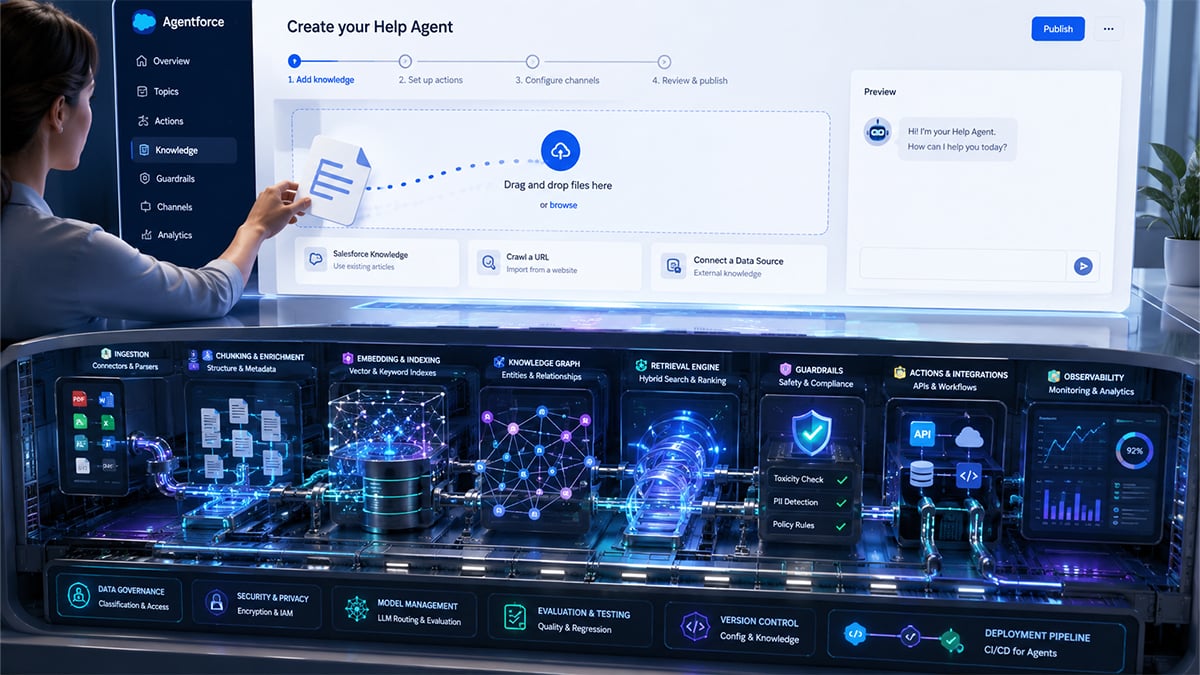
To understand why these vertical launches matter strategically, you need the concept our Keenan Vision research calls the Agent Context Engine — the architectural layer between raw enterprise data and autonomous agent action that ninety-five percent of AI pilots never build.
The Agent Context Engine is not a product. It is an architectural pattern composed of five capabilities that must work together in real time.
Harmonized Context
Harmonized Context reconciles semantic meaning across systems. “Revenue” in your CRM means something different than “revenue” in your ERP. A “patient” in a scheduling system maps to a “member” in an insurance platform. Before an agent can act, these definitions must resolve to a single coherent representation. In healthcare, this means reconciling records across EHR systems, wearable data from Verily, patient-controlled digital wallets from HealthEx, and medical imaging from Viz.ai into a unified clinical picture. In telecom, it means aligning subscriber data across billing, provisioning, field service, and CRM systems that were never designed to talk to each other.
Resolved Identity
Resolved Identity determines that records scattered across multiple systems all refer to the same entity — the same patient, the same subscriber, the same field technician. You harmonize meaning first, then resolve identity against it. The sequence matters because you cannot reliably match records until the data describing them has been semantically aligned.
Platform Enforcement
Platform Enforcement is the governance gate. After context is harmonized and identity is resolved, the platform’s native permission model determines what this agent, acting for this user, is authorized to access and do. This is where embedded architecture creates structural advantage: the same engine governing human access governs agent access. There is no parallel permission system to maintain, no separate audit trail to reconcile.
Semantic Model
The Semantic Model provides the business ontology — the formal representation of how entities relate and what rules govern them. For a healthcare organization, it encodes that a medication order requires an authorized prescriber, that a referral must route to an in-network specialist, that a patient with three emergency visits in thirty days triggers a care coordination workflow. For a telecom operator, it encodes discounting rules, territory assignments, service-level commitments, and escalation protocols.
Observability
Observability closes the feedback loop: tracking agent quality, generating audit trails, and producing the signals that improve the engine over time. When a regulator asks, “why did the agent make this decision?”, observability provides the lineage — what data was accessed, what context was assembled, what permissions were applied, what reasoning path was followed.
The output of the Agent Context Engine is what we call a Context-Grounded Instruction — not a prompt, but a structured package containing harmonized context, resolved identity, applied permissions, semantic framing, and observability hooks. Everything an agent needs to act as a governed participant in an enterprise.
Warehouses remember. Engines think. The enterprises that build the engine win.
“Overlay Now, Embedded Forever” — and Why Regulated Industries Prove the Point
Our research documented a pattern we call “Overlay Now, Embedded Forever.” It describes how enterprise AI adoption actually unfolds:
Overlay AI — systems that sit above existing applications and integrate through APIs — wins early because it compresses the activation energy required to demonstrate value. You can plug an overlay into your CRM, your ticketing system, your data warehouse, and show results in weeks. The context it needs is borrowed through connectors, not built from scratch.
Embedded AI — capabilities built inside a platform’s native security model, data model, and workflow engine — wins later because governance, identity resolution, and auditability are architecturally native. The context is institutionalized, not borrowed.
The practical staging is: overlay for speed, hybrid for years, embedded where it counts. But “where it counts” has a specific definition: workflow-authoritative use cases — anything that touches money, compliance, regulated decisions, or irreversible actions. In those domains, the question is not whether the pilot works; it is whether the system can be governed.
Healthcare and telecom are textbook workflow-authoritative environments. HIPAA audit trail requirements. EHR data sovereignty rules. Telecom billing compliance. Medical imaging chain-of-custody. These are domains where regulators do not care whether your demo was impressive. They care whether your agent operated within a governed permission model, accessed only authorized data, produced an auditable decision trail, and complied with industry-specific rules at every step.
This is precisely why these two Agentforce launches are a long-term success signal rather than just product news.
The Architectural Evidence in These Announcements
Look at what Salesforce has built underneath the marketing language.
The EHR Writeback Agent does not just read electronic health records. Instead it facilitates bi-directional data exchange, allowing contact center representatives to retrieve patient data, update demographics, and submit medication refills. This goes beyond an overlay chatbot summarizing records through an API because it is a governed agent operating inside the workflow-authoritative layer of clinical operations, writing data back into systems of record with full audit trails.
The Viz.ai integration detects suspected diseases directly from medical imaging and EHRs, then automatically triggers workflows in Agentforce Health so specialists can coordinate care. Medical imaging chain-of-custody is among the most heavily regulated data flows in healthcare. An overlay bolted on through APIs cannot credibly provide the governance posture that clinical imaging workflows demand.
The Rural Health Agent includes an offline mobile app for remote patient records. Instead of a chatbot, this is an embedded system operating in environments where connectivity is constrained. Plus, the agent must maintain data integrity without a real-time connection to the platform — a design constraint that demands deep integration with the platform’s data model, not surface-level API orchestration.
The Quoting Agent in the Communications suite automatically applies discounts within the organization’s permitted discounting rules. The phrase “within the organization’s permitted discounting rules” is the tell. That is Platform Enforcement, using the governance gate in the Agent Context Engine, to operate at inference time. The agent does not just generate a quote; it generates a governed quote whose discount authority flows from the same permission model that governs human sales representatives.
Lumen’s deployment across 3,000 sellers is not a pilot. It is a production-scale embedded system generating measurable business outcomes ($5.6 million in first-year savings) inside an enterprise workflow engine.
In every case, the architecture goes deeper than summarization, triage, or routing, which are the workflow-adjacent use cases where overlays excel. Embedded agents are performing workflow-authoritative actions: writing to clinical records, triggering specialist coordination from imaging data, applying governed pricing rules, managing hospital operations in real time. These are the use cases where our research says embedded architecture becomes essential — and where the “Embedded Forever” part of the thesis is playing out.
The Data Partnership Strategy: Building the Context Layer
The three healthcare partnerships deserve separate attention because they reveal how Salesforce is constructing the Agent Context Engine for regulated verticals.
HealthEx and Verily provide what amounts to a master unified health record by combining patient-controlled digital health wallets with enriched clinical and social intelligence from wearables. This is the Harmonized Context and Resolved Identity layers of the Agent Context Engine made tangible — disparate health data sources reconciled into a coherent, identity-resolved patient picture that agents can reason over at inference time.
Viz.ai provides the real-time clinical signal layer. This detects suspected conditions from medical imaging and triggers governed workflows automatically. This is the Semantic Model at work: the ontology that encodes clinical relationships between imaging findings, specialist referral protocols, and time-critical care coordination pathways.
They are architectural commitments that deepen Salesforce’s embedding in the healthcare data infrastructure. Each partnership adds another layer of context that no overlay competitor can easily replicate — because replicating it would require building the same governed, bi-directional data exchange infrastructure that Salesforce is wiring into its platform natively.
This is how embedded platforms build durable moats. Not through feature competition, but through context accumulation. The deeper the data partnerships, the richer the Agent Context Engine, the harder it becomes for any overlay to contest that layer without effectively becoming an embedded system itself.
Counterpoint: Why “Embedded Forever” Is Not “Embedded Today”
The architectural logic favoring embedded AI in regulated industries is sound. But Salesforce’s embedded advantage remains partially aspirational, and sophisticated overlay competitors are not standing still.
One of Salesforce’s challenges is keeping the platform fully integrated and up to customer usability expectations. Partners consistently report the data platform is nearly there, but it has some critical weaknesses. Salesforce has responded with different releases filling different capability gaps. But many Agentforce deployments stall at point of full data integration — the precise layer these vertical agents need to operate.
There is a cognitive cliff that regular Trailblazers need to overcome to navigate data activation. The data platform requires specialized skills in semantic modeling and data architecture that typical Salesforce practitioners do not possess. Early adopters like MIMIT Health and Lumen have cleared these thresholds, but they had significant implementation investment and direct Salesforce engineering engagement. The path for a mid-market health system or regional telecom carrier is considerably less paved.
Meanwhile, the most sophisticated overlay competitors understand that workflow-authoritative use cases demand audit trails, permission enforcement, and identity resolution — and they are actively engineering solutions. They are not trying to match every embedded capability. They are trying to be good enough on governance while remaining dramatically faster to deploy.
For a hospital CIO under operational pressure, “production in three weeks with 80% of the governance” may beat “production in twelve months with 100% of the governance.” That calculus is uncomfortable for the embedded thesis, but it reflects how procurement decisions sometimes get made.
The core competitive tension is product development pace. Salesforce ships three major releases per year across a multi-cloud platform architecture. An overlay startup focused on healthcare workflows or telecom billing can ship weekly, iterate on a single vertical’s data model, and accumulate domain expertise at a speed no horizontal platform can match. Every vertical agent suite Salesforce launches adds surface area that must be documented, enabled, and supported across the entire partner ecosystem — compounding the enablement debt our research documented.
The embedded advantage is real and durable — if Salesforce can close the activation energy gap, finish the data foundation, solve the Cognitive Cliff for mid-market practitioners, and maintain velocity against competitors who are smaller, faster, and increasingly governance-aware. The vertical launches at HIMSS and MWC are strategically correct. The question is whether Salesforce can execute at the pace regulated industries truly need.
What This Means for CIOs in Regulated Industries
If you are running AI strategy in healthcare, telecom, financial services, or any other regulated vertical, these announcements carry a clear signal for your architecture decisions:
Overlay experiments remain valuable for workflow-adjacent use cases. Summarization, triage, drafting, routing — these are legitimate quick wins that prove value and build organizational muscle. Do not stop doing them.
But when agents start writing to systems of record, applying governed business rules, and triggering clinical or financial workflows, only embedded architectures can deliver the audit trails, identity resolution, and permission enforcement that regulators require. The EHR Writeback Agent is the archetype: an agent that reads and writes clinical data within a governed permission model, producing the full audit lineage that HIPAA demands. No overlay achieves that without becoming, effectively, an embedded system.
The Agent Context Engine is not optional. Whether you build it yourself or adopt a vendor’s pre-packaged version, your agents need harmonized context, resolved identity, platform-native permission enforcement, a semantic model encoding your business logic, and observability generating audit trails and quality signals. Without that engine, your agents are smart but blind — powerful reasoning capabilities aimed using incoherent inputs.
Evaluate vertical Agentforce suites as architecture commitments, not feature lists. The question is not “does this agent do what I need today?” The question is: “does this architecture accumulate context, deepen governance, and build switching costs that make my AI investment more durable over time?” For regulated industries, the answer increasingly favors embedded.
The organizations that win will treat architecture as strategy — choosing speed where speed is rational, choosing durability where durability is mandatory, and building the Agent Context Engine that makes both possible.
Vernon Keenan is CEO of Keenan Vision LLC and publishes SalesforceDevops.net. The Architecture as Strategy research referenced in this article was conducted in partnership with UC Berkeley Haas School of Business.