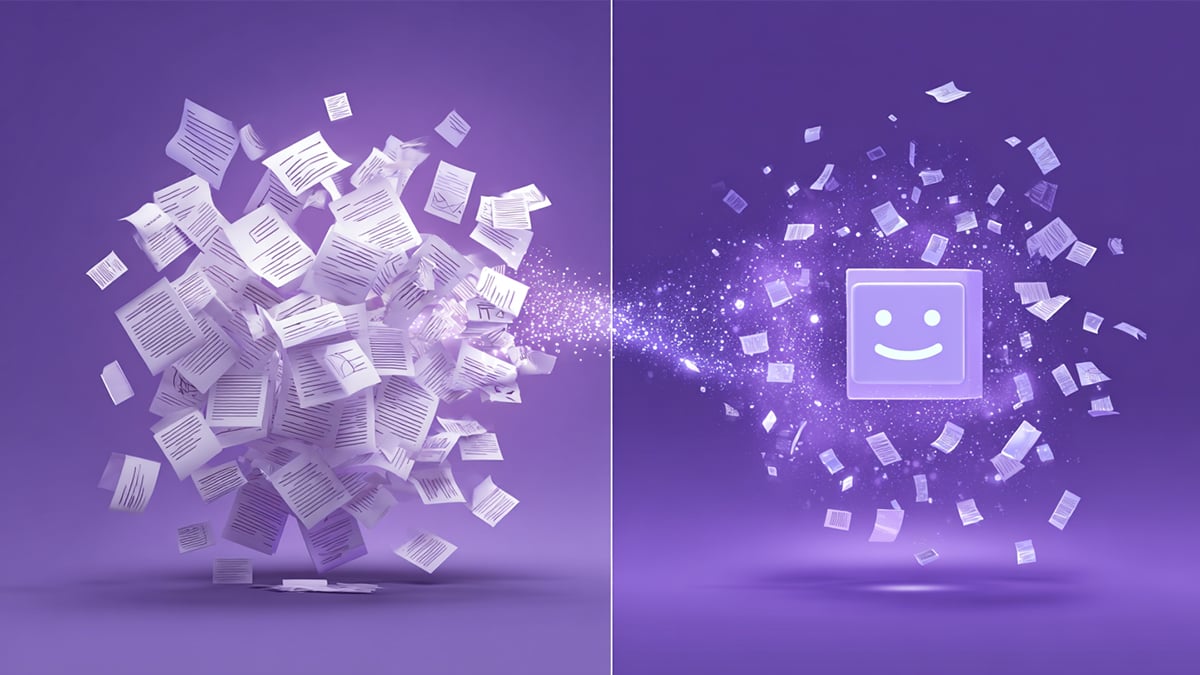
Slackbot Gets a Glow-Up: Salesforce Transforms a Familiar Face into Your Personal Agent for Work
The little square face with a smile has been a fixture in Slack workspaces since the beginning, handling mundane tasks like setting reminders and answering basic questions. Today, that familiar icon represents something fundamentally different. Salesforce has reimagined Slackbot as a deeply personal AI agent that understands not just your messages, but your entire organizational context.
“Slackbot is your personal assistant or agent for work,” said Rob Seaman, interim CEO of Slack, during a press briefing. “We believe it’s a marquee example of how we’re bringing agents into the flow of work and giving them access to the right information to help drive value for you as a user, and for your entire company.”
The distinction matters. While most AI assistants start from zero context, forcing users to explain themselves repeatedly, Slackbot arrives pre-loaded with institutional memory. It can access your direct messages, public channels, private conversations you participate in, and connected systems like Salesforce CRM and Google Drive—all while respecting existing permission boundaries.
Salesforce has been dogfooding this technology internally with striking results. The company reports 25,000 weekly active users among its 80,000 employees, with 80% retention rates and 96% satisfaction scores, the highest of any AI feature Slack has shipped. Perhaps more telling: this adoption happened with no internal marketing or enablement campaigns. The product simply went viral.
Table of contents
The Demo: From Spirit Animals to Sprint Plans
During the press briefing, Amy Bauer, Director of Product Management for Slack, demonstrated capabilities that moved well beyond simple question-and-answer interactions.
Her opening prompt was deliberately playful: “What animal would I be based on my activity in Slack?” The response—identifying her as a dolphin based on her strategic coordination, analytical deep-dives into data, and communication patterns—illustrated Slackbot’s ability to synthesize behavioral context across thousands of interactions.
But the real power emerged in a business scenario. Bauer walked through preparing an executive review for a product pilot, a task that typically requires hours of manual synthesis across scattered systems.
First, she asked Slackbot to analyze feedback from a 254-member pilot channel. The system executed iterative searches, grouping responses by sentiment, identifying themes, and even suggesting priority areas for the roadmap—all with inline citations linking back to specific user feedback.
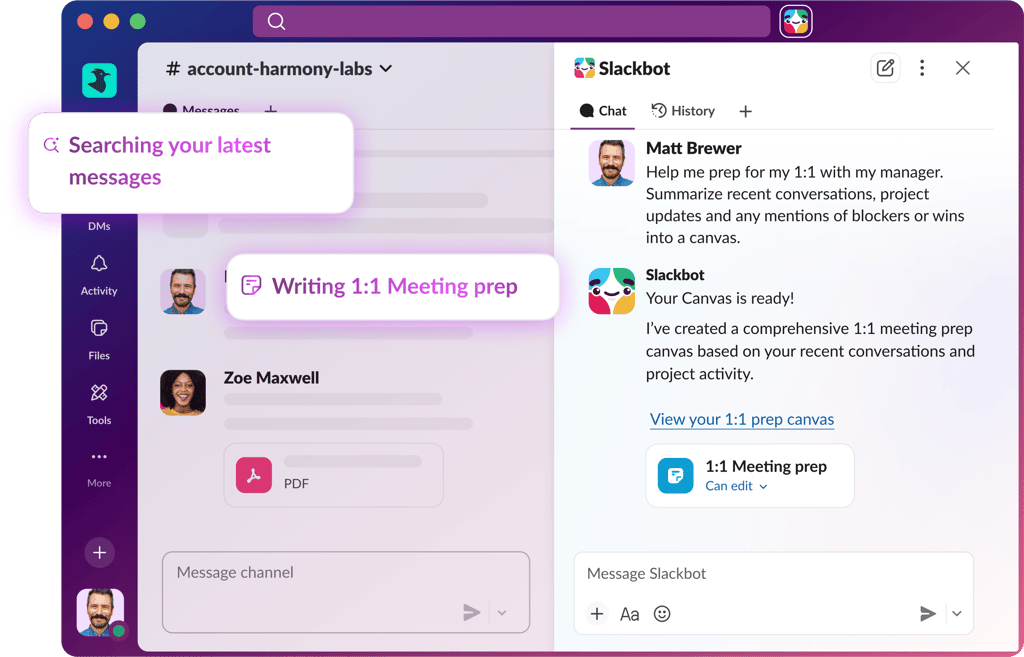
Then came the impressive part. Bauer uploaded an image of a usage metrics dashboard and asked Slackbot to correlate the visual data with the qualitative feedback it had just analyzed. The system didn’t just read the image; it cross-referenced adoption patterns with user complaints, identified correlations between low-adoption customers and negative feedback, and surfaced risk assessments.
“This is where Slackbot really earns its keep for me,” Bauer said during the demonstration, “because what it’s doing is not just simply reading the image—it’s actually looking at the image and comparing it to the insight it just generated.”
Finally, she asked Slackbot to identify enterprise accounts with open Q4 deals that might be good candidates for early access, based on the gaps the analysis had revealed. Drawing on connected Salesforce data, the system returned prioritized recommendations with specific justifications tied to the pilot’s identified weaknesses.
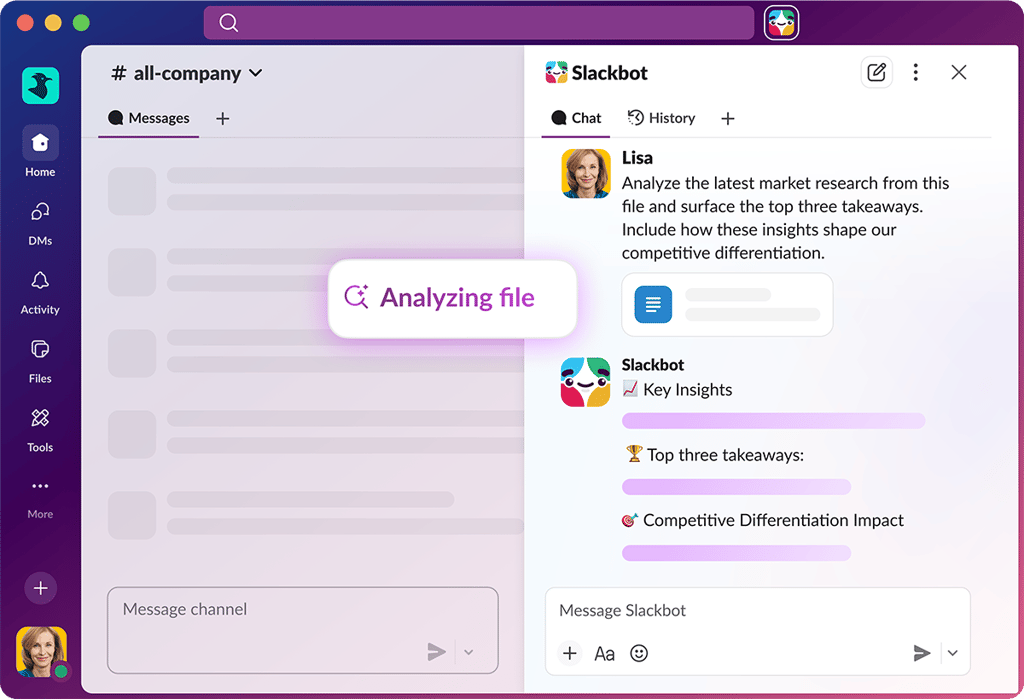
The entire workflow—from raw feedback to executive-ready canvas with expansion strategy—took minutes rather than the hours or days it would typically require.
A Supervisor, Not a Teammate
There’s an important architectural distinction worth understanding. Microsoft has positioned its Copilot as a team member that participates directly in chat sessions, contributing to conversations alongside human colleagues. Salesforce has taken a different approach.
Slackbot operates as a supervisory layer—a personal assistant that sits in a dedicated right-hand panel, observing your entire Slack corpus rather than participating in individual conversations. When you invoke Slackbot, you’re not adding an AI participant to a channel discussion. You’re querying an intelligent system that can search, synthesize, and act across all your accessible communications.
“We’re treating Slackbot as your personal agent and assistant,” Seaman explained. The company does support third-party agents and Agentforce agents that can be added directly to channels, but Slackbot itself maintains separation—providing oversight rather than participation.
This design choice has practical implications. Slackbot can analyze patterns across hundreds of channels you technically have access to but never actually read. It can correlate information from a customer conversation six months ago with a pricing discussion that happened last week. It functions more like an executive briefing system than a chatty colleague.
Ryan Gavin, Slack’s CMO, illustrated this with a personal use case: “I roll into Slackbot and say, ‘What are the areas that my team needs my focus right now? What are the places they could use help based on the priorities of Slack and the business?’ Give me a prioritized list.”
The system doesn’t just search—it reasons about organizational context. Gavin noted he never told Slackbot who his team members were or what his priorities should be. The system inferred both from months of communication patterns.
The Distribution Question
Slack’s heritage as a product-led growth company remains its greatest asset in the current AI moment. The platform sees 20 million website visitors monthly, with overwhelming majority of customer acquisition happening through small teams that grow into enterprise deployments. Tens of millions of people already use Slack daily, creating the conversational exhaust that makes Slackbot’s contextual intelligence possible.
The vision of Slack as the “conversational interface for the agentic enterprise” is elegant. As Seaman framed it: “Every net new technology company that’s created is doing something innovative that matters. The first or second interface in which they’re putting their product is Slack.”
Yet the Slack-first strategy, however philosophically sound, primarily serves existing Salesforce customers. The company is working to change this—bundling Salesforce record channels with Salesforce editions, introducing functionality that coaches small teams toward CRM adoption—but the gap between capability and market penetration remains.
For enterprises already deep in the Slack ecosystem, Slackbot represents immediate, tangible value. For the broader market, the question is whether conversational AI grounded in organizational context can serve as sufficient incentive to adopt Slack itself.
The Verdict: Substance Behind the Hype
Slackbot’s general availability to Business+ and Enterprise+ customers—at no additional cost—removes a significant adoption barrier. Users on qualifying plans simply gain access to capabilities that, in other contexts, would require separate licensing, integration projects, and training programs.
The customer feedback from pilot deployments reinforces the value proposition. “Slackbot is saving me, at bare minimum, 90 minutes a day,” said Sinan, Head of Beast Games Marketing at Beast Industries. “I ask it to create a canvas for a meeting tomorrow, and in 17 seconds it’s better than I could ever do.”
Peter Stoltz, VP and Head of CIO Office at reMarkable, called it “the memory I wish I had myself,” noting its utility for everything from translation help to navigating how the company operates.
The technical architecture is sound. The MCP client integration roadmap suggests Salesforce is positioning Slackbot as a control surface for broader agent ecosystems. The search capabilities—leveraging MapReduce-style parallel queries and semantic synthesis—represent genuine innovation in enterprise information retrieval.
If there’s a reservation, it’s the branding decision itself. Slackbot has existed since Slack’s earliest days as a simple utility bot. Repurposing that familiar name for such a transformative capability risks underselling the innovation. This isn’t a glow-up—it’s a complete reimagination. A new identity might have better signaled the magnitude of what Salesforce has built.
But that’s a marketing quibble, not a product criticism. For the millions of knowledge workers already living in Slack, the new Slackbot represents exactly what enterprise AI has promised but rarely delivered: intelligence that understands your work, respects your permissions, and meets you where you already are.
The future of work may indeed be agentic. For Slack customers, that future arrived today.
Vernon Keenan is a senior industry analyst specializing in enterprise application development and the Salesforce ecosystem. He writes for SalesforceDevops.net.