Stanford Confirms Quiet Erosion: The First Large-Scale Evidence of AI’s Impact on Entry-Level Jobs
Earlier this week Stanford researchers Erik Brynjolfsson, Bharat Chandar, and Ruyu Chen released a landmark paper: Canaries in the Coal Mine? Six Facts about the Recent Employment Effects of Artificial Intelligence.
For those of us tracking the labor-market impacts of generative AI, this study is a watershed moment. It provides the first large-scale, near real-time evidence that generative AI is reshaping employment — not through wages, but through the silent disappearance of entry-level jobs.
Table of contents
Six Facts Stanford Found
The Stanford Digital Economy Lab analyzed payroll records from ADP, covering millions of U.S. workers across thousands of firms. Here’s what they found:
- Young workers in exposed jobs are being displaced.
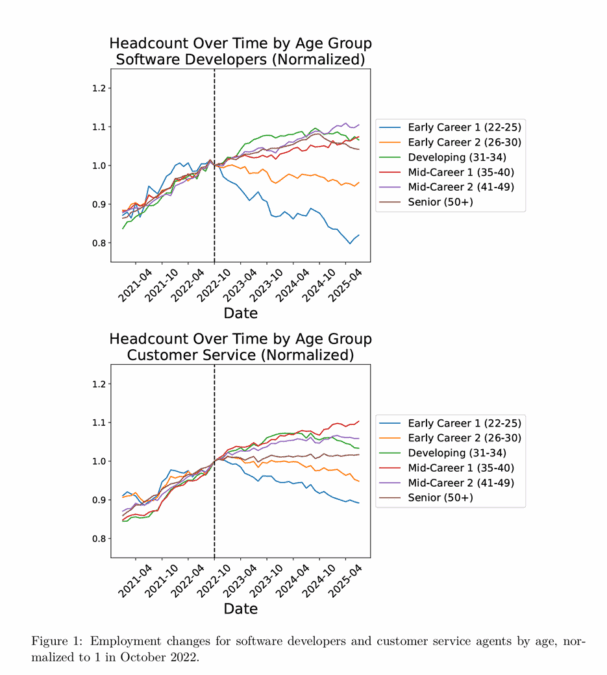
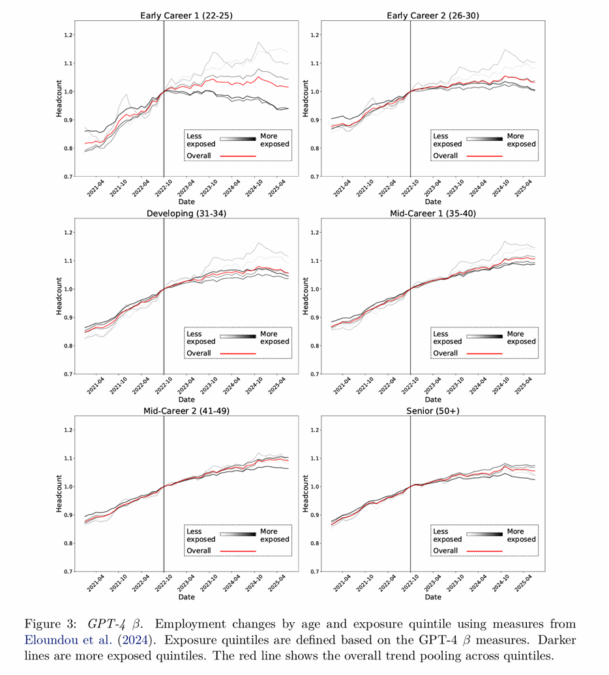
Entry-level employees (ages 22–25) in AI-exposed fields like software engineering and customer service saw a 13% relative decline in employment since late 2022, compared to stable or rising employment for older workers in the same roles.
- Overall employment is still growing — but not for the young.
For the economy as a whole, job growth remains robust. But for early-career workers, employment is stagnant.
- Automation hurts, augmentation helps.
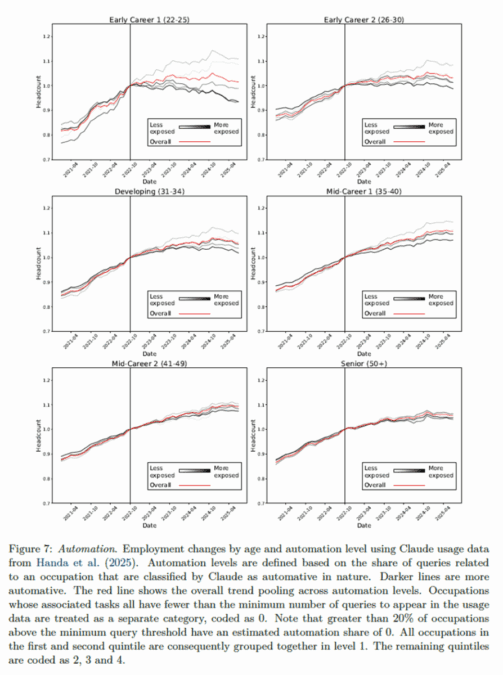
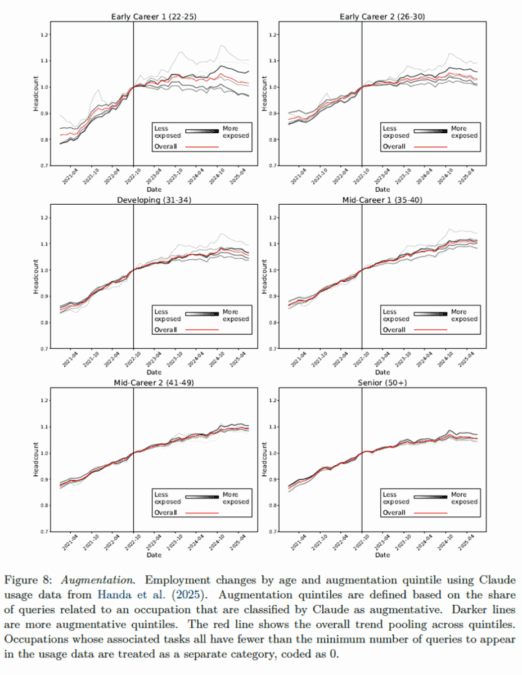
In jobs where AI substitutes for codified work, entry-level employment declines. But in occupations where AI augments human labor, employment for young workers remains stable or even increases.
- Not just tech-sector layoffs.
The declines persist even after accounting for firm- or industry-level shocks like interest rates or the post-COVID tech correction. This is structural. - Headcount declines, not wages.
Salaries have not meaningfully declined — instead, firms are cutting back on early-career hiring. Quiet erosion happens through missing opportunities, not pay cuts. - Robust across occupations and industries.
The same pattern appears beyond tech, and even in roles not amenable to remote work. In fact, health aides and less-exposed fields are growing faster for young workers.
Why This Matters: Quiet Erosion Confirmed
For nearly two years, we’ve been using the term Quiet Erosion to describe how AI silently removes the on-ramps to professional careers. Unlike past technology shifts, which created new categories of entry-level work, generative AI appears to be eroding the bottom rungs of the career ladder while preserving opportunities for those with tacit, experience-based skills.
Stanford confirms this distinction. Their study explicitly notes that AI replaces “codified knowledge” — the stuff of classrooms and textbooks — but not the tacit, hard-earned knowledge that comes only from years on the job. In other words:
- Young workers are most vulnerable because their value-add is primarily codified knowledge.
- Older workers are resilient because they hold tacit knowledge AI cannot yet replicate.
This is precisely the dynamic predicted in Virtual Employee Economics by the Law of Cognitive Commoditization: codified skills are automated first, tacit skills last. And experienced workers aren’t even safe, according to the Law of Exponential Learning which predicts that AI producers will create self-improving Virtual Employees who will eventually codify the tribal knowledge which makes human workers flexible.
The Canaries in the Coal Mine
The title of the Stanford paper — Canaries in the Coal Mine — is not just metaphorical. These declines among 22–25-year-olds in AI-exposed occupations are the first measurable signals of a deeper labor market shift.
For Salesforce customers, partners, and ISVs, the implications are immediate:
- Talent pipelines will narrow. Entry-level hiring in software development is under strain, making it harder to cultivate future experts.
- AI strategy must go beyond cost savings. Quiet erosion may hollow out critical skills unless companies invest in tacit knowledge transfer and augmentation strategies.
- The Intelligence Gradient is visible. Economic value is flowing away from codified entry-level tasks toward augmented and orchestration roles.
Not Just a Theory
The Quiet Erosion is no longer just a theory. It is now backed by Stanford data at scale.
Figures 1–3 in this paper should be circulated in every boardroom and policy forum concerned with the future of work. They show, in unmistakable detail, that the AI revolution has already begun to reshape the labor market — not with loud layoffs, but with the quiet erosion of entry-level opportunity.
The question for all of us is clear: Will we build new pathways for the next generation, or allow the entry ramp to white-collar careers to disappear?