Metazoa Snapshot: MCP Workstations for Salesforce Org Management
Metazoa has quietly doubled down on a thesis familiar to every seasoned Salesforce admin. The real productivity gains come from making metadata intelligible, actionable, and safe. With Snapshot — now framed as a local MCP (Model Context Protocol) workstation — Metazoa is positioning a desktop-first approach. This pairs deep metadata visibility with tightly constrained AI assistance. The result: a practical, security-forward path from insight to change for complex orgs.
Table of contents
What is Metazoa Snapshot?
Snapshot is a native desktop toolkit plus an AppExchange managed package. It captures, analyzes, documents, and manipulates an org’s metadata snapshot. It has long been used for permission/profile cleanups, data-dictionary generation, technical-debt reporting, and controlled deployments. Essentially it is a “Swiss army knife” for org management.
Metazoa has recently extended that core with AI-centric workflows. An MCP workstation model keeps metadata and agent logic local to the admin’s machine. Snapshot users are typically admins, consultants, or system integrators who face daunting maintenance or migration challenges.
Why MCP Workstation Matters
There are three practical reasons the workstation model is more than marketing:
- Structured context, not pixels. Snapshot supplies logical, traceable representations of UI elements and metadata. These include asset types, stable identifiers, and parent/child links. This allows an assistant to reason about the org the way a human does — not by guessing from a screenshot. That reduces hallucination risk and increases explainability.
- Action with guardrails. The MCP-enabled assistant can navigate and perform bounded UI actions. For example, drill, prepare deployments, or open code. However, destructive actions are gated by explicit confirmations and role framing so administrators remain in control. This is crucial for compliance-sensitive orgs.
- Zero-trust locality. By running the MCP server and AI client locally, Snapshot avoids routing org credentials and metadata through third-party clouds. This is a plausible differentiator for regulated industries that need auditable, non-exfiltrating workflows.
Snapshot Continuous Innovation
Metazoa has continued to invest in Snapshot’s deployment and transformation capabilities. Earlier this year, they published a release that improves cloning, splitting, and merging environments using placeholder “Shell Assets.” This circumvents dependency blockers. It is a practical way to bootstrap destination orgs and reduce deployment friction. That release is a clear sign Metazoa is solving long-running deployment logjams alongside their MCP/AI work.
Cognitive DevOps: Where Snapshot Accelerates the SDLC
Cognitive DevOps blends traditional DevOps practices with AI-native capabilities — embedding assistants into the software lifecycle to reduce activation energy, increase feedback velocity, and automate rote tasks while preserving human judgment for risk decisions. Snapshot is a textbook Cognitive DevOps enabler because it supplies three critical ingredients:
- Context fidelity: high-quality, metadata-first context that AI agents can rely on for deterministic reasoning.
- Action primitives: audited, reversible operations (diffs, dry-runs, sandbox actions) that agents can invoke as part of pipelines or on-demand workflows.
- Control surfaces: approval gates, explainability hooks, and audit trails that keep humans legally and operationally accountable.
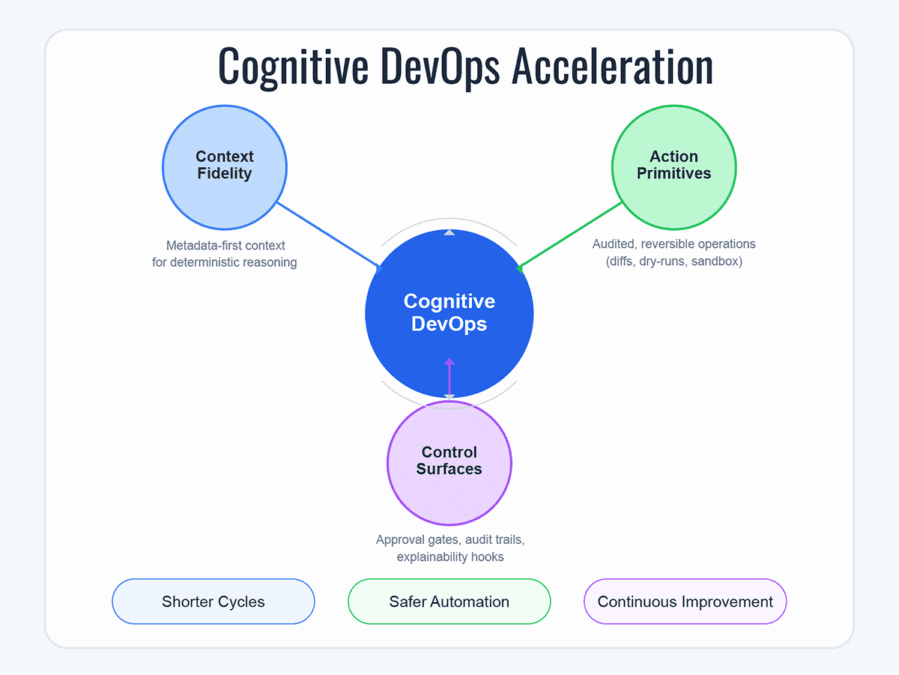
In practice, that means a developer or admin can run a Snapshot analysis, ask an assistant to propose a migration plan, and then move a validated subset through a dry-run deployment with automated checks — all while capturing the decision trail for compliance and postmortem learning. Those feedback loops are the core of Cognitive DevOps: shorter cycles, safer automation, and continuously improving processes.
Where Snapshot Fits in Salesforce DevOps
Snapshot sits at an intersection between admin tooling, metadata intelligence, and the emerging class of MCP servers. These servers expose enterprise capabilities to agentic assistants. For DevOps-centric ecosystem observers, Snapshot’s model suggests the company is developing these opportunity areas:
- Exposing safe, audited primitives (sandbox ops, metadata diffs, dry-run deployments) as MCP tools.
- Providing observability and approval workflows that can mediate agent actions.
- Packaging zero-trust or on-prem options for regulated customers.
Metazoa’s approach signals that admin ergonomics plus metadata fidelity remain a strong commercial play. This holds true even as the agent tooling around MCP matures.
Caveats and what to watch
It is very interesting to see how MCP has operationalized some of Snapshot’s plans. Some potential complications for Metazoa to consider:
- Operational complexity. Desktop workstations require installation, training, and lifecycle management — a different sales and support model than cloud-first ISVs.
- Interoperability. MCP momentum will reward vendors who publish clear MCP specs and community examples. Snapshot’s advantage will depend on how open and standard its MCP endpoints become.
- Security governance. Locality reduces some risk vectors but doesn’t eliminate the need for strong auth, audit trails, and enterprise policies. These include around keys, backups, and endpoint security.
Bottom line for Admins and System Integrators
Metazoa’s Snapshot remains one of the clearest examples of practical metadata intelligence for Salesforce admins. By packaging that capability as a local MCP workstation, Metazoa is betting that many enterprises will prize explainability and zero-trust controls over purely cloud-native convenience. If you run complex orgs, Snapshot is worth trialing. It is expecially helpful if your org faces heavy compliance or deployment-dependency problems.