The MCP Gap: Why Salesforce DevOps Tools Are Missing the AI Revolution
A wake-up call to Salesforce DevOps vendors who are sleepwalking through the AI transformation
Hours Every Sprint Down the Drain
Let me paint you a picture of enterprise Salesforce DevOps in 2025. Every two weeks, my team burns 12 hours on deployment activities. Not development. Not innovation. Just the mechanical grind of moving approved changes through environments. Add another 5-8 hours of my time as a leader, wrestling with the process, triaging failures, and coordinating emergency fixes.
That’s 300+ hours annually. For one team. We’re invested in getting CI/CD pipelines implemented and onboarding all administrators towards our feature branch strategy – but it’s not enough. Delayed deployments don’t just slow development—they can halt mission-critical business processes.
But here’s what really stings when you run a “mature” org: when a simple metadata change triggers cascading test failures that only developers can fix. This is the reality of managing a complex, tech debt-laden Salesforce org in 2025. And our DevOps tools, despite their best intentions, aren’t evolving fast enough to help us.
Table of contents
Conversational DevOps: Beyond Point-and-Click
I’ve been experimenting with the Model Context Protocol (MCP)—the open standard that lets AI models connect to external systems. Think of MCP as the “USB-C for AI applications.”
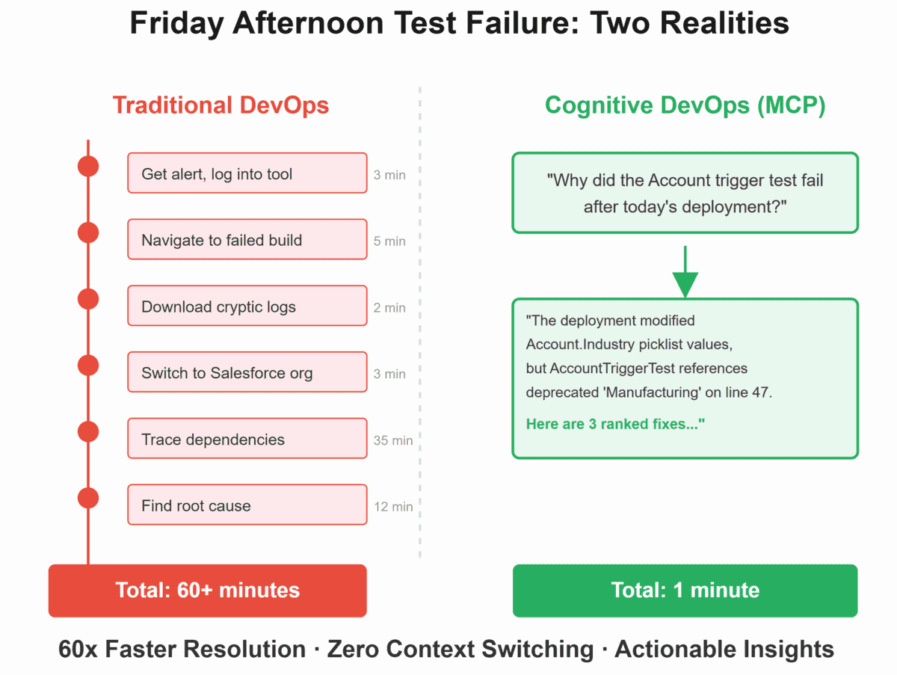
Imagine asking your DevOps pipeline: “Why did the Account trigger test fail after today’s metadata deployment?” Instead of clicking through logs and switching between screens, you get an intelligent analysis: “The deployment modified the Account.Industry picklist values, but the test class AccountTriggerTest still references the deprecated ‘Manufacturing’ value on line 47. Here are three ways to fix it.”
Or this: “Show me any unusual permission grants from last week’s deployments” instead of scrolling through interface screens, hunting for anomalies that could indicate compliance risks.
Better yet: “Generate an interactive chart showing deployment success rates by environment over the last quarter, broken down by metadata type.” No subscription upgrades required. No waiting for “canned” analytics. Just intelligent, on-demand insights.
These aren’t pie-in-the-sky requests. This is possible with MCP today—if Salesforce DevOps tools supported it.
The Innovator’s Dilemma, Salesforce Edition
Look, I get why Salesforce DevOps vendors haven’t jumped on MCP yet. They’ve spent years building sophisticated UIs, investing millions in point-and-click workflows that their enterprise customers demanded. They have roadmaps stretching into 2026, technical debt from acquisitions, and legitimate concerns about API stability and security.
Moving to conversational interfaces means reimagining their entire product architecture. It means potentially cannibalizing their existing feature sets. It means betting on a standard that’s still evolving. These are rational, reasonable concerns for established vendors with thousands of customers relying on them for mission-critical deployments.
But here’s the thing: it doesn’t matter.
While traditional vendors wrestle with their innovator’s dilemma, a new Cognitive DevOps ecosystem is emerging that will eat them alive. Not because the vendors are incompetent—they’re not. But because the rules of the game are changing faster than enterprise software companies can pivot.
The Cognitive DevOps Tsunami
Here’s what makes this disruption inevitable: while Salesforce DevOps vendors debate their AI strategy, the broader ecosystem is shipping at breakneck speed.
Microsoft has already built an MCP integration for Azure DevOps. Every major IDE—Cursor, VS Code, Windsurf, Zed—has MCP support. Salesforce itself is building MCP into Agentforce 3, with a pilot launching this year. The development community has built hundreds of MCP servers connecting AI to everything from GitHub to PostgreSQL to file systems.
But more importantly, a new class of players is emerging. Startups that were born cloud-native, AI-first, with no legacy code to maintain. They’re not adding AI to DevOps—they’re building DevOps from AI primitives up. They don’t see conversational interfaces as a feature; they see traditional UIs as technical debt.
These aren’t your typical venture-backed disruptors making noise. They’re building production systems for Fortune 500 companies who are desperate for the 10x productivity gains that Cognitive DevOps promises. And they’re doing it at price points that make traditional DevOps licensing look like highway robbery.
What We’re Actually Missing
Picture this familiar nightmare: It’s Friday afternoon. Your latest deployment just triggered a cascade of test failures. Your developer gets the alert, logs into the DevOps tool, navigates through screens to find the failed build, downloads cryptic logs, context-switches to the Salesforce org, manually traces metadata dependencies, and finally—after an hour of detective work—discovers that the deployment modified Account.Industry picklist values, but AccountTriggerTest still references a deprecated value.
Now imagine this instead: “Why did the Account trigger test fail after today’s deployment?”
Response: “The deployment modified Account.Industry picklist values, but the test class AccountTriggerTest still references the deprecated ‘Manufacturing’ value on line 47. Here are three ranked fixes based on your org’s patterns.”
One minute. One question. Problem solved.
But test failures are just the beginning. The same conversational approach could transform permission auditing (“Alert me to any SOX compliance risks from this week’s deployments”), release planning (“Assess the risk profile of this package and suggest deployment sequencing”), architecture decisions (“Given our current schema, what’s the optimal approach for this business process?”), and dozens of other workflows that currently burn developer hours.
What’s revolutionary about LLMs is their ability to personalize responses and meet you at your level. Even the most well-intentioned user interfaces can’t work for every knowledge worker. That’s the power of MCP: rudimentary alerts and errors transform into conversations, visualizations, or recommendations tailored to your expertise.
The Market Will Decide—Brutally and Soon
To the vendors reading this: I’m not unsympathetic to your position. You have real customers, real revenue, real responsibilities. Betting the company on an emerging standard feels risky.
But the market doesn’t care about your technical debt. It doesn’t care about your roadmap. It doesn’t care that you’ve been the leader in Salesforce DevOps for a decade. The market cares about one thing: can you reduce my 300 hours of deployment overhead to 30?
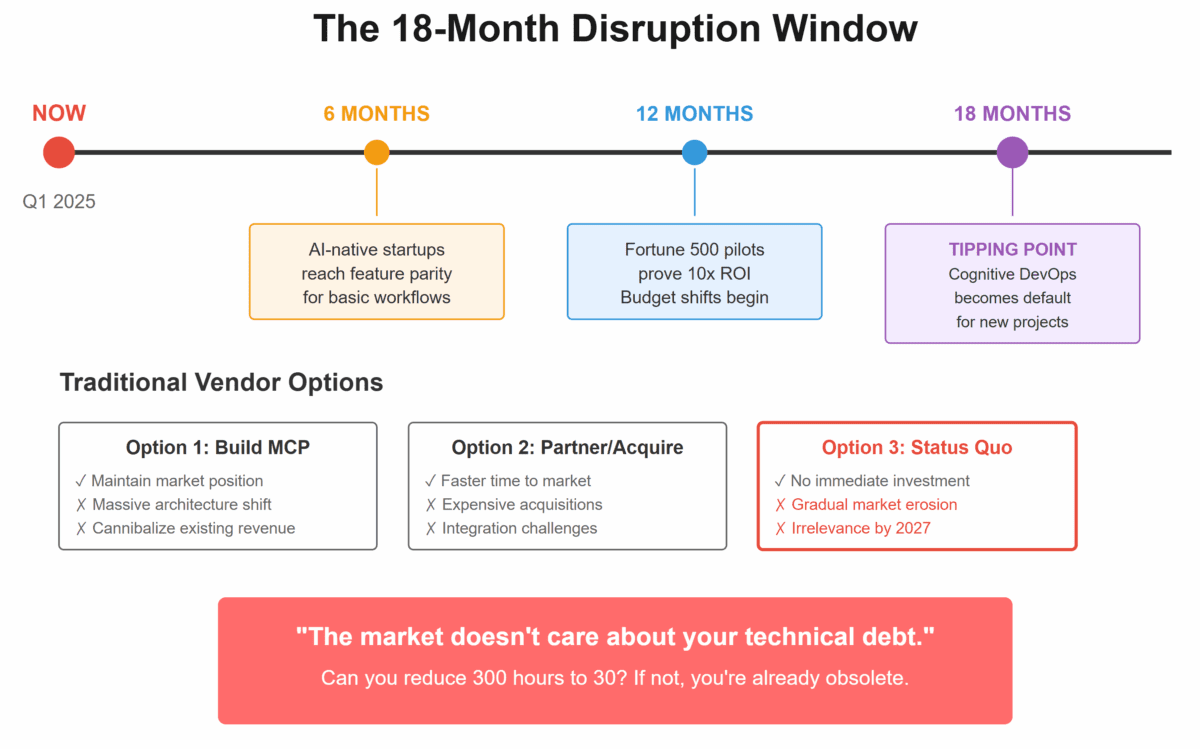
The Cognitive DevOps players can. Or at least they’re credibly promising they can. And in a world where every CTO is under pressure to “do more with less” and “leverage AI,” that promise is irresistible.
You have maybe 12-18 months before these new entrants mature enough to handle enterprise-scale deployments. Use that time wisely. Build MCP support. Open-source parts of your stack. Partner with the disruptors rather than competing with them. Because when the tsunami hits—and it will—you want to be riding the wave, not standing on the beach wondering why the water receded.
To the community: You’re already building the future. Every MCP server you share, every integration you open-source, every blog post about conversational DevOps—you’re accelerating the inevitable. Keep building. The vendors will follow or fade.
To my fellow practitioners: Start experimenting now. Build proof-of-concepts. Show your leadership what’s possible. Because in 18 months, you’ll either be explaining why you’re still clicking through screens, or you’ll be the hero who saw the future coming and prepared for it.
The Cognitive DevOps revolution isn’t coming. It’s here. The only question is whether you’ll help lead it or get left behind.
Chris Pearson is Director of Salesforce Development at Jostens, where he manages complex enterprise Salesforce implementations and advocates for AI-driven development practices. He has extensive experience with MCP integration and AI augmentation of DevOps workflows.