SRE.ai Raises $7.2M: Major Market Validation of Virtual Employee Economics
Ex-Google DeepMind Founders Secure Salesforce Ventures and Crane Backing to Transform $51B Services Market
SRE.ai’s $7.2 million seed round, led by Salesforce Ventures and Crane Venture Partners, marks a watershed moment for the Cognitive DevOps sector. The funding validates not just another AI startup, but the fundamental economic principles driving the transformation of enterprise services—what we’ve termed Virtual Employee Economics.
Table of contents
Understanding Virtual Employee Economics
Virtual Employee Economics provides a framework for understanding how autonomous AI agents transform enterprise operations. Unlike traditional automation that follows linear cost curves, VE Economics operates under three fundamental laws: the Law of Infinite Scale (marginal cost approaches zero while maintaining quality), the Law of Cognitive Commoditization (skilled tasks progressively approach computational cost), and the Law of Exponential Learning (capabilities improve exponentially through network effects). These improvements represent a paradigm shift comparable to the Industrial Revolution’s factory system, but for knowledge work.
Founded by ex-Google DeepMind engineers Raj Kadiyala and Edward Aryee, SRE.ai isn’t simply automating DevOps tasks. They’re operationalizing all three laws of VE Economics simultaneously, targeting a $51 billion addressable market in Salesforce-related services alone.
The 20x Multiplier Opportunity
Our market analysis reveals a striking pattern: the Salesforce DevOps software market sits at roughly $250 million, while the corresponding DevOps services market exceeds $5 billion—a 20x multiplier. This ratio exposes where human expertise creates the most friction and cost in enterprise operations.
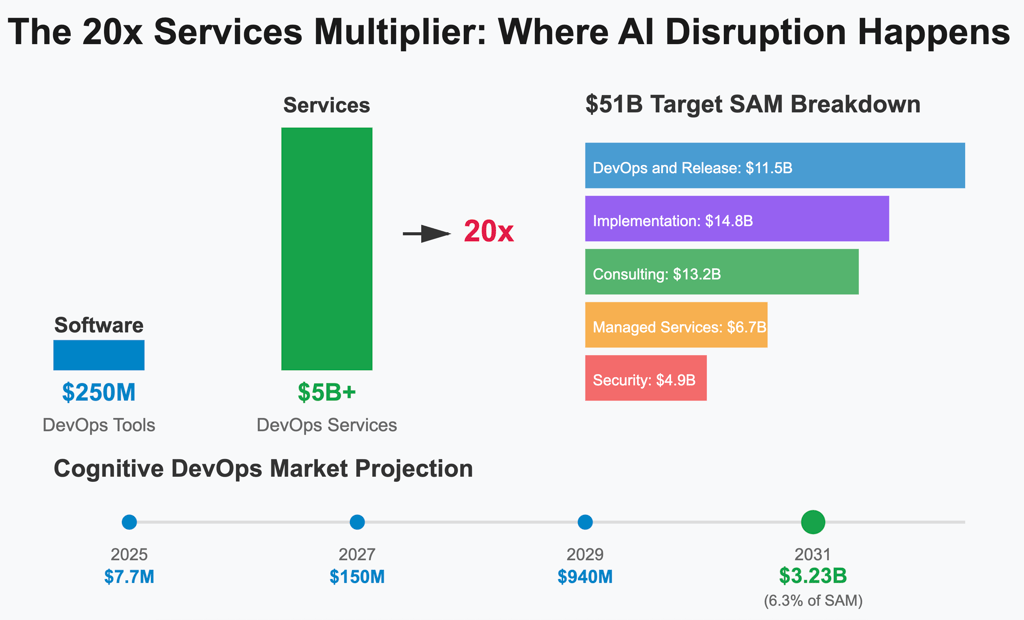
SRE.ai’s platform directly attacks this disparity. By acting as what the founders call a “translation layer” between business-critical platforms and IT governance, they’re converting expensive human expertise into accessible AI capabilities. Our projections show this Cognitive DevOps market reaching $3.23 billion by 2031, representing a 6.3% penetration of the serviceable available market.
The Three Laws in Action
Law 1: Infinite Scale Realized
When Kadiyala describes fixing “mission critical business applications [that] were never designed for the scale, complexity, or speed of AI,” he’s invoking the First Law of VE Economics—the ability to scale operations infinitely at near-zero marginal cost.
Consider enterprise migration projects. Traditional approaches require linear scaling of human resources—one developer per 10,000 lines of code, with 30-40% coordination overhead. SRE.ai’s approach spawns dozens or hundreds of AI agents to handle migrations in parallel. Agent #1,000 costs essentially nothing to deploy yet performs identically to agent #1.
This explains why Dom Pusateri at Salesforce Ventures sees SRE.ai “empowering every enterprise stakeholder—from admins to architects—to move faster.” The constraint isn’t resources anymore; it’s imagination.
Law 2: Cognitive Commoditization Achieved
The Second Law predicts that cognitive tasks will see their economic value approach computational cost as VEs master them. SRE.ai exemplifies this through their natural language interface that makes elite DevOps skills accessible to non-technical users.
“Low code shouldn’t mean high clicks,” the founders emphasize. They’re collapsing the skill premium that traditionally justified $200,000 DevOps engineer salaries, making those capabilities available to $75,000 business analysts.
Law 3: Exponential Learning Unleashed
Perhaps most significantly, Edward Aryee’s observation about capturing “tribal knowledge” directly validates the Third Law of Exponential Learning. Traditional enterprises hemorrhage institutional knowledge through turnover, silos, and manual knowledge transfer. SRE.ai plans to capture every deployment, fix, and workaround as permanent memory.
“We’re giving companies a smarter way to operate—one where AI remembers, orchestrates, and helps teams scale without chaos,” Aryee explains. The goal is to create a knowledge flywheel. Customer #100 receives a dramatically more capable platform than customer #1, not through software updates but through accumulated learning across the network.
Max Chapman of Crane Venture Partners recognizes this dynamic: “Edward and Raj are…delivering contextual intelligence and building the control plane for a critical but long-overlooked layer of the modern enterprise stack.”
Market Dynamics and Competitive Implications
SRE.ai enters a rapidly evolving Cognitive DevOps ecosystem. Competitors like Cirra AI, Ressl AI, and Cloobot are each targeting specific aspects of the automation opportunity. But SRE.ai’s comprehensive platform approach—combined with Salesforce Ventures’ strategic backing—positions them to capture the network effects that create winner-take-most dynamics in VE markets.
Our segment analysis projects DevOps services achieving the highest VE adoption at 11% by 2031, compared to 8-9% for implementation and maintenance, 5.5% for migration, and 3% for security services. SRE.ai’s platform spans all these categories, maximizing their addressable market.
The timing is critical. Global Systems Integrators are beginning defensive maneuvers to protect their margins. Early movers like SRE.ai who establish network learning effects will become increasingly difficult to displace.
The Broader Implications
This funding round signals more than startup success—it validates the VE Economics framework as a lens for understanding enterprise transformation. The three laws aren’t just theoretical constructs: they’re becoming operational reality.
For enterprises, the message is clear: organizations still relying on traditional service models will face mounting competitive pressure as early adopters leverage infinite scale, cognitive commoditization, and exponential learning.
For investors, SRE.ai demonstrates the massive arbitrage opportunity in the services-to-software ratio. This is the mythical “Services as Software” dream many see building multi-trillion opportunities for AI agents. Every enterprise software category with high service multipliers represents similar transformation potential.
What’s Next for SRE.ai
With funding secured, SRE.ai is building out its engineering team and partnering with select enterprise customers. The platform’s evolution from Salesforce-specific to broader enterprise applications (ServiceNow, Jira) will test whether these economic principles translate across ecosystems.
The real test comes in 2026-2027, when our models project VE SOM jumping from $52 million to $150 million—a period requiring both technical excellence and market education. If SRE.ai can maintain its learning velocity while scaling deployments, they’ll validate not just a business model but an entirely new economic paradigm.
The revolution in enterprise services isn’t coming—it’s here, funded, and building exponentially smarter systems every day. Organizations that understand and adapt to VE Economics will thrive. Those that don’t may find themselves competing against infinitely scalable, exponentially learning competitors operating at computational cost.
Welcome to the age of Virtual Employee Economics. SRE.ai just proved it’s investable.