Salesforce’s Battle for the Enterprise AI Budget
Why delivering the right AI capabilities, through any channel, matters more than owning the model
An executive perspective on how the way we plan, budget and deliver AI solutions is changing and how Salesforce can offer every customer greater value
By Mehmet Orun, CDMP | Salesforce MVP
Just before Dreamforce, I wrote about why I don’t believe the return of Sales Cloud and Service Cloud to Salesforce’s pricing pages represents a retreat from Agentforce. My argument was relatively simple: business leaders generally don’t have an AI budget. They have budgets to deliver sales, service, marketing, and other business outcomes.
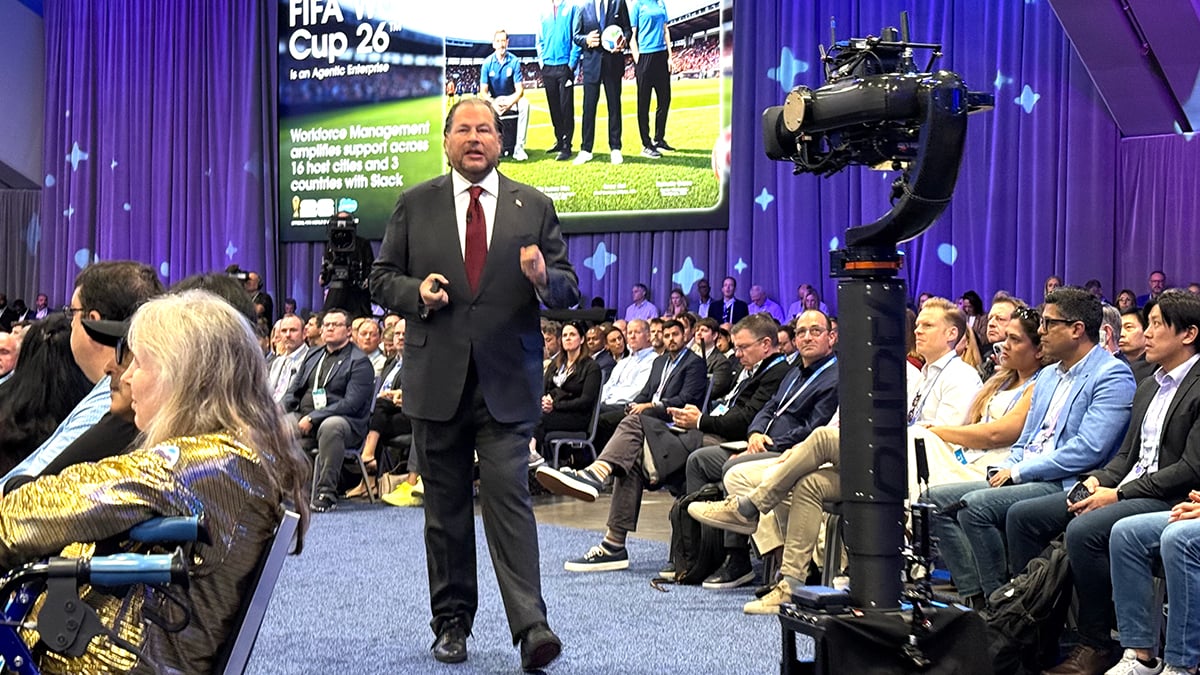
After spending last week at my 15th Dreamforce, I think there is another side to that argument.
Table of contents
There is an enterprise AI budget.
Someone ultimately has to decide how that money is spent, how its use is governed, and whether the capabilities being consumed are producing enough value to justify their cost. While every business function increasingly wants to take advantage of what AI has to offer, in most organizations, much of the accountability for doing so securely, confidently, compliantly, and economically ultimately lands with the CIO.
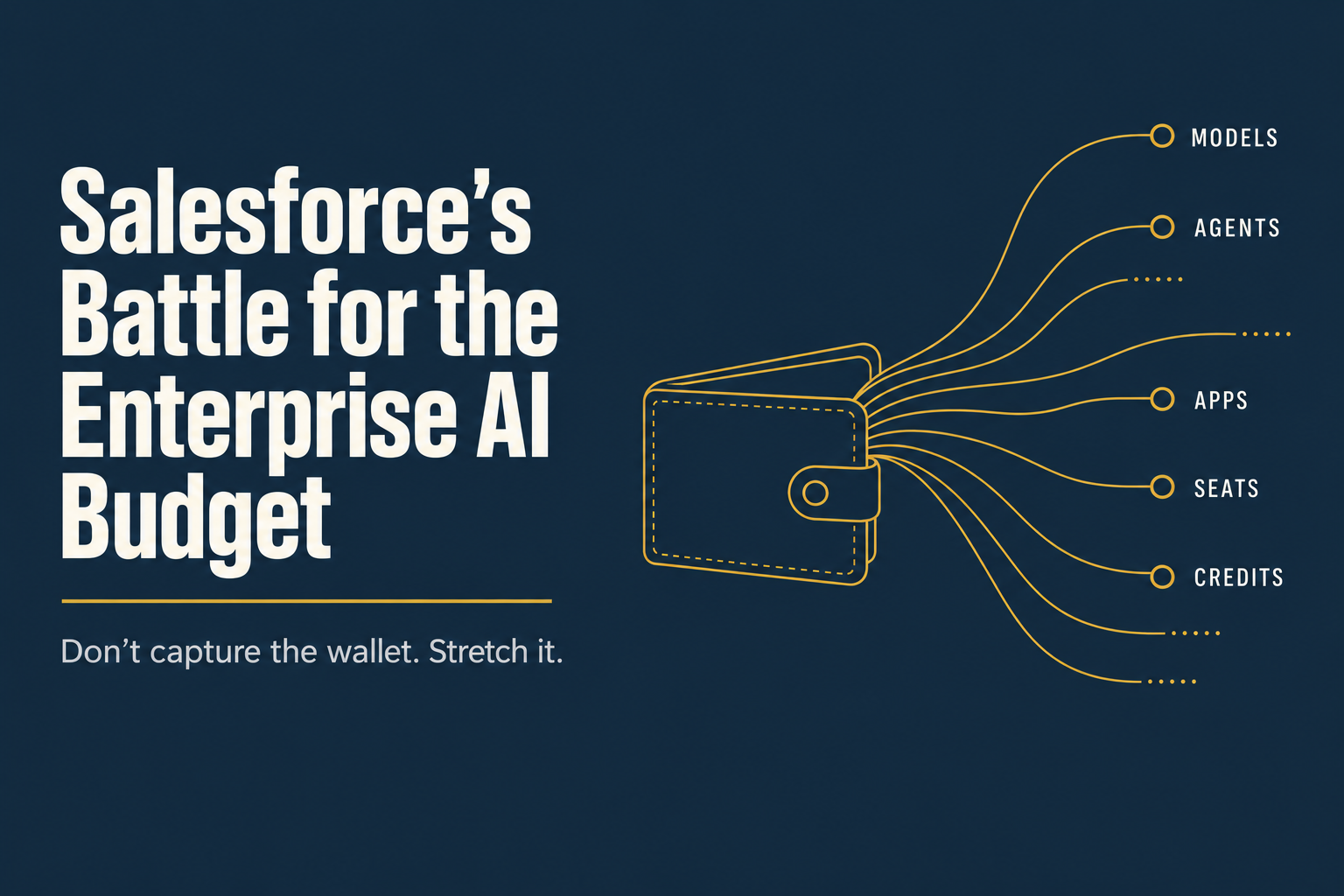
And everyone wants a share of that wallet.
With roughly 1,600 sessions at Dreamforce, nobody can see more than a fraction of what is presented. But across the keynotes, product announcements, executive conversations, and smaller sessions I attended, I kept seeing variations of the same theme.
Salesforce is positioning itself to compete for a larger share of the enterprise AI budget by promising to help customers get more value from that budget—not simply by giving them more Salesforce products to buy.
This distinction matters.
Stretching an AI budget isn’t about finding another attractive AI product to add to the portfolio. It is about knowing when AI is appropriate, which capability or model is appropriate, what trusted context it requires, how much the interaction should cost, and whether the resulting outcome justified that cost.
That may become one of the most consequential enterprise technology problems of the next several years.
AI Tool and Model Capabilities Are Expanding—and the Economics Are Changing
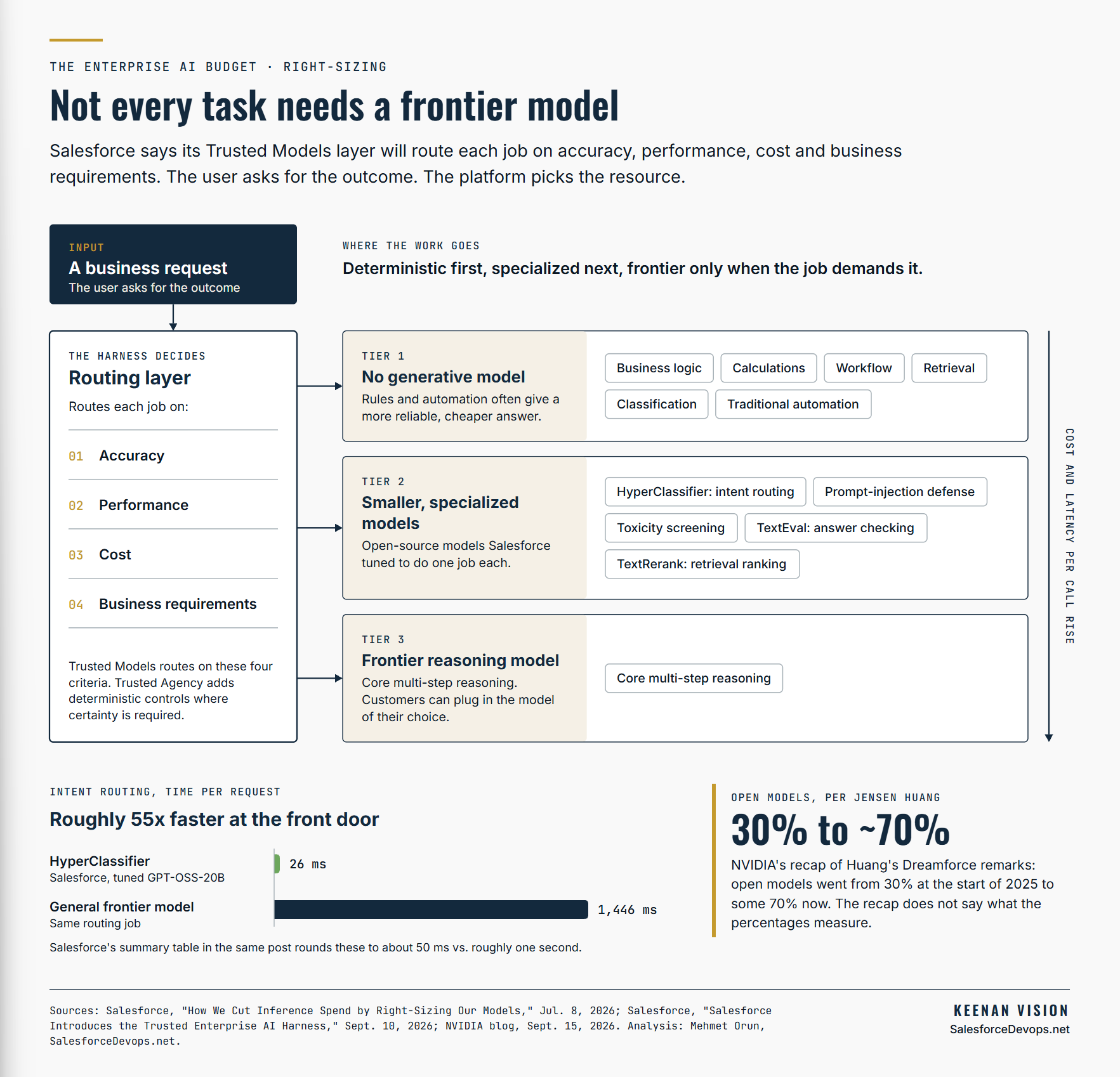
One of the comments that caught my attention at Dreamforce came from NVIDIA CEO Jensen Huang. He noted that “the open models went from 30% at the beginning of that year to now some 70%.”
That doesn’t mean frontier model providers are becoming less important. Quite the opposite. OpenAI, Anthropic, Google, NVIDIA, and others will continue improving what their technologies can do, and many of us will continue using them directly.
What it does suggest is that enterprises will have more choices for how particular AI tasks get performed.
Some tasks will justify the capabilities and cost of a frontier reasoning model. Others may be handled faster and less expensively by smaller or specialized models. Some don’t require a generative model at all. Deterministic business logic, retrieval, classification, calculations, workflow, or traditional automation may provide a more reliable and economical answer.
Salesforce has already been working on this problem internally. In a July 8 post, the company described breaking portions of Agentforce workloads into specialized models rather than sending every task through a frontier model. Its argument was straightforward: different parts of an agentic workload have different requirements, and using the largest general-purpose model for all of them can be slower, more expensive, and less precise.
This creates an interesting problem for the enterprise architect.
Even a highly accomplished architect cannot reasonably evaluate every request in real time and decide which model, resource, workflow, or deterministic process offers the best combination of accuracy, performance, security, compliance, and cost.
Nor should the business user have to know.
The user should be able to ask for the business outcome. The platform should increasingly be responsible for determining the most appropriate resources for delivering it.
The Opportunity to Become the AI Control Plane
This is where Salesforce’s Enterprise AI Harness became particularly interesting to me.
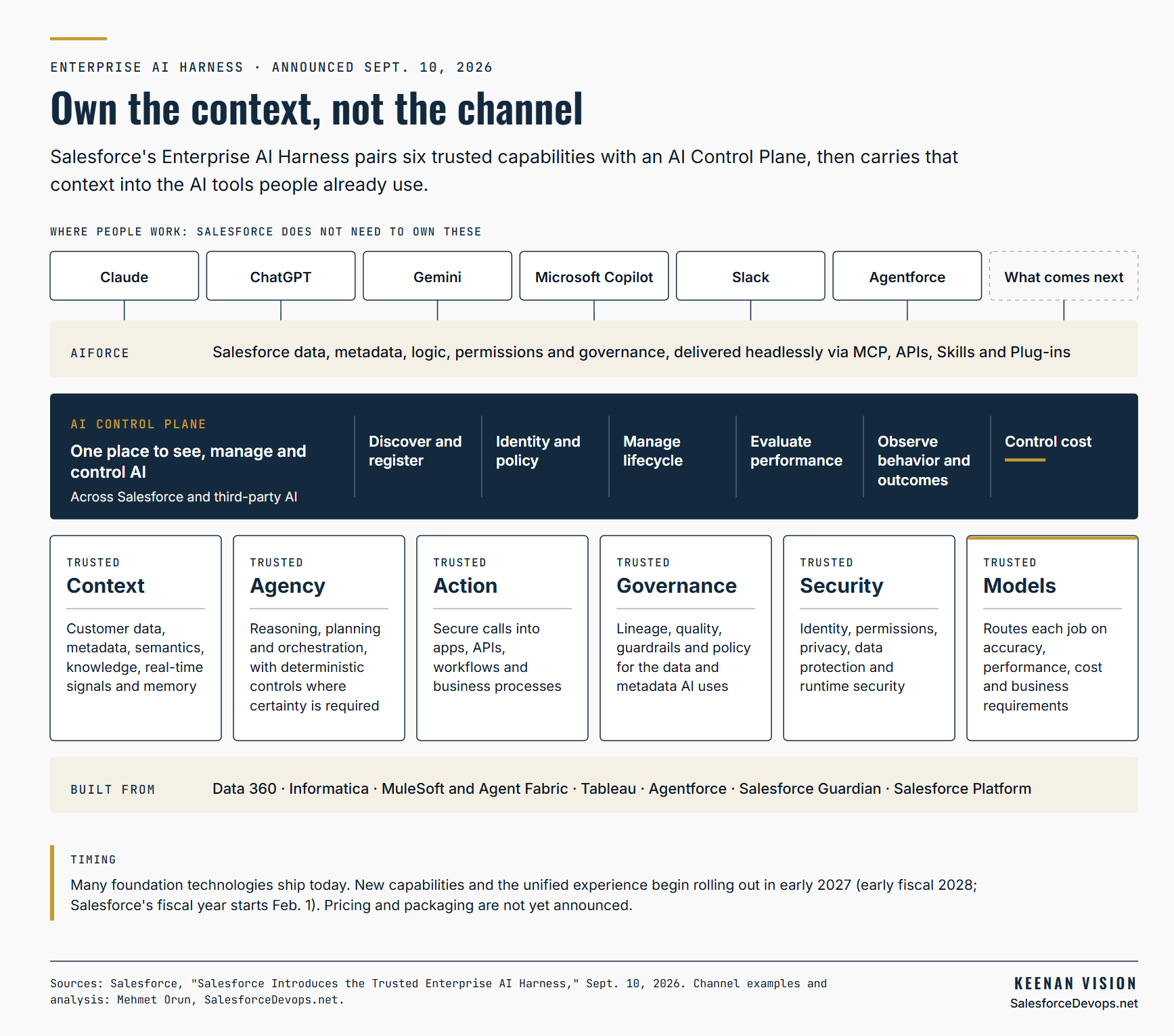
When Vernon Keenan interviewed Rohan Kumar, Salesforce President and Chief Platform and Engineering Officer, in August, Kumar described an Enterprise Harness that he believed needed to become a unified product. By Dreamforce, Salesforce had announced that architecture as the Enterprise AI Harness, consisting of six trusted capabilities and a common AI Control Plane.
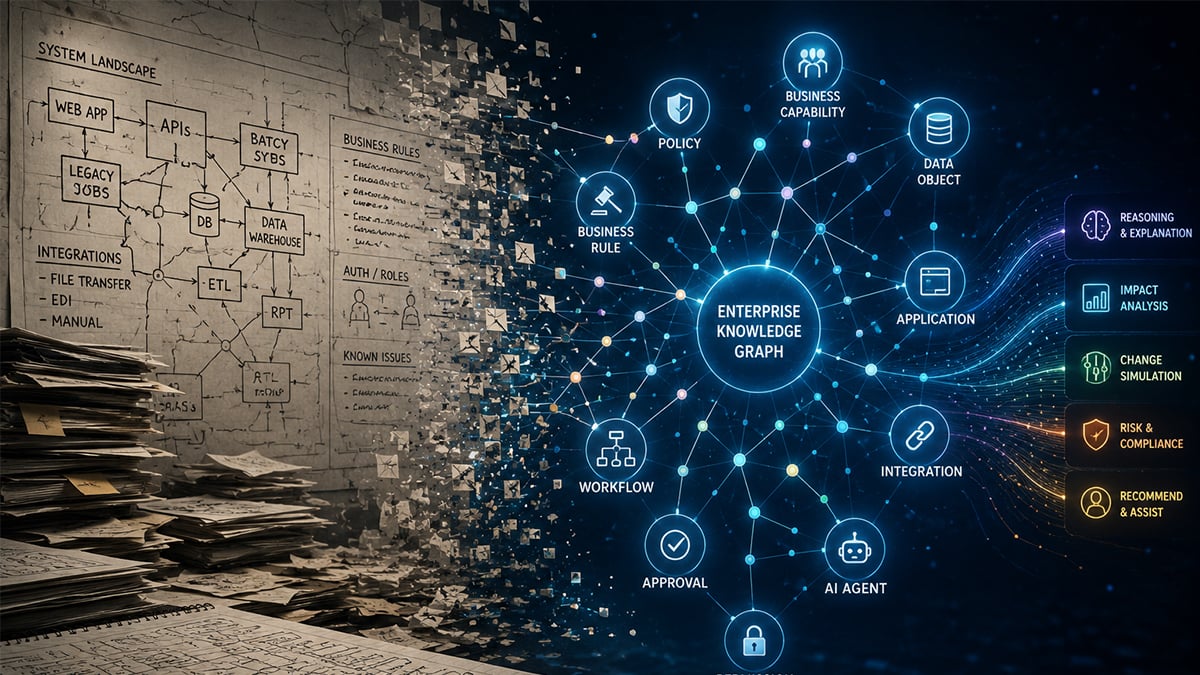
Salesforce breaks down the components of the Trusted Enterprise AI Harness into distinct capabilities: Trusted Context, Agency, Action, Governance, Security, and Models. The Control Plane is intended to provide a common place to discover and register agents and AI capabilities, establish identity and policy, observe behavior and outcomes, manage lifecycle, evaluate performance, and control cost across Salesforce and third-party AI.
Trusted Models is particularly relevant to the budget question. Salesforce says it intends to route work based on accuracy, performance, cost, and business requirements, while allowing customers to use Salesforce technology, existing technologies, third-party models, agents, and systems.
This is a much bigger opportunity than simply building a better agent.
Salesforce has decades of business metadata, permissions, workflows, customer relationships, business logic, and increasingly enterprise data context through Data 360. MuleSoft brings integration and API context. Informatica adds another layer of data management, governance, metadata, and lineage. Salesforce is increasingly describing these assets as components of a common architecture rather than independent products.
If Salesforce can bring those pieces together, the opportunity is to become something closer to a resource management and optimization layer for enterprise AI.
This also changes the economics of the relationship. Salesforce doesn’t have to provide the model, build every agent, or own every user experience to participate in the enterprise AI budget. If it becomes the layer that determines which resources to use, provides the trusted context, governs the interaction, and measures the outcome, it can create value across AI spending that may ultimately flow to many different providers.
Then, the question stops being: Which AI model should we buy?
And turns into: What is the most trusted, effective, and economical way to accomplish this particular business task?
And increasingly, the person asking the question shouldn’t need to know the answer.
All Engagement Channels Require the Right Context
There was another important implication in the Enterprise AI Harness announcement that could easily get lost among the individual product announcements.
Salesforce doesn’t necessarily need to own every interface where employees use AI.
Customers are going to use Claude. They are going to use ChatGPT, Gemini, Microsoft Copilot, Slack, Agentforce, and whatever comes next. Trying to make every employee interaction begin and end inside a Salesforce user interface would run counter to how enterprise technology is evolving.
Salesforce’s opportunity is different. It can seek to provide the trusted enterprise context, governance, security, actions, and controls behind those experiences, regardless of where the user chooses to work.
AIforce makes this direction more explicit. Announced at Dreamforce, it is designed to bring Salesforce data, metadata, business logic, workflows, permissions, security, and governance to the AI tools people choose to use. In other words, Salesforce doesn’t necessarily need to own the engagement channel to provide—and potentially monetize—the trusted business context behind it.
Salesforce itself describes the Enterprise AI Harness as open and composable, designed to work with third-party models, agents, systems, and existing customer technology.
That makes the customer relationship, business metadata, security model, and enterprise context potentially more durable than any individual AI interface.
Models will change. User experiences will change. The most popular AI tools will continue to evolve.
The enterprise still needs to know who the user is, what they’re allowed to do, what customer they’re talking about, which data can be trusted, which policies apply, what action can safely be taken, and how much all of this is costing.
That is a valuable position to occupy.
The Battle Is Still for Wallet Share
None of this changes the commercial reality.
Salesforce has an obvious commercial incentive to capture more of that spend.
Its recent edition changes create one path. As I discussed in Part I, Core, Advanced, and Max combine capabilities that customers previously may have purchased separately—or may currently purchase from competitors.
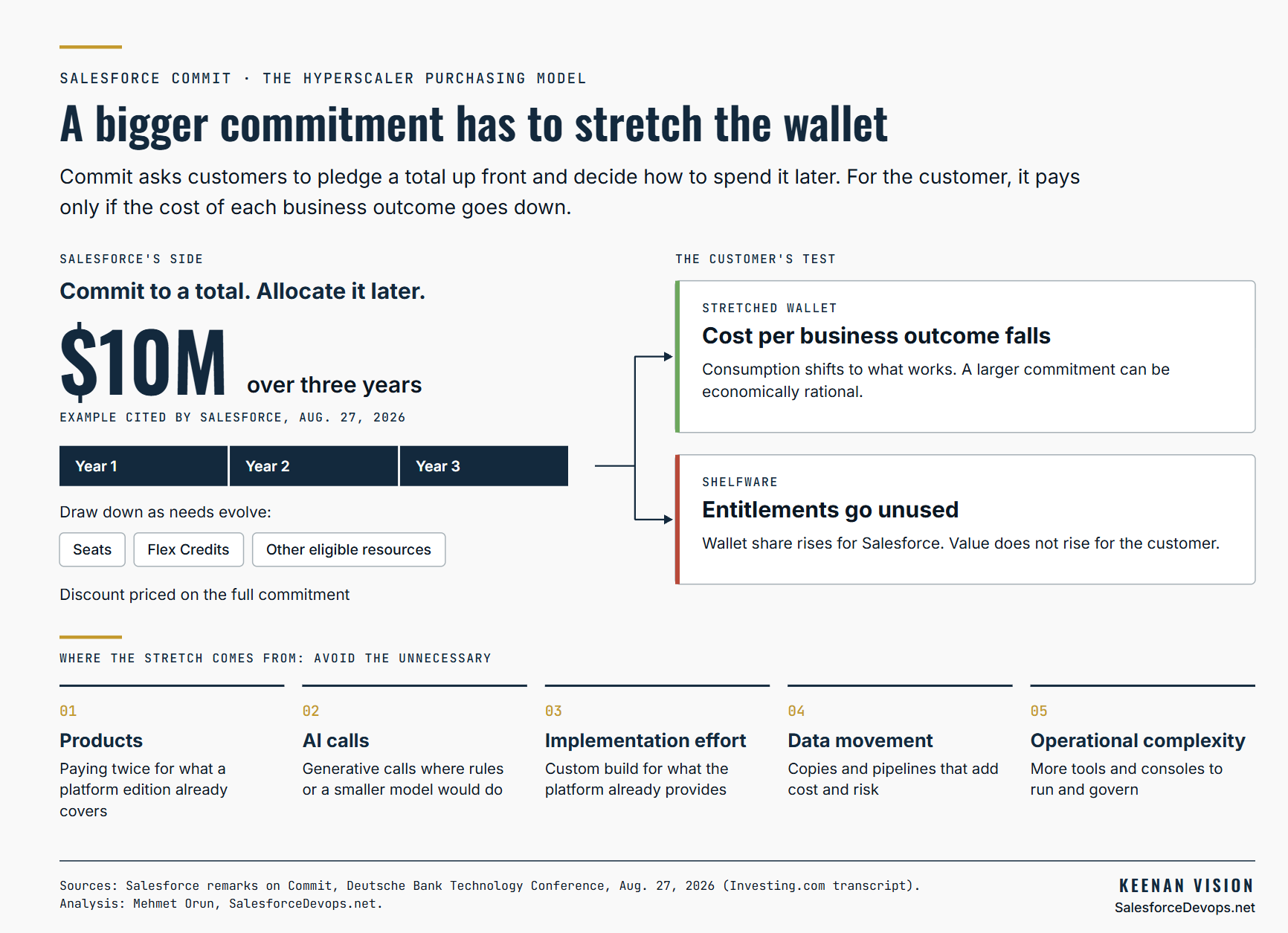
“Salesforce Commit”, a new discount approach based on a customer’s overall spend for Salesforce products, services, and partner solutions from AgentExchange, introduces another.
This changes the purchasing conversation.
Instead of negotiating every technology option or unit of consumption independently, Salesforce and customers can jointly decide how to maximize investment benefits within the budget commitment based on what can deliver intended outcomes most effectively.
From Salesforce’s perspective, that can increase wallet share.
From the customer’s perspective, it only works if the broader commitment helps the organization stretch the wallet.
That means avoiding unnecessary products, unnecessary AI calls, unnecessary implementation effort, unnecessary data movement, and unnecessary operational complexity.
A larger commitment can be economically rational if the total cost of producing the business outcome goes down.
A larger commitment that merely produces unused entitlements is not value.
The Ecosystem Is Part of the Economic Model
This same theme extended beyond Salesforce’s software announcements.
In one Dreamforce session I attended, Joe Alviani, Vice President for Technology Solutions for Salesforce Professional Services, discussed changes in the consulting delivery model, including examples of work being delivered with substantially smaller teams by applying AI, accumulated delivery knowledge, and greater automation.
The interesting part wasn’t simply that fewer consultants could potentially perform the work.
It was the change in what professional services must sell.
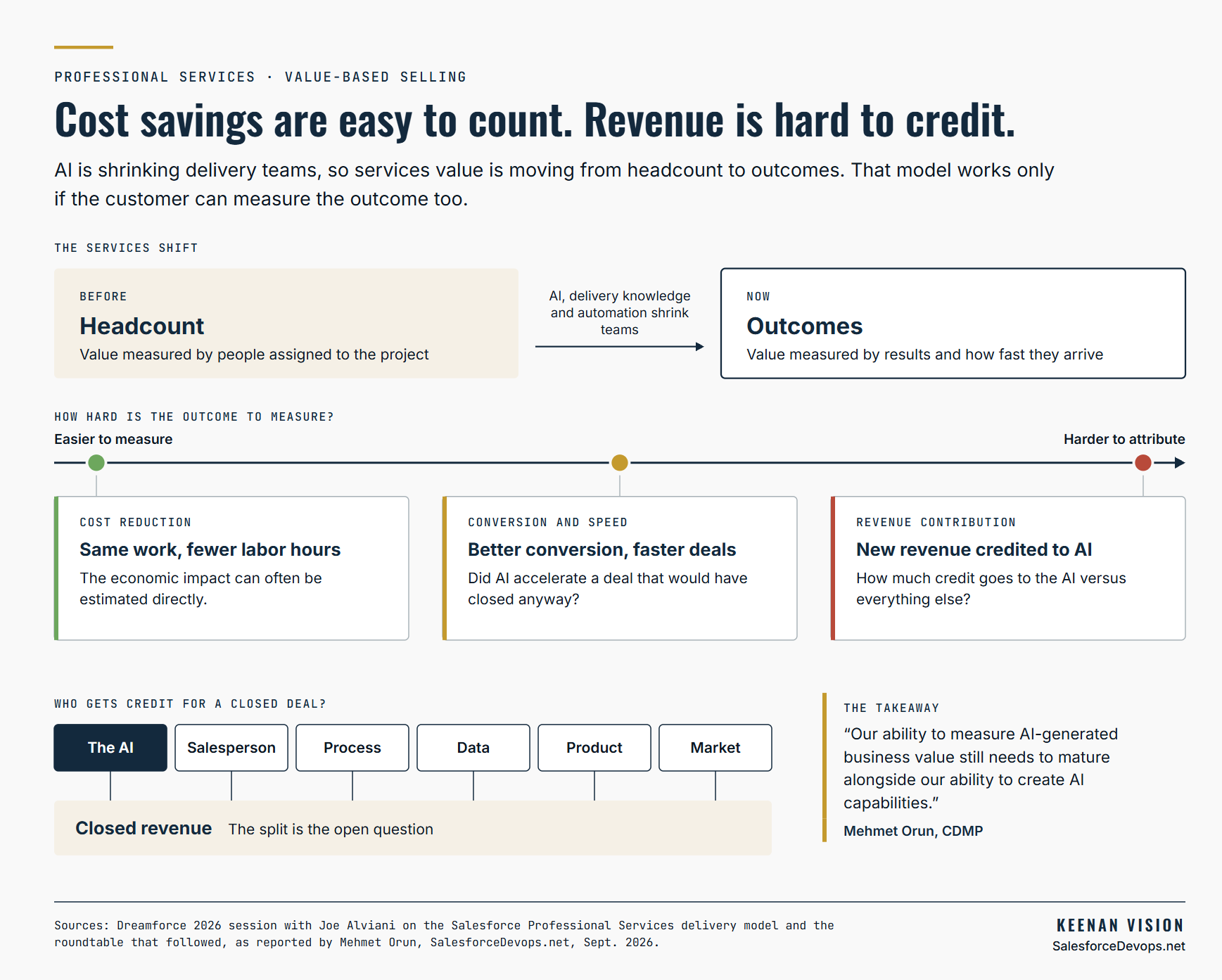
If technology makes implementation faster, continuing to measure services value primarily through the number of people assigned to a project becomes increasingly difficult to defend. The opportunity moves toward the value delivered and the speed with which it can be realized.
Our roundtable discussion surfaced the harder side of that transition.
Value-based selling requires more than a provider willing to price around outcomes. The customer has to be able to define and measure those outcomes as well.
Cost reduction is comparatively straightforward. If an agent allows a service organization to resolve the same volume of work with fewer labor hours, the economic impact can often be estimated.
Revenue contribution is harder.
Did the AI create the revenue? Did it improve conversion? And did it accelerate an opportunity that would have closed anyway? How much value should be attributed to the technology versus the salesperson, process, data, product, or market?
Those aren’t reasons to abandon value-based models. They are reasons to recognize that our ability to measure AI-generated business value still needs to mature alongside our ability to create AI capabilities.
The Portfolio Story Is Ahead of the Product Experience
Dreamforce also reminded me that there is still considerable work ahead.
Salesforce increasingly talks about Data 360, MuleSoft, Informatica, Tableau, Agentforce, security, governance, metadata, and its business applications as components of a common enterprise architecture.
But that isn’t always how a customer experiences them today.
I deliberately walked among different booths and asked variations of the same questions—for example, about data governance capabilities. The answers still tended to begin with the product represented at that particular booth.
That isn’t surprising. These technologies have different histories, teams, capabilities, and customers.
But it exposes the gap Salesforce now needs to close.
The strategy is more integrated than the customer experience is today.
If Salesforce wants customers to make broader commitments based on the value of its portfolio, it increasingly needs to make that portfolio behave—and be understood—as a solution rather than a collection of products.
The Enterprise AI Harness may provide part of the architecture for doing that.
Getting More From the AI Budget
This brings me back to what I think was one of the less obvious themes of Dreamforce.
The battle for the enterprise AI budget won’t be won simply by offering more AI.
There will be more models. More agents. More AI applications. More open-source alternatives. More specialized capabilities. And probably more ways to consume all of them than most organizations can reasonably manage independently.
The opportunity is to help enterprises decide what to use, when to use it, what context it requires, how to govern it, and whether the value produced justified the resources consumed.
Salesforce is unusually well positioned to compete for that role because of the business applications, customer data, metadata, workflows, permissions, integration infrastructure, and ecosystem it already has.
That doesn’t mean the outcome is predetermined.
The products still need to work together more seamlessly. Customers need meaningful visibility into consumption and value. The Harness and Control Plane need to deliver on their architectural promise. And Salesforce has to demonstrate that capturing a larger share of the customer’s technology wallet can actually leave the customer better off.
But I came away from my 15th Dreamforce believing that this is increasingly the contest Salesforce wants to enter.
Not simply:
How much of your AI budget can Salesforce capture?
But:
How much more can Salesforce help you accomplish with the AI budget you already have?
If Salesforce can answer the second question convincingly, the first may take care of itself.
Mehmet Orun is a longtime practitioner, architect, product leader, executive and Salesforce customer; as well as co-founder of Datablazers and founding board member of Dreamin’ in Data. Drawing on three decades of technology transitions, he shares perspectives spanning deep technical guidance and business strategy to help leaders and practitioners make better decisions about data, AI, and technology.