Agentforce Contact Center and the End of the Integration Era
Salesforce said something important in 2023. They said they did not want to become a contact center company.
On March 10, 2026, they became one.
This is not a product launch story. It is a platform sovereignty story. And the executives admitted it themselves — on the record, in a press briefing, in answer to a direct question.
Here is what happened, why it matters, and what it means for every enterprise running a contact center on Salesforce today.
Table of contents
The iPhone Moment That Actually Makes Sense
Kishan Chetan, EVP and GM of Agentforce Service, opened the briefing with the Steve Jobs iPhone analogy. That analogy gets used too often in tech. This time it fits.
Jobs stood on stage in 2007 and said he had three products: a music player, a phone, and an Internet device. Then he revealed it was one device. The magic was not the features. The magic was unification.
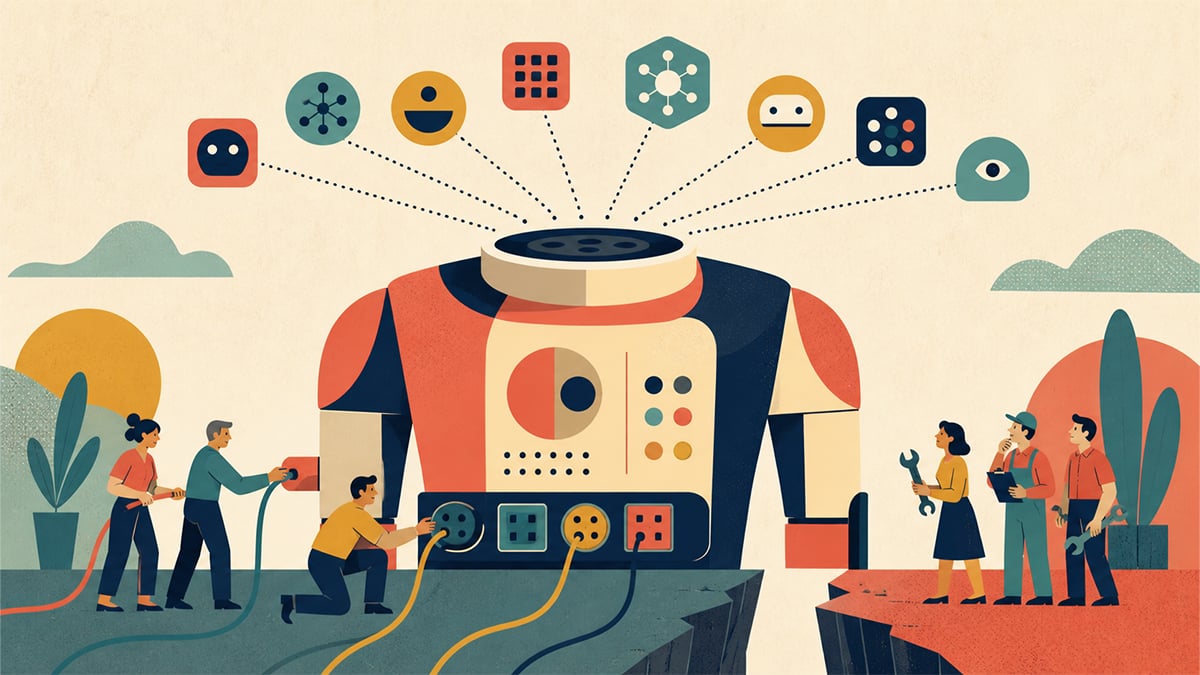
Salesforce is making the same argument about the contact center. For decades, enterprises ran three separate systems: a CRM, a telephony platform, and an AI layer. They were connected by integrations. Those integrations were expensive, slow, and leaky.
Agentforce Contact Center is Salesforce’s argument that it should be one system.
25 Years of Trying to Own the Phone
To understand this announcement, you need the history.
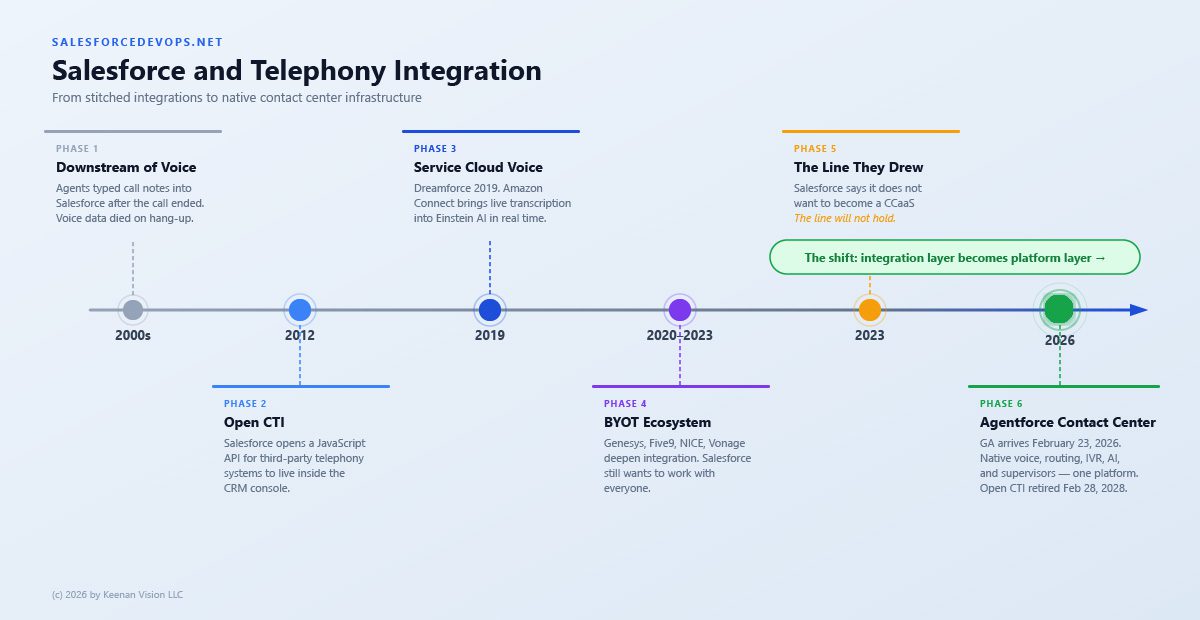
2000s: Salesforce was downstream of voice. Agents typed notes into the CRM after they hung up. Phone data died when the call ended.
2012: Salesforce launched Open CTI. It was a JavaScript API that let third-party phone systems connect to Salesforce. It created a whole ecosystem of integration partners. Voice data could now appear in the CRM console — but only what you built yourself.
2019: Salesforce announced Service Cloud Voice at Dreamforce, partnering with Amazon Connect. For the first time, voice transcription fed directly into Einstein AI in real time. This was a major step. But it still required a third-party telephony platform to carry the call.
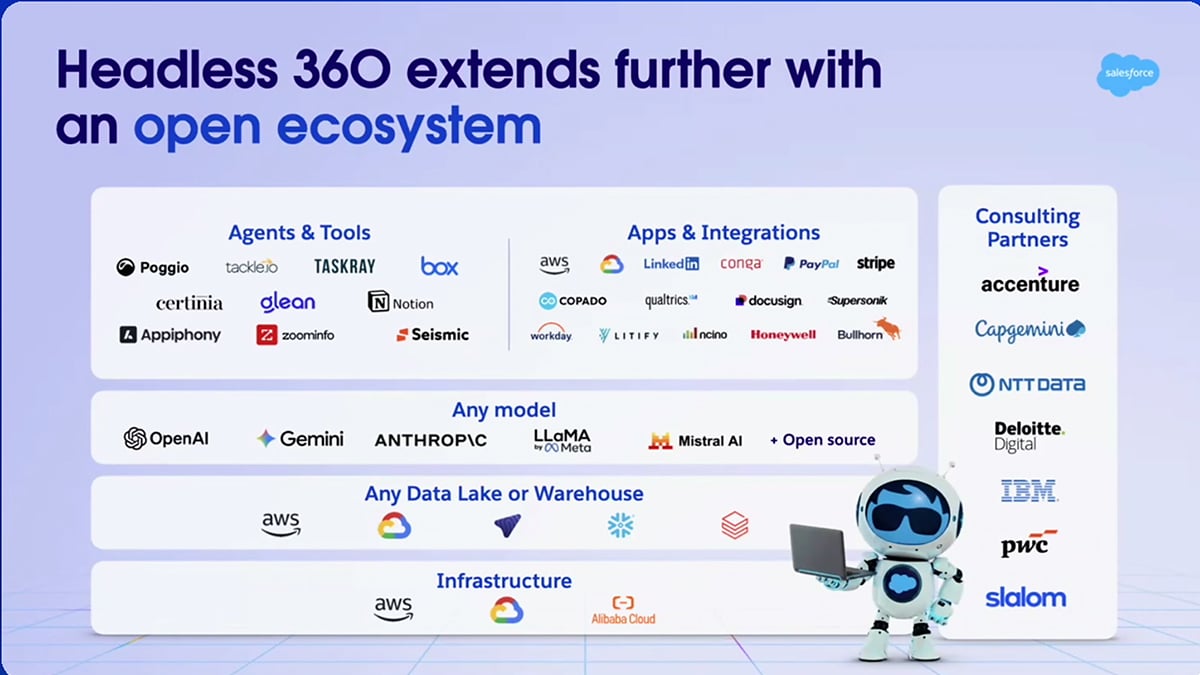
2020-2023: The ecosystem grew. Genesys, Five9, NICE, Vonage, and others all built deep integrations with Service Cloud Voice. Salesforce called this BYOT — Bring Your Own Telephony. The message was: we want to work with everyone.
2023: Salesforce explicitly said they did not want to become a CCaaS provider. That was the line they drew.
February 23, 2026: Agentforce Contact Center went generally available. The line was crossed.
What They Actually Built
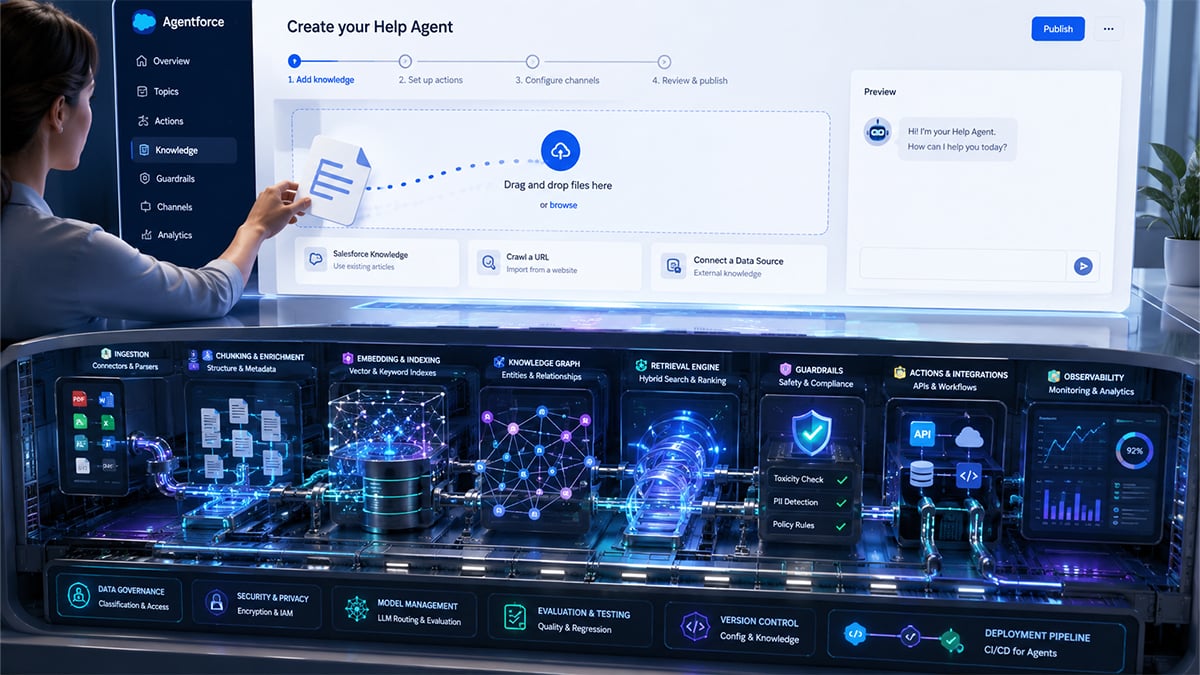
This is not Agentforce Voice plugged into an existing product. Gautam Vasudev, SVP of Agentforce Contact Center, was direct about this in the briefing: “We’ve actually just built out a whole native CCaaS offering, start to finish.”
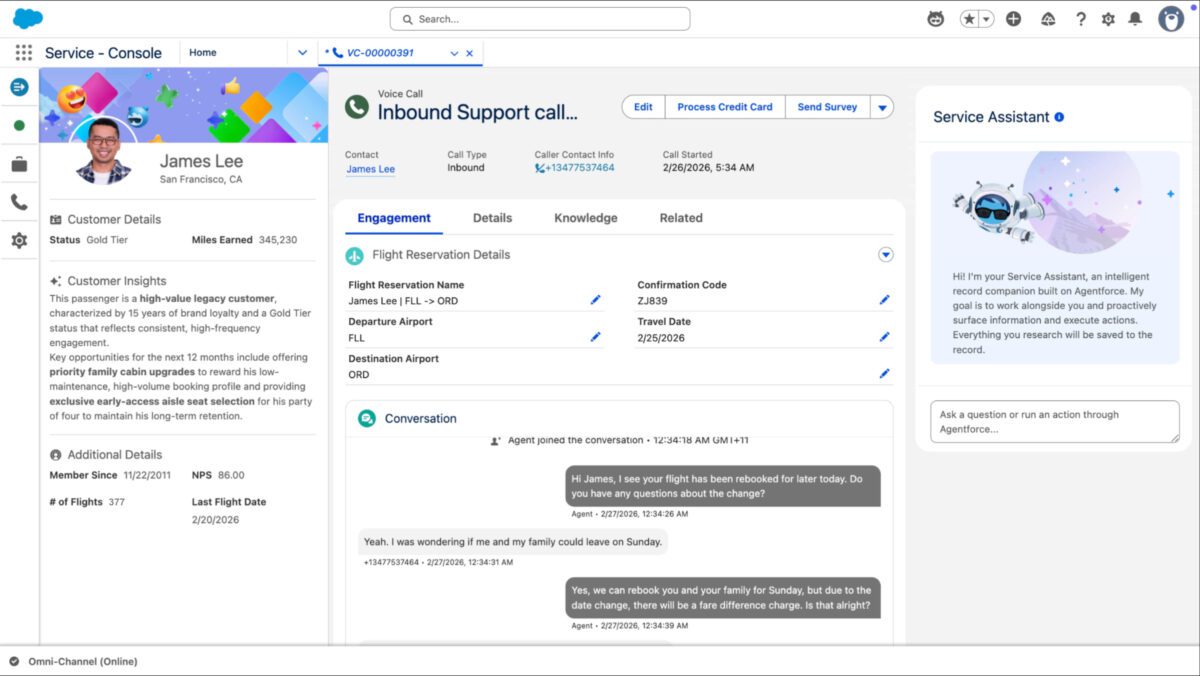
That means a full stack. Here is what is new and native:
- A voice channel built directly on the Salesforce platform — not on Amazon, not on Genesys
- IVR and IVA (Intelligent Voice Agent) capabilities built on Salesforce Flow
- One workspace for AI agents, human agents, and supervisors
- Phone number provisioning in minutes, not days
- Real-time sentiment and intent signals across all channels
- Unified routing engine that handles voice, chat, email, cases, and custom objects
The contact center market has a term for this: a single pane of glass. Salesforce’s version has one key difference. The glass is also the CRM. All the data is in the same place. There is no synchronization step. There is no integration to maintain.
The On-Record Admission
The most important moment in the briefing was not the demo. It was the Q&A.
A reporter asked the direct question: In 2023 Salesforce said it did not want to become a CCaaS provider. Why now?
Kishan Chetan’s answer explains everything: “As we bring AI agents and humans together, we realize that having all of the data in one place, making sure that the contexts are fully passed together, becomes really important. It’s a huge demand from our customers.”
Read that carefully. He is not describing a competitive decision. He is describing an architectural necessity.
When voice data lives in Genesys and customer history lives in Salesforce, there is a seam between them. At that seam, context degrades. The AI agent on the phone does not know what the customer bought last month. When the call escalates to a human agent, that agent starts partially blind.
Salesforce’s argument is that AI cannot work across that seam well enough. To deliver truly personalized, proactive service, the data must be unified at the foundation — not synchronized after the fact.
They also answered the harder question directly. A reporter asked: Is Salesforce now competing with NICE and Genesys? Chetan responded, “Yes, there will be places where we have overlapping capabilities and customers who look at both options.”
That is an unusually candid answer. Most platform companies avoid saying yes to that question. Salesforce said yes.
The Agent Context Engine: Why This Was Always Coming
Those of us who have been tracking Salesforce’s AI architecture have been watching this move develop for two years.
The core problem in AI-powered customer service is context. An AI agent needs to know who the customer is, what they have bought, what they have complained about, what channel they prefer, and what they tried before this call. That is a five-layer problem:
- Harmonized Context: all interaction data in one place
- Resolved Identity: knowing it is the same customer across channels
- Platform Enforcement: applying business rules consistently
- Semantic Model: understanding what the customer actually means
- Observability: watching the agent perform and learning from it
In the old overlay model — where CCaaS and CRM were separate platforms — Harmonized Context was structurally broken. You could not harmonize context you could not see. Voice data was a dark continent. The call happened, the customer hung up, and the CRM had a note — if the agent remembered to type one.
Agentforce Contact Center closes that gap. Voice is now native data. Every call is transcribed, logged, and searchable. Every handoff carries full context. The AI agent and the human agent share the same record.
This is what makes the contact center the highest-stakes proving ground for agentic AI. The failure modes are visible and immediate. A customer repeating themselves is not an abstract data quality problem. It is a broken experience that loses trust in real time.
What the Customers Said
The customer roundtable in the briefing produced some of the most useful evidence in the entire announcement. These were unprompted, unscripted responses from pilot customers.
George Reuter, Managing Director at Compass Working Capital, gave the most analytically important framing: “Agentforce Contact Center is really doing two things… we’re leaping two generations. One, we’re moving to just a modern omni-channel presence. But at the same time, what Agentforce Contact Center is allowing us to do is embed AI tooling as part of how they manage that.”
He did not say this was a better integration. He said it was a generational skip.
And he also gave a specific number. Compass has 30 coaches. Each coach spends 30 minutes per appointment on data entry. Each coach handles about 400 appointments per year. With AI handling that data entry, Compass estimates saving 6,000 hours annually across the organization.
Beth LeClerc, VP of Business Systems at Savant Systems, added a line that tells the whole story about the end of the integration era: “This is one of the last areas where we have resources on my team focusing on support, maintenance, integration with other technologies. I’m really excited to bring them a native and holistic and cohesive offering.”
In enterprise IT, ‘resources focused on integration maintenance’ is a polite term for money spent keeping the lights on. That cost disappears in a native architecture.
On the AI containment side, Gautam Vasudev reported pilot results from travel and hospitality: “We’re seeing 40 to 60 percent containment, which means the voice agent itself was able to handle the customer request with high quality, without a subsequent escalation.”
A 40-60% autonomous resolution rate on voice calls is significant. It is not a chatbot deflecting web queries. It is an AI agent handling phone calls — the highest-effort, highest-trust customer service channel.
The Quiet Erosion Comes for the Call Center
There is a pattern we have been tracking for three years. It does not announce itself. A pattern that does not arrive with layoff notices and press releases. It moves the way water moves through limestone. Slowly. Invisibly. Until one day the ground gives way.
We call it the Quiet Erosion.
Stanford’s Digital Economy Lab documented a 13% employment decline among workers aged 22 to 25 in AI-exposed occupations. Those are the people who answer phones for a living. They are the first hired and the first replaced. They are the entry point of the contact center labor pyramid. But the contact center is not special. It is simply the most visible version of a problem spreading across every AI-touched profession.
Ask a software engineering manager today where their senior developers came from. They will tell you: they started by fixing bugs. By writing tests. By doing the unglamorous work that nobody else wanted. That work is disappearing. GitHub Copilot and its successors are consuming the entry-level coding queue the same way Agentforce Voice is consuming the entry-level service queue. The junior developer pipeline is thinning. The junior agent pipeline is thinning. In five years, organizations will wonder why they cannot find experienced people. They will have forgotten that experience must be grown somewhere.
This is the structural contradiction at the heart of the AI labor transition. Every efficiency gain at the entry level is a subtraction from the training ground that produces the advanced workers who handle the hard cases. George Reuter of Compass Working Capital did the math for us without meaning to. Thirty coaches. Four hundred appointments each per year. Thirty minutes of data entry per call, eliminated by an AI agent. Six thousand hours reclaimed annually. At a thirty-person organization.
Scale that to a contact center running five hundred seats. Then ask who handles the escalations in 2029 when years of entry-level hiring has been skipped.
The 40 to 60 percent containment rates Vasudev cited for travel and hospitality pilots sound like a victory. And in the short term, they are. Those are resolved cases. Lower costs. Higher CSAT. But those are also the cases that taught a generation of agents how to listen, how to de-escalate, how to read a frustrated customer and find the path through. That curriculum is being automated away.
The Quiet Erosion does not fire anyone on day one. It simply stops hiring. Attrition does the rest. And when the AI finally surfaces a case too complex to contain, the kind that requires judgment earned through ten thousand simpler calls, there will be fewer and fewer humans left who have done the work to earn that judgment.
That is not a Salesforce problem. It is a civilization problem. And the contact center is just where we are watching it happen first.
The Executive Takeaway
Salesforce has moved from being the CRM of record for contact centers to being the operating system of the contact center itself. This took 14 years. From Open CTI in 2012 to a fully native, fully agentic contact center in 2026.
The total cost of ownership calculation has changed. The integration tax — the cost of connecting CCaaS platforms to CRM through middleware, APIs, and consulting labor — disappears in a native architecture. The trade-off is vendor lock-in and reduced depth in workforce management and compliance analytics where NICE and Verint still lead.
For enterprise CIOs evaluating contact center investments in 2026, one question cuts through the noise. How much do you spend annually keeping your CCaaS platform and Salesforce talking to each other? If that number exceeds $200,000 — a threshold that mid-market contact centers running 150 seats routinely cross — the Agentforce Contact Center TCO case becomes structurally compelling regardless of feature tradeoffs.
Do that audit. Do it in the next 30 days.
As for the Quiet Erosion that follows — the thinning of entry-level queues, the slow disappearance of the training ground — that is a consequence Salesforce neither controls nor is responsible for navigating. We are living through an Oppenheimer moment in enterprise technology. The scientists built the device. The generals decide where it lands. Right now the generals are enterprises and governments, operating in an environment with no meaningful AI labor regulation in sight. Salesforce’s job is to build the best platform it legally can. What enterprises choose to do with six thousand reclaimed hours is entirely up to them.
Vernon Keenan is the founder of Keenan Vision LLC and the publisher of SalesforceDevops.net. He has tracked the Salesforce ecosystem for over 25 years and advises enterprise technology leadership on AI strategy, platform economics, and digital transformation.