Companies are starting to use AI agents not just as tools, but as workers. These Virtual Employees handle customer service cases, qualify sales leads, write code, and manage data—jobs that used to require a person. Virtual Employee Economics is a framework that explains how this shift works, using three laws.
This isn’t speculation. The evidence comes from peer-reviewed studies at Harvard, Stanford, and MIT, earnings reports from Salesforce and Microsoft, and payroll data covering millions of American workers.
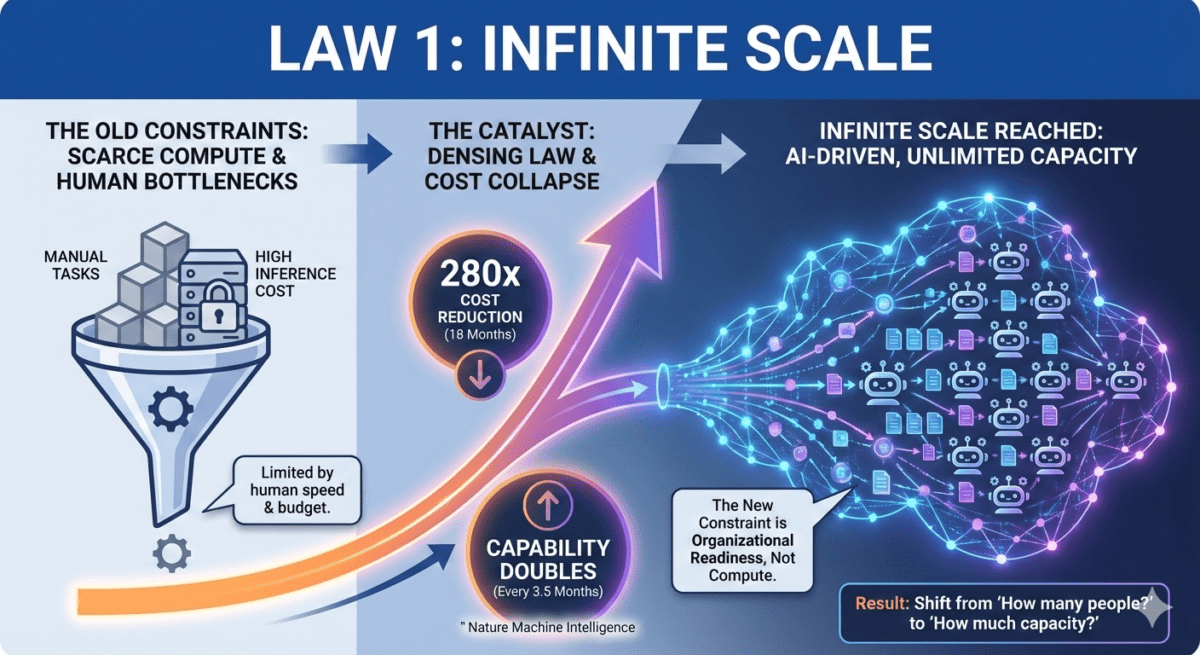
Once AI learns to do a job, it can do that job a million times at almost no extra cost.
AI inference costs fell 280x in 18 months while capability density doubles every 3.5 months — the bottleneck has shifted from compute to organizational readiness.
Think about what happens when a company trains one customer service agent. It takes weeks. Now think about what happens when an AI agent learns to resolve a billing dispute. That knowledge instantly scales to every customer interaction across the platform—simultaneously.
The numbers are striking. The cost of running AI models dropped 280 times in just eighteen months, according to Stanford’s 2025 AI Index. Salesforce now processes 3 billion automated workflows per month through Agentforce. Microsoft served 500 trillion tokens through its AI platform in a single year, seven times more than the year before.
The catch
Scale is cheap, but getting ready for scale is not. Most AI agent projects still fail—roughly 80–95% of them—because companies’ data is messy, their processes aren’t documented, and their teams aren’t prepared. The AI works. The organizations often don’t.
Law 2: Cognitive Commoditization
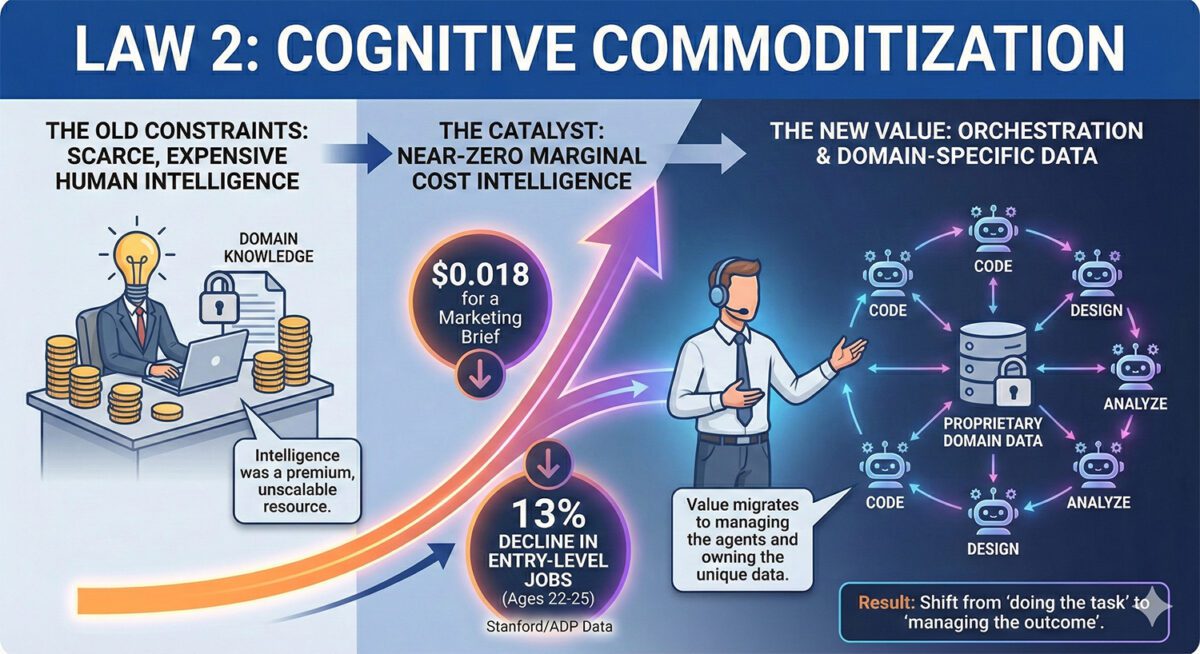
When AI can do what your entry-level employees do, the value of that work drops to near zero.
Intelligence is no longer scarce — Stanford payroll data shows a 13% employment decline for workers ages 22–25 in AI-exposed roles. Value migrates to orchestration and proprietary data
Here is the most replicated finding in AI research: when you give AI tools to a group of workers, the people who improve the most are the ones who were struggling. In a study of 5,000 customer service agents, novices got 34% more productive with AI assistance. Top performers barely changed. The AI was essentially copying the best workers’ techniques and giving them to everyone else.
The same pattern showed up with management consultants at BCG (+43% for below-average performers), software developers at Microsoft (+26% task completion), and professional writers in a study published in Science (+37% speed, with the weakest writers gaining the most).
The real-world consequence: Stanford researchers analyzed payroll data and found a 13% decline in employment for young workers (ages 22–25) in AI-exposed jobs since 2022. Companies aren’t laying people off. They’re just not hiring the next generation for those roles.
The catch
Commoditization hits codified, repeatable skills, the kind you can write a manual for. It doesn’t touch judgment, relationship-building, creative problem-solving, or deep domain expertise. Those skills become more valuable as everything around them gets cheaper.
Law 3: Exponential Learning
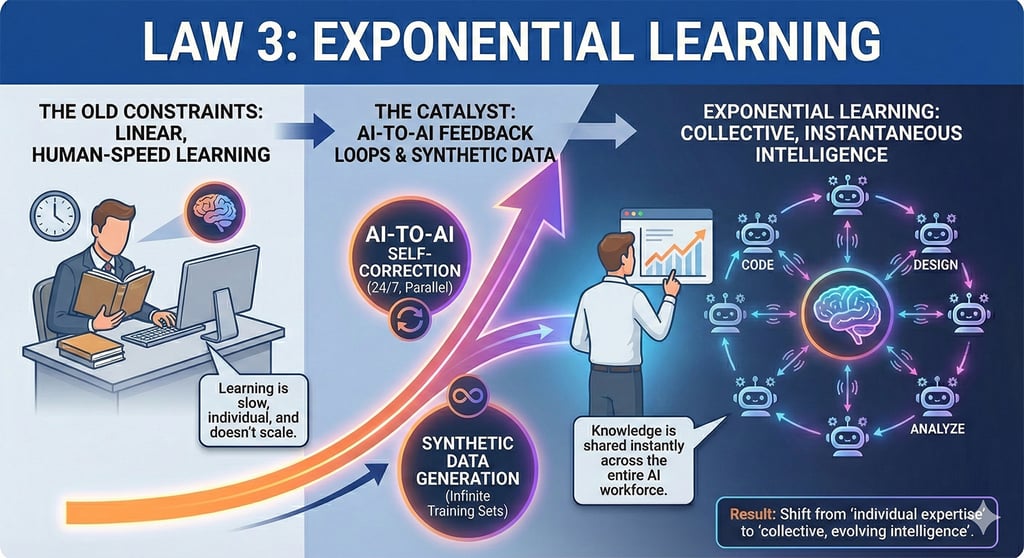
AI gets better at an accelerating rate—but only if you build the system to let it learn.
AI capability density doubles every 3.5 months at the platform level — but only firms that build feedback architectures will capture the exponential at the enterprise level
AI model capabilities are improving at a pace that’s hard to overstate. In coding, AI performance on a standard benchmark (SWE-bench) jumped from 4.4% to 71.7% in one year. An analysis in Nature Machine Intelligence found that AI capability density doubles every 3.5 months—faster than Moore’s Law ever was.
Platforms like Salesforce and Microsoft already run massive learning loops: every customer interaction generates data that feeds back into better models. Zendesk trains its AI on 19 billion historical service tickets. Each query makes the next one better.
The catch
This exponential improvement lives at the platform level. Most individual companies don’t get it. An MIT study found that most corporate AI systems “don’t retain feedback, don’t accumulate knowledge, and don’t improve over time.” Klarna learned this the hard way: they replaced 853 customer service roles with AI, saved $60 million, then watched quality decline until they had to start rehiring humans.
What Should You Do About It?
Fix your data before you deploy AI. Most Agentforce failures aren’t technology problems. They’re data problems—dirty metadata, inconsistent object models, undocumented business logic. Start there.
Build feedback loops into every deployment. If your AI agent can’t learn from its mistakes, it’s a static tool, not a Virtual Employee. Score agent outputs. Route failures to human review. Feed corrections back in.
Invest in what AI can’t replace. Domain expertise, organizational knowledge, client relationships, and the judgment to know when the AI is wrong. Those are worth more now than they were a year ago.
Watch the pricing shift. Salesforce moved from $2 per conversation to $0.10 per action. If your business charges by the hour or by the seat, the economics are moving against you. The future is outcome-based pricing.
The Bottom Line
The Three Laws of Virtual Employee Economics describe forces that are already operating—not predicting a distant future. AI costs are collapsing. Entry-level cognitive work is being commoditized. AI models are learning at exponential rates. The gap between what AI can do and what most organizations are doing with it is the biggest story in enterprise technology right now.
The firms that understand these laws and act on them will build compounding advantages. Everyone else will be playing catch-up.
Vernon Keenan is Founder of Keenan Vision and Senior Industry Analyst at SalesforceDevops.net.
To provide the best experiences, we use technologies like cookies to store and/or access device information. Consenting to these technologies will allow us to process data such as browsing behavior or unique IDs on this site. Not consenting or withdrawing consent, may adversely affect certain features and functions.
Functional
Always active
The technical storage or access is strictly necessary for the legitimate purpose of enabling the use of a specific service explicitly requested by the subscriber or user, or for the sole purpose of carrying out the transmission of a communication over an electronic communications network.
Preferences
The technical storage or access is necessary for the legitimate purpose of storing preferences that are not requested by the subscriber or user.
Statistics
The technical storage or access that is used exclusively for statistical purposes.The technical storage or access that is used exclusively for anonymous statistical purposes. Without a subpoena, voluntary compliance on the part of your Internet Service Provider, or additional records from a third party, information stored or retrieved for this purpose alone cannot usually be used to identify you.
Marketing
The technical storage or access is required to create user profiles to send advertising, or to track the user on a website or across several websites for similar marketing purposes.