Gartner Crowns Salesforce Data 360 as CDP Leader — But the Real Story Is the Category Shift
The 2026 Magic Quadrant reveals a market “bifurcating into platformization and agentification”
Gartner has released its 2026 Magic Quadrant™ for Customer Data Platforms, and Salesforce is the definitive Leader — positioned furthest right on both Completeness of Vision and Ability to Execute. But the ranking itself isn’t the story. The story is about what Gartner now expects this category to deliver.
In its evaluation, Gartner describes Salesforce Data Cloud (recently renamed to Data 360 in October 2025 at Dreamforce) as demonstrating “an innovative vision for a context engine for unifying structured and unstructured data to serve as a foundation for agents and automation.” That phrase — context engine — signals a fundamental shift in how the analyst firm views this market. This isn’t a marketing technology evaluation anymore. It’s an assessment of which vendors can provide the foundation for enterprise AI.
Table of contents
The Market Bifurcation
Gartner’s opening line sets the frame: “The customer data platform market is bifurcating into platformization and agentification.” The firm advises buyers to “assess their needs for orchestration or autonomy, prioritize warehouse-native and composable architectures, evaluate cost-to-value and invest in agentic AI and automation.”
This represents a decisive break from historical CDP evaluations focused on marketing data unification and campaign activation. Gartner now describes CDP technology as “an enterprise data strategy and technology decision” where “enterprise IT organizations view the investment as an essential component for both upstream technical users and downstream business users.”
The implications are significant. Leaders in this market, according to Gartner, “support the expanded, enterprise-wide scope of the CDP, which now serves as an intelligent data fabric and context engine.” The category has evolved from marketing tools to enterprise data foundation.
Why Salesforce Won
Gartner’s evaluation highlighted several capabilities that drove Salesforce’s positioning.
On vision, the report states Salesforce “has a broad product strategy, delivering an emerging set of agent orchestration capabilities, inclusive of agentic AI that can autonomously make decisions and take actions across Marketing, Sales, Service, Commerce, Analytics and Industry Clouds.” This cross-functional scope distinguishes platform leaders from vendors still focused on marketing activation.
On execution, the numbers are substantial. Gartner reports Data 360 “has been deployed by more than 25,000 organizations, with over 60 trillion records unified and more than 4 trillion activations in 2024.” Zero-copy federation — the capability that enables Data 360 to query external data warehouses without moving data — is “growing nearly 300%,” allowing enterprises to leverage existing data warehouse investments.
Rahul Auradkar, President of Data Foundations at Salesforce, frames the competitive distinction directly: “Most competitors have always stuck with the ‘M’ in CDP — they’ve really been marketing data platforms. We put the ‘C’ back in CDP.”
The contrast with other vendors validates this framing. Gartner positions Adobe as a Visionary rather than a Leader, noting that “Adobe’s CDP is a marketing-centric platform and is not well suited to solve enterprise-wide CDP needs.” The evaluation criteria have shifted beneath vendors still optimizing for campaign activation.
What This Means in Practice
The abstract concept of a “context engine” becomes concrete when you see it deployed. Dr. Romi Chopra offers a compelling example.
Chopra is a physician-entrepreneur who founded MIMIT Healthcare, building what he calls an “agentic enterprise” on the Salesforce platform. His architecture wraps an intelligent operating layer around traditional electronic health records, using MuleSoft for integration and Data 360 as the unifying substrate.
“Data is like oil,” Chopra explains. “If it’s in different tanks everywhere, it doesn’t work. So, we got it all in one place — we harmonized it, we unified it, we segmented it, we activated it. Now if a patient comes in, their labs from somewhere else, their records from somewhere else — through Data 360, I click on their 360 profile and I can see it all.”
The results are tangible. Patients reach their care team 24/7 via text, WhatsApp, or email. AI agents summarize medical histories. Care teams coordinate through Slack with full visibility into patient context. When a patient experiences post-procedure complications at 2 AM, they message the contact center, the on-call physician responds with complete context, and the interaction is logged for the morning team — all without an emergency room visit.
“Today we are wall-to-wall Salesforce,” Chopra says. “We are basically an agentic enterprise. All your data — structured, unstructured, wherever it lives — we collect it, put it in Data 360. AI agents do summaries. We have a 360 profile. We activate it all with one mission: to make sure the patient does well.”
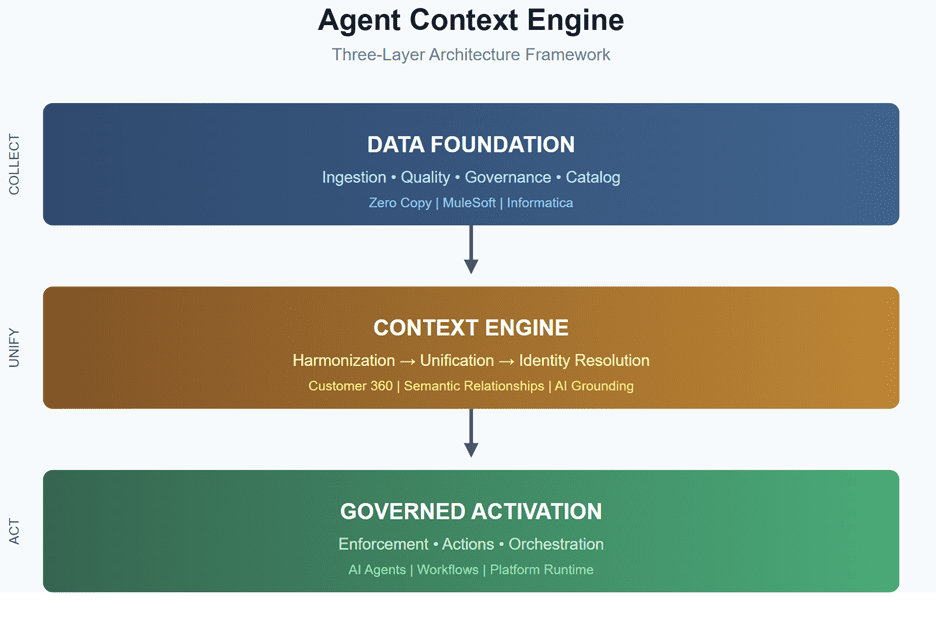
The Agent Context Engine Framework
Gartner’s repositioning validates a framework we’ve been developing to explain why most enterprise AI initiatives fail to move beyond pilot.
The famous MIT study documented that 95% of generative AI pilots fail to become economically productive. Our UC Berkeley Haas research partnership, published as “Architecture as Strategy” in summer 2025, found reports of 87% failure rates specifically for Agentforce proof-of-concept deployments. The pattern is consistent: enterprises struggle not with AI model capabilities, but with data foundation readiness.
Gartner’s two paradigms — platformization and agentification — map directly to this challenge. Platformization leaders like Salesforce provide the unified data substrate that agents require. Agentification leaders pursue autonomous AI but depend on that substrate existing. Without a context engine that harmonizes and unifies data across the enterprise, agents cannot reason accurately.
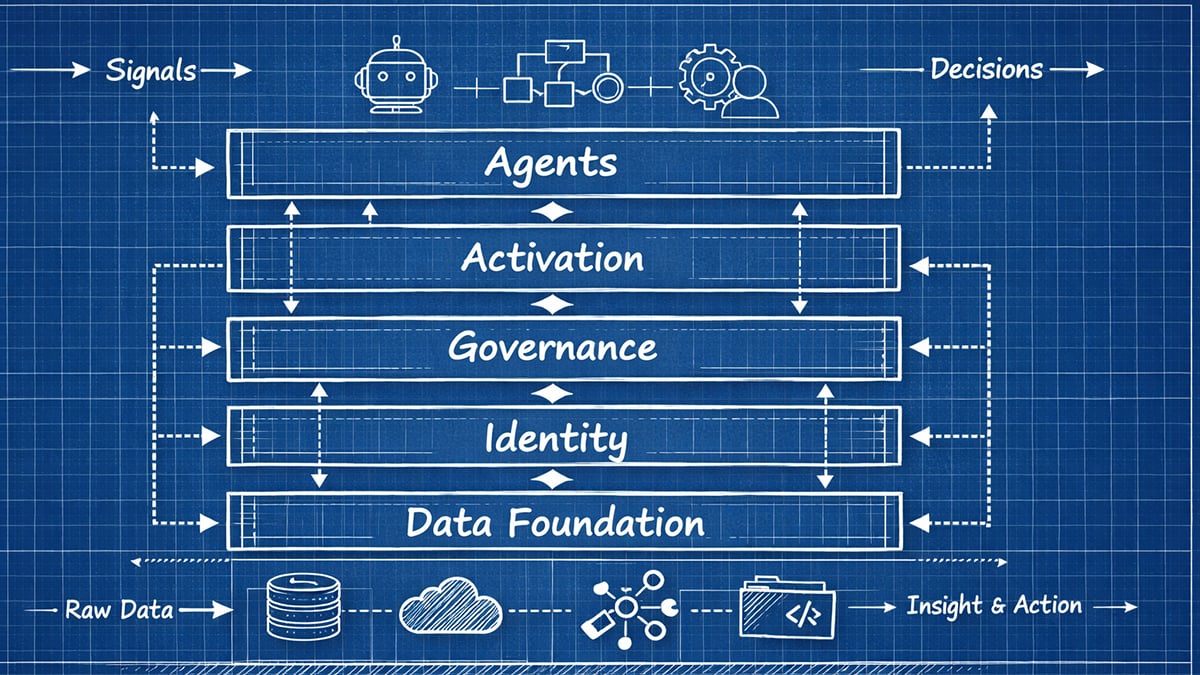
The Agent Context Engine framework provides a lens for evaluation:
- Data Foundation Layer. Ingestion, quality, and governance. This is where tools like MuleSoft, Zero Copy federation, and Informatica operate. Data must be collected and cleaned before it can be harmonized.
- Context Engine Layer. Harmonization, unification, and identity resolution. This is Data 360’s core function — taking data from disparate sources, mapping it to consistent structures, and resolving identities across systems. Gartner’s description of CDP as “intelligent data fabric and context engine” points here.
- Governed Activation Layer. Enforcement and action pathways. The Salesforce platform handles runtime governance — determining who can access what data and which actions agents can take. This is where Agentforce connects to deliver business outcomes.
The Cautions
Gartner’s evaluation includes cautions that warrant attention.
- On pricing: “Although Salesforce has begun to simplify its pricing model, the complexity of its licensing and the introduction of consumption-based pricing still present challenges to some clients, particularly when scaling usage or integrating multiple Salesforce products.”
- On ecosystem dependency: “Clients report the best outcomes when using Data 360 alongside other Salesforce products. Those with non-Salesforce systems and heterogeneous data environments may face additional complexity.”
- On enablement: “Customers who invest in Data 360 enablement have better outcomes than customers that do not. Training, certification and organizational change management are key success factors.”
These cautions align with broader patterns in enterprise AI adoption. The technology capabilities exist, but organizational readiness often lags.
Market Implications
For Salesforce customers, Data 360 investment is validated. The path from data foundation to Agentforce adoption is clearer. Organizations that have invested in Data 360 are positioned for what Gartner calls the “agentification” transition.
For competitors, the bar has moved. Marketing-centric CDP plays are now competing in a different category than enterprise context engines. Gartner’s explicit statement that Adobe is “not well suited to solve enterprisewide CDP needs” signals where the evaluation criteria have shifted.
For enterprises evaluating AI strategy, the question changes. Stop asking “which AI model should we use?” and start asking “do we have a context engine?” The model layer is commoditizing rapidly. The context layer — harmonized, unified, governed data that agents can reason over — is where competitive advantage accumulates.
The Takeaway
The 2026 Gartner Magic Quadrant for Customer Data Platforms isn’t just a vendor ranking. It’s a market signal that the category definition has shifted from marketing data unification to enterprise context foundation.
Gartner’s framing is explicit: the market is “bifurcating into platformization and agentification.” The CDP now serves as “an intelligent data fabric and context engine.” Buyers should “invest in agentic AI and automation.”
The question for enterprise leaders isn’t whether Salesforce won — they did, decisively. The question is whether your organization’s data architecture can serve as the context engine that AI agents require. The winners in the agentic era won’t be those with the best models. They’ll be those with the best context.
Download the Gartner 2026 Magic Quadrant™ for Customer Data Platform report here.
GARTNER is a registered trademark and service mark of Gartner, Inc. and/or its affiliates in the U.S. and internationally and is used herein with permission. All rights reserved. Gartner does not endorse any vendor, product or service depicted in its research publications, and does not advise technology users to select only those vendors with the highest ratings or other designation. Gartner research publications consist of the opinions of Gartner’s research organization and should not be construed as statements of fact.
Vernon Keenan is CEO of Keenan Vision LLC and publisher of SalesforceDevops.net. He serves as a strategic advisor to enterprise technology leaders on AI adoption and platform strategy.