AgentExchange: Salesforce’s Bet That Trust Can Scale With Agentic Speed
Salesforce Unifies AppExchange, Slack Marketplace, and Agentforce Ecosystem Into Single AgentExchange Marketplace
The 20-year-old AppExchange gets its biggest overhaul yet, consolidating more than 13,000 apps, agents, and integrations under one roof — with a $50M fund to keep the partner pipeline flowing.
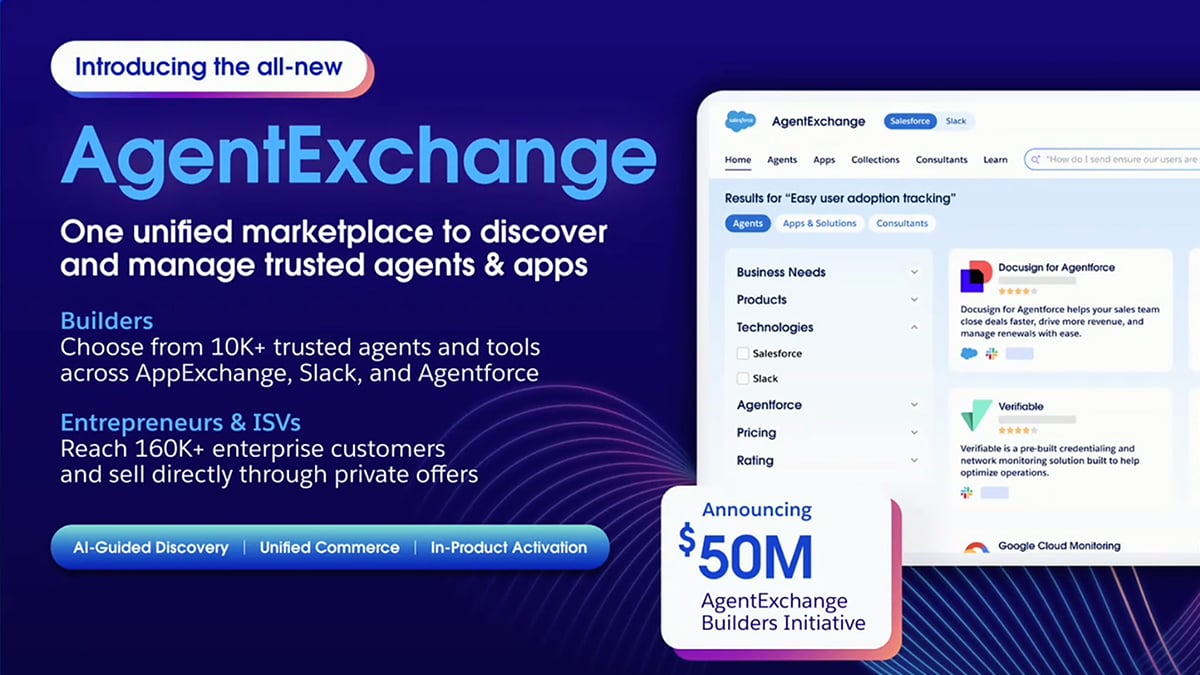
Salesforce today launched the unified marketplace that merges AppExchange, Slack Marketplace, and the Agentforce ecosystem into a single discovery and procurement experience — pulling more than 10,000 Salesforce apps, 2,600 Slack apps and agents, and over 1,000 Agentforce agents, sub-agents, tools, and MCP servers into one searchable catalog with integrated billing, semantic search, and one-click activation. The launch arrives alongside a $50 million AgentExchange Builders Initiative for ISV partners building in the Virtual Employee economy. “What’s really changing here in the agentic enterprise is that work does not happen in one place anymore,” Tyler Carlson, SVP and Head of Product for AgentExchange and Ecosystem at Salesforce, told industry analysts in a TDX press briefing this morning.
“A sales workflow might need Salesforce data, an approval flow in Slack, an AI agent surfacing insights and next-best actions right in the flow of work. Until now, customers have had to piece that together across different surfaces and different activation flows, which creates friction and breaks momentum.”
That friction is what AgentExchange is built to eliminate.
Carlson dropped one more number worth pausing on: 800% year-over-year growth in new agent creation on the Slack platform alone. The agentic landscape is already confusing to navigate, and it is getting more so by the week. AI coding platforms now ship production-ready agents in days rather than quarters, accelerating speed-to-market exponentially and putting more inventory on the shelves than any business buyer can reasonably evaluate.
Table of contents
Discovery-to-Deployment Solution
Carlson framed AgentExchange as “a simpler way for customers to move from discovery to deployment of all of these third-party applications.” On a slide, that sounds modest. In a demo, it looks slick. In real life, it is one of the hardest engineering and partnership problems in B2B software.
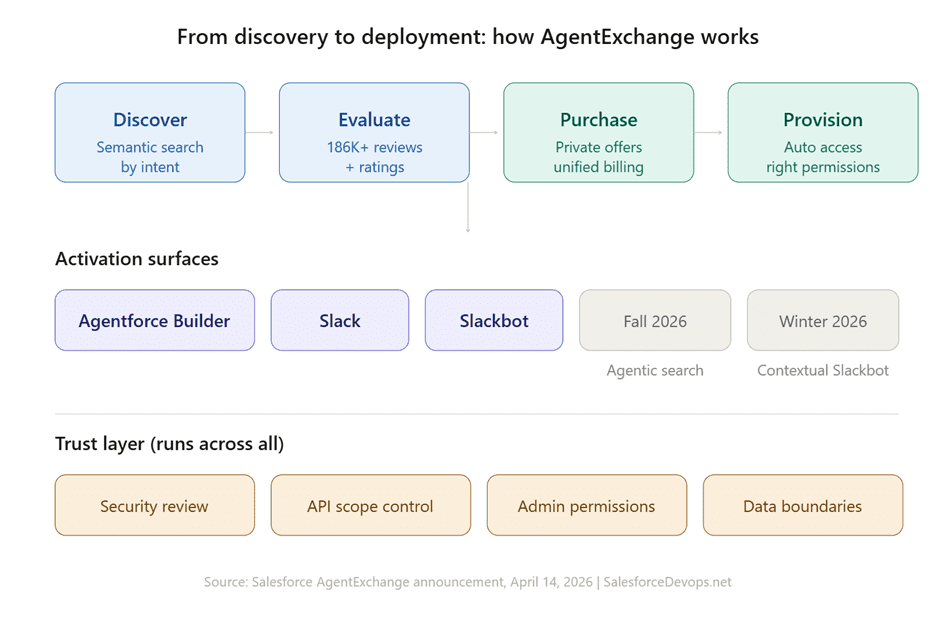
I’ve led partner ecosystems. Building a seamless flow that takes a customer from “I’m not sure what I need” to “the licenses are provisioned, billing is consolidated, and the right people have access” — without chasing approvals across three legal teams and several billing systems — is momentously difficult to pull off. Most enterprise marketplaces tolerate that friction because removing it is a years-long integration problem crossing CRM, ERP, identity, and partner finance.
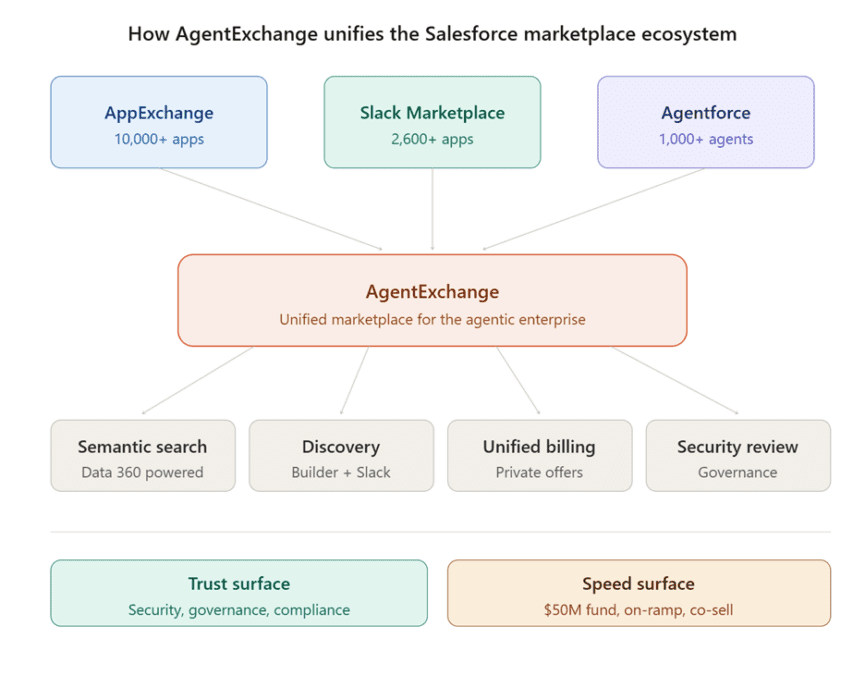
If AgentExchange delivers what the demo showed — private offers requested in the marketplace, accepted in Slack, provisioned automatically, invoiced through the customer’s existing Salesforce account — that is a meaningful step forward that deserves credit. Business leaders trying to rationalize agent spend across an exploding category need a clear path from “this might be the right tool” to “the team is using it.” AgentExchange is structurally an attempt to give them that.
Trust That Scales With Speed
This is the tension AgentExchange is built to resolve, and the one I’ll be watching most closely.
Speed and trust are usually at odds. Consumer app stores pick speed. Enterprise procurement picks trust. The agentic enterprise can’t pick either. Every MCP server is a new trust surface. Every sub-agent is a new permissions question. And every cross-platform integration is a new place where the wrong scope gets granted to the wrong account. If governance lags capability, the gains we get from AI are offset by the risks we incur from ungoverned, unvetted agent sprawl. A trusted marketplace like AppExchange has to evolve into the distribution layer for agents specifically because the rest of the market isn’t going to do this work on its own.
Every solution listed undergoes Salesforce’s security review. Admins retain control over data permissions, API scopes, and integration boundaries at the user, role, and profile level. The marketplace exposes more than 186,000 customer reviews. Carlson, asked about reliability on the call, put it plainly: customers shouldn’t have to choose between the autonomy agents unlock and the trust they require.
The honest read is that this is necessary but not sufficient. A unified governance surface is better than three separate ones. But who decides when an agent’s behavior drifts after deployment? Who is liable when a sub-agent exfiltrates data through a tool call that was approved at install time? These questions are not in the press release. They are the ones the next two years will spend answering.
The $50M Builders Initiative
Stricter security enforcement is necessary to protect customers, but it inherently raises the barrier to entry for smaller ISVs. The $50 million AgentExchange Builders Initiative is the counterweight — capital, engineering support through the Salesforce Approved Forward Deployed Engineering Partner Network, and new go-to-market programs including lead referrals and marketing development funds. It explicitly targets the five-person coding shops and early-stage startups that historically struggle to clear enterprise security bars on their own, ensuring the push for platform trust doesn’t choke the long tail of innovation that made AppExchange valuable in the first place.
That balance is the whole game.
Early Signals From the Ecosystem
MeshMesh, an AI-native implementation platform, achieved $2 million in marketplace revenue within nine months of its AgentExchange listing — with 80 percent of customers originating from in-product discovery rather than outbound sales. “AgentExchange gives Salesforce customers direct access to MeshMesh to implement and operate the entire ecosystem of Salesforce clouds and products by simply asking,” said Kevin Nuest, MeshMesh co-founder and CEO. “Teams save 80 to 95 percent in time and cost, delivering the time-to-value they need to compete and win.”
Customer outcomes are landing too. Humana Dental cut provider credentialing from 60 days to less than 24 hours using Verifiable’s app — a 98 percent reduction that netted seven-figure cost savings. Siemens Digital Industries is using Certinia’s Project Agent to flag at-risk deliverables before they become problems. Sanofi reports a 15 percent cost reduction in pharmacovigilance operations in its first year using IQVIA’s compliance app, with a target of 50 percent by 2027.
AgentExchange is live today, with agentic search, intelligent app comparisons, and a streamlined Agentforce Builder installer arriving in fall 2026, and contextual Slackbot discovery following in winter.
The Distribution Layer for the Virtual Employee Economy
When agents, sub-agents, and MCP servers become discoverable and deployable alongside traditional apps, the distribution economics of the Virtual Employee economy begin to take shape. Consider MeshMesh’s 80 percent in-product discovery rate. In traditional SaaS distribution, customer acquisition depends on outbound sales and brand awareness. In marketplace-native distribution, the agent finds the customer at the moment of need, not the other way around. It’s the kind of data point that crystallizes a broader shift we’ve been tracking — the center of gravity in enterprise AI moving from model quality to system design.
Whether the bet pays off depends on execution. The seamless purchasing flow has to work at scale, not just in demos. The security review process must keep pace with the rate of new agent submissions. The Builders Initiative has to open the on-ramp for the long tail, not just the partners Salesforce already knows.
But the architectural decision — collapsing three storefronts into one governed distribution layer with capital behind the on-ramp — is correct. Trust has to scale with speed, or the agentic enterprise eats itself. AgentExchange is Salesforce making the case that it doesn’t have to.
Alecia Wall is Director of Ecosystem Development, Enterprise AI at Keenan Vision LLC and a UC Berkeley Haas School of Business alum. She is co-author of Architecture as Strategy, research documenting enterprise AI deployment patterns and why 95% of GenAI pilots fail. She covers platform orchestration, multi-agent governance, and enterprise AI ecosystem dynamics for SalesforceDevops.net, with a lens that extends beyond Salesforce to the broader market of vendors, integrators, and alliances shaping how organizations deploy AI at scale.
Disclosure: The author maintains advisory relationships with Salesforce and affiliated companies.