TDX 2026 Reporter’s Notebook: Salesforce Goes Headless — And Widens the Builder Gap
Salesforce Headless 360 is a play for the Claude-pilled generation. But the Trailblazers who built the ecosystem still aren’t invited to this party.
SAN FRANCISCO —Salesforce just dropped seven coordinated announcements at TDX 2026 that together constitute the most significant architectural pivot in the platform’s 25-year history. The umbrella brand is Salesforce Headless 360: the declaration that everything on Salesforce is now an API, MCP tool, or CLI command. Agents and coding tools can access the full platform without ever touching a browser.
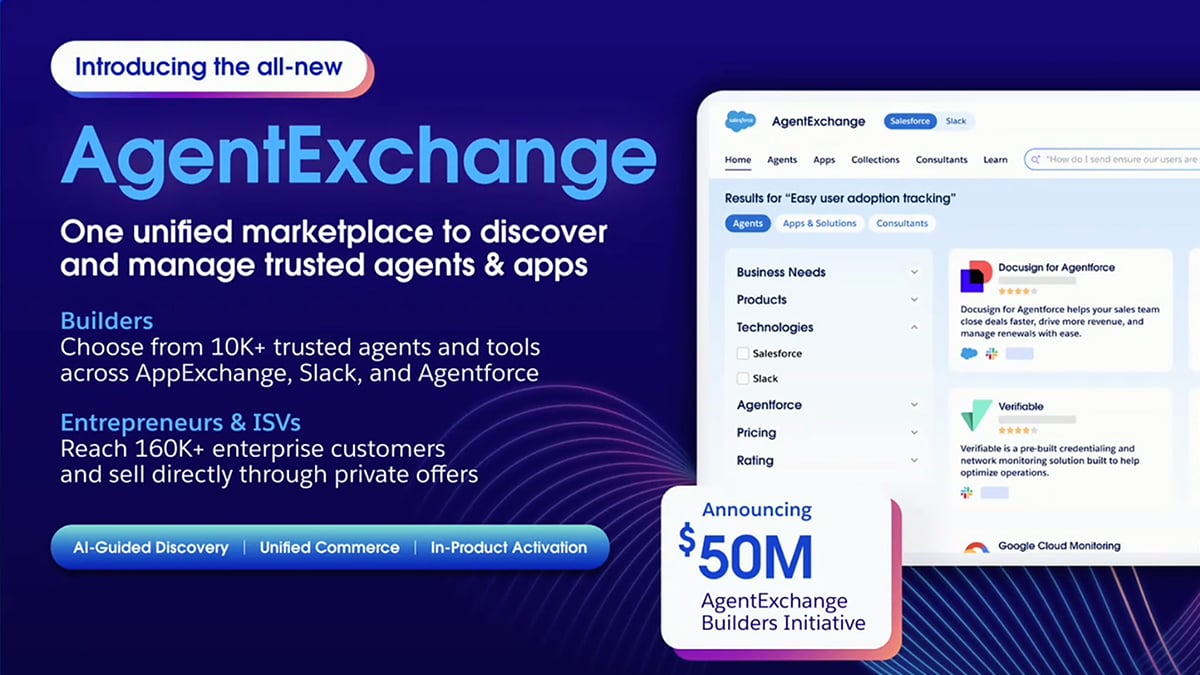
Yesterday, my colleague Alecia Wall covered the AgentExchange launch — the consolidation of AppExchange, Slack Marketplace, and the Agentforce ecosystem into a single governed storefront with 13,000+ listings and a $50M Builders Fund behind it. That was the distribution layer. Today’s announcements are the factory floor, the quality control line, and the delivery trucks that AgentExchange needs to function.
But underneath the engineering ambition sits an uncomfortable question Salesforce isn’t answering on stage: Who, exactly, is this for?
Table of contents
The Headline: Parker Harris Gets His Answer
Last month, Salesforce co-founder Parker Harris asked out loud: “Why should you ever log into Salesforce again?” Today, that rhetorical question became product direction. Headless 360 delivers 60-plus new MCP tools, 30-plus preconfigured coding skills, native React support for custom UIs, and the Agentforce Experience Layer — a new rendering service that decouples what an agent does from how it appears. Build an agent interaction once; it renders natively inside Slack, WhatsApp, ChatGPT, Claude, Gemini, Teams, or any MCP-compatible client.
The DevOps Center MCP brings natural-language deployment into CI/CD pipelines, with Salesforce claiming up to 40% reduction in cycle times. It’s a significant claim, but directionally it signals that the build-test-deploy loop is being compressed into a single conversational experience.
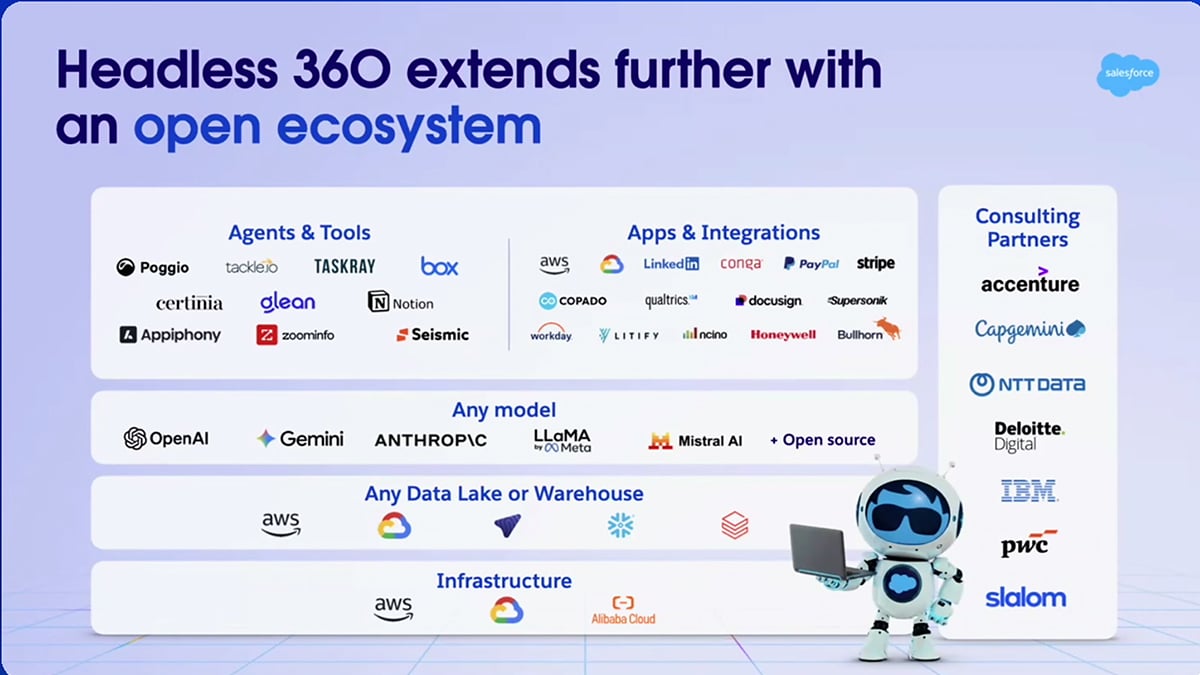
For developers already living in Claude Code, Cursor, Codex, or Windsurf, this is Salesforce throwing open the front door and saying: bring your own IDE, bring your own model, bring your own workflow. We’ll give you the platform underneath.
The Real Play: Recruiting the Claude-Pilled
Here’s the strategic read that matters more than any individual feature announcement.
Salesforce is not primarily talking to its existing developer base today. It is talking to the generation of builders fueling the explosive growth of Anthropic, Cursor, Windsurf, and the broader vibe coding movement — developers who build by conversing with AI models, who think in MCP tools and API-first architectures, who have never clicked through a Salesforce Setup menu and don’t intend to start.
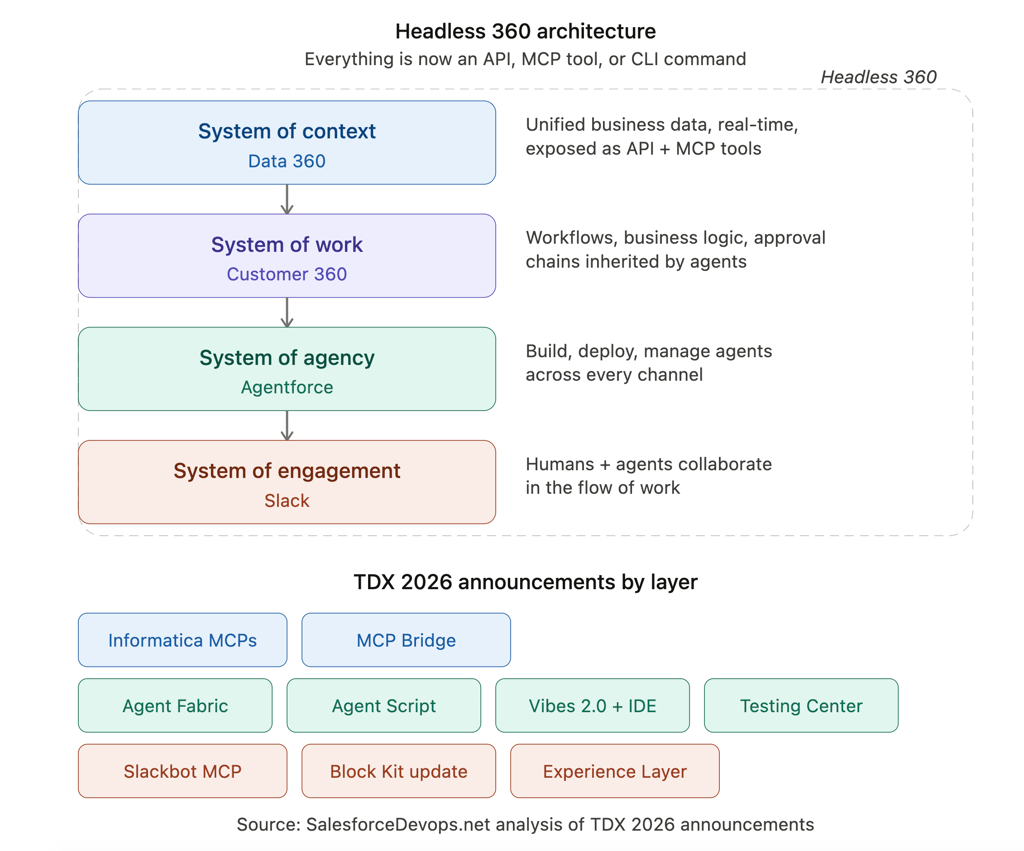
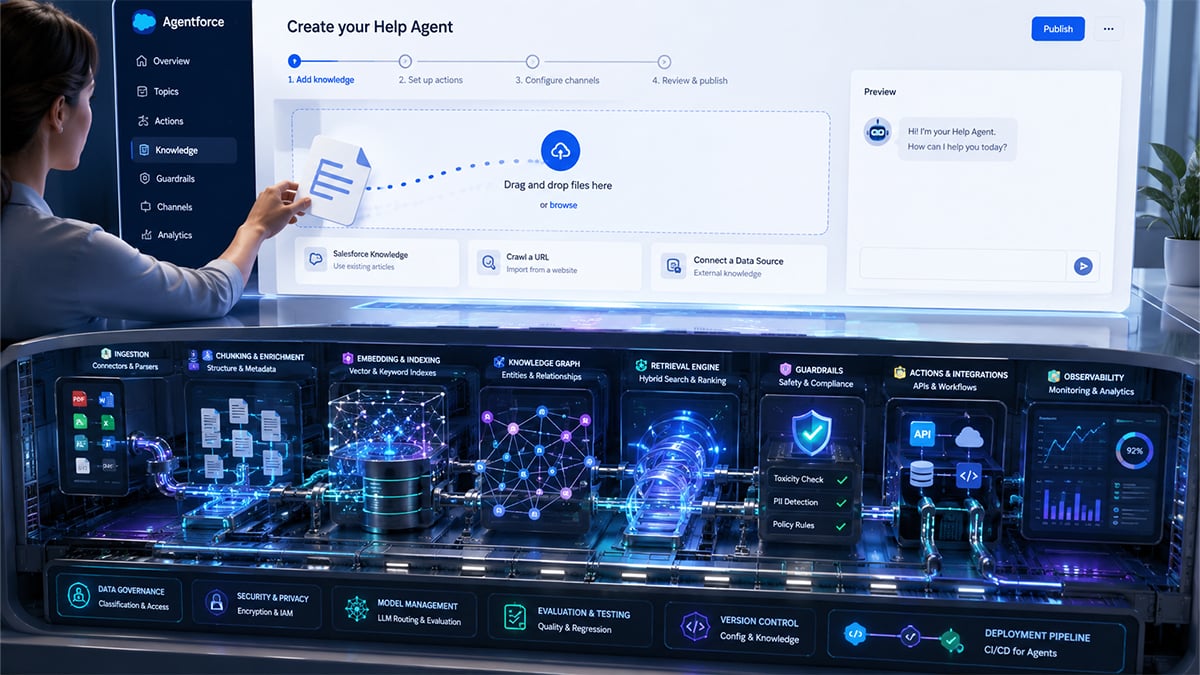
Salesforce’s Headless 360 stacks data, workflows, and AI agents into a unified API-driven architecture, with new TDX 2026 capabilities accelerating agent development and deployment.
The free Developer Edition upgrade announced today makes this explicit. Every Developer Edition org now includes Agentforce Vibes IDE (a browser-based, cloud-hosted VS Code environment), Agentforce Vibes with Claude Sonnet 4.5 as the default coding model, and Salesforce Hosted MCP Servers — all at no cost. The IDE launches from Setup with full org awareness pre-configured. No local installation, no CLI setup, no extension hunting. It’s a zero-friction on-ramp designed to convert curiosity into platform investment.
The usage limits tell the story: 110 requests per month with Claude Sonnet 4.5, 1.5 million tokens per month, monthly refresh through May 31, 2026. After that, a one-time-only allocation with no further refresh. Salesforce is engineering a sprint of experimentation, not a permanent free tier. The clock is ticking by design.
Agentforce Vibes 2.0 (née Vibes, née Code Builder) adds multi-model support — Claude Sonnet and GPT-5 alongside Salesforce’s own models — and understands your org’s metadata, schema, and existing code patterns. The two-mode workflow (Plan mode for analysis, Act mode for execution) mirrors how professional developers already interact with coding agents. And the open-sourcing of Agent Script — a structured agent definition language with sub-agents, variables, guardrails, and transitions — gives coding agents native fluency in building other agents on the platform.
The message is clear: if you’re already vibe coding with Claude or Cursor, everything you know still works. Salesforce is the data, the workflows, the trust layer underneath. The surface changes. The platform doesn’t.
The Builder Gap Widens
And here’s the tension Salesforce isn’t addressing.
For twenty years, the Salesforce ecosystem ran on Trailblazers — admins, declarative builders, low-code power users who could deliver extraordinary business value by clicking, not coding. Flow Builder, Process Builder, validation rules, formula fields, and the entire declarative toolkit created a class of business technologists who didn’t need to write Apex to be dangerous. That constituency built the ecosystem. They’re the reason Salesforce has the install base it has.
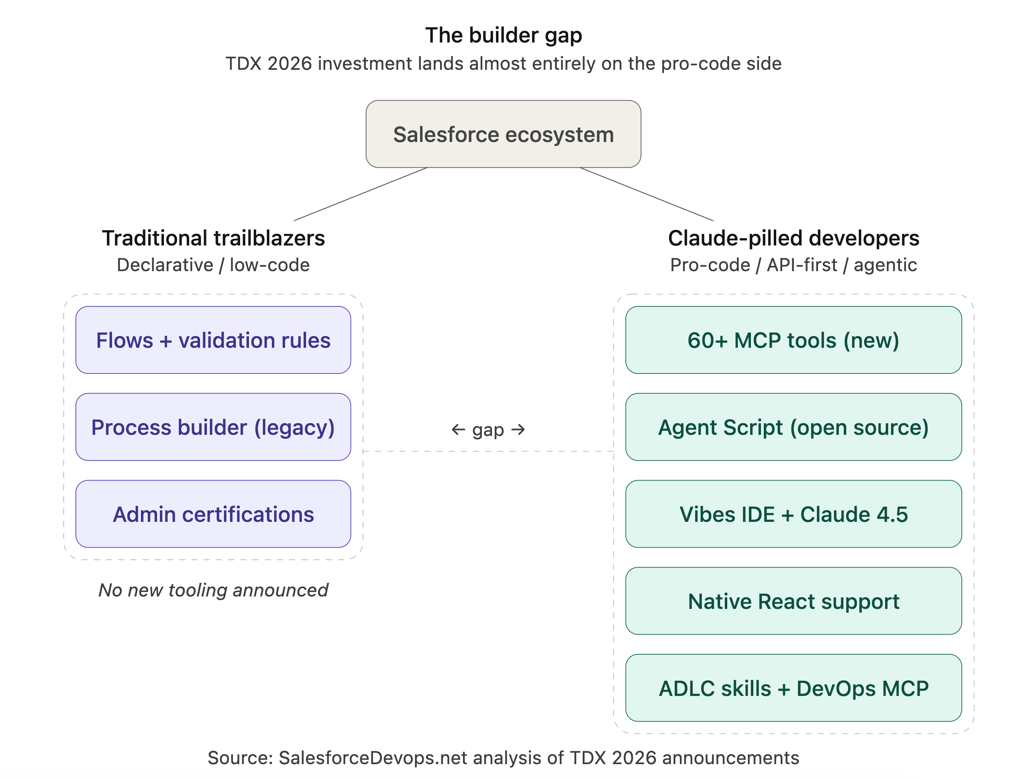
Today’s announcements are not for them.
Headless 360, MCP tools, Agent Script, native React, ADLC skills, Hosted MCP Servers — this is a pro-code menu. The vibe coding framing makes it feel accessible, but the underlying skillset is software engineering. When Salesforce says, “agents will write Agent Script for you,” that’s true — but someone still has to prompt, evaluate, debug, test, and deploy what the agent produces. That someone needs to understand structured type systems, API architectures, CI/CD pipelines, and LLM behavior. Those are not skills the traditional Trailblazer community was trained in.
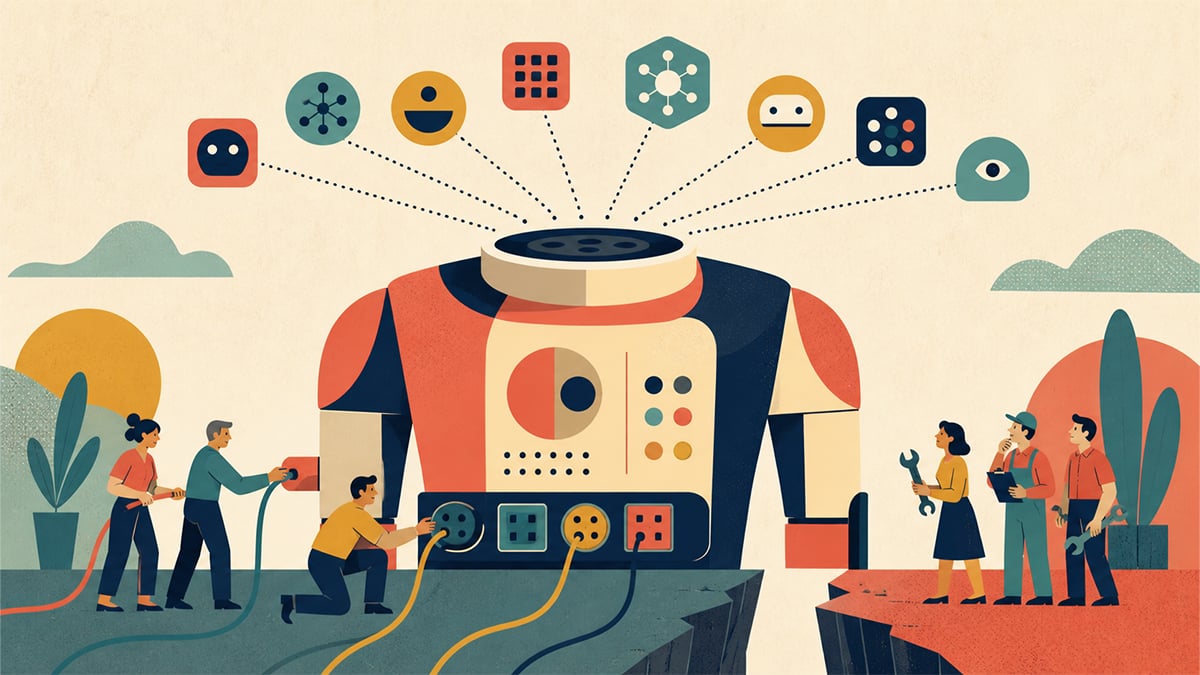
The result is what I’m calling the Builder Gap — and today it got wider. On one side: a new generation of AI-native developers who can build on Salesforce without ever having been Salesforce developers. On the other: the existing ecosystem of admins and declarative builders who are watching the platform’s center of gravity shift toward tooling they weren’t trained to use.
The FDE Partner Network announcement — Accenture and Deloitte as founding members, 20-plus firms selected for production Agentforce expertise — underscores this. The network ties partner incentives to agents reaching production, not just contract execution. That’s a governance improvement. But the expertise required is engineering depth, not admin fluency. The partner network is scaling pro-code delivery capacity because that’s what the platform now demands.
Agent Fabric: The Governance Layer Nobody’s Talking About
While Headless 360 grabs the headlines, the Agent Fabric expansion is arguably the most important announcement for enterprises running agents in production.
Agent Fabric now delivers a governed control plane for multi-vendor AI landscapes with expanded automated discovery (now covering Amazon Bedrock and GoDaddy alongside existing platforms), a visual authoring canvas for multi-agent workflows, and the MCP Bridge that makes existing APIs agent-ready at scale. Informatica-hosted MCPs showing up in Agent Registry is the first concrete post-acquisition integration evidence — data quality and governance tools are now automatically available so that every agent interaction starts with trusted, governed data.
The guided determinism model — Agentforce Script for Agent Broker — is Salesforce acknowledging that fully autonomous multi-agent orchestration isn’t enterprise-ready. You define fixed handoff rules while LLMs handle the reasoning in between. It’s a hybrid architecture: deterministic guardrails with probabilistic intelligence inside the rails. LLM Governance on AI Gateway standardizes token management and compliance across multi-model stacks, and Trusted Agent Identity enables mobile authorization for high-risk agent actions.
For the Cognitive DevOps taxonomy I’ve been building, Agent Fabric is the first production control plane that covers discovery, orchestration, governance, and observability for heterogeneous agent fleets. It’s where the rubber meets the road for enterprises that have agents scattered across Agentforce, Bedrock, LangSmith, and homegrown stacks.
Slack: Where the Conversation Becomes the Interface
The Slack announcements complete the picture. Slackbot is becoming an MCP client that orchestrates across 6,000-plus Salesforce apps. Custom AI agents on Slack have grown 300% since January. The new Slack Agent Kit lets developers go from CLI command to live agent in ten minutes. And the updated Block Kit — with Card, Alert, Carousel, Data Table, and Chart components — transforms agent responses from walls of text into interactive, structured UIs.
The Vercel and Lovable “Add to Slack” integration (coming May) is a signal worth noting: it establishes Slack as a universal deployment target for agents built anywhere, not just on Salesforce. That’s a platform play that extends beyond the Salesforce ecosystem.
This is where yesterday’s AgentExchange coverage connects. AgentExchange is the storefront where you discover and procure agents. Slack is the shopfloor where those agents show up in the flow of work. The agent browser inside Slack (Tools > Agents) makes the entire AgentExchange catalog accessible without leaving the conversation. The loop closes.
What’s Still Missing
A few things the Keenan Vision team be pressing on at the show floor and in follow-up briefings:
The observability-to-learning gap. Testing Center, Custom Scoring Evals, Session Tracing, and A/B Testing are genuine advances in agent lifecycle management. Salesforce explicitly acknowledges that agents are probabilistic, not deterministic — and that post-launch behavior monitoring is the hard problem. But do these tools convert traced interactions into reusable organizational knowledge? Observation is not learning. Session traces that get reviewed by humans and then discarded don’t compound. The question is whether Salesforce is building the infrastructure for agents to get better over time, or just for humans to watch them.
Agentforce Curated Memory (announced in pilot) hints at the answer — capturing preferences, decision traces, and successful resolutions across sessions — but it’s early and the details are thin.
The Builder Gap remediation plan. Salesforce has the Trailblazer community, the credentialing infrastructure, and the training apparatus to retool its existing ecosystem for the agentic era. But today’s announcements don’t include a visible bridge program for admins who need to cross from declarative to agentic. Agentforce Labs Quickstart — instant access from any IDE, no provisioning — removes friction for developers. What removes friction for the admin who’s been building Flows for a decade and now needs to understand Agent Script, MCP architectures, and LLM evaluation?
The Informatica integration depth. Informatica-hosted MCPs in Agent Registry are a start. When do we see CLAIRE AI capabilities surfacing natively in Agentforce workflows? That’s the test of whether the $8 billion portfolio Rahul Auradkar oversees is actually integrating or just co-listing.
The Bottom Line
Salesforce Headless 360 is a technically impressive, strategically coherent bid to become the platform layer for the agentic enterprise — the system of context, work, agency, and engagement that every coding agent and AI model needs underneath it. The four-layer stack (Data 360, Customer 360, Agentforce, Slack) is clean. The MCP-first architecture is right. The governance story through Agent Fabric is ahead of the market.
But agentic system development is still a work in progress — for Salesforce and for the industry. Today’s announcements are optimized for the segment that is fueling the growth of Anthropic, Cursor, and the vibe coding revolution: pro-code developers who already think in APIs and models. That’s the right market to chase. It’s also a market that Salesforce has historically struggled to attract and retain.
Meanwhile, the Trailblazers who built this ecosystem over two decades — the admins, the declarative builders, the business technologists — are watching the platform evolve past them. The Builder Gap isn’t a bug in today’s announcements. It’s a feature of the strategic bet Salesforce is making. Whether the company can close that gap before it loses the constituency that made the platform valuable in the first place — that’s the story I’ll be tracking through the rest of 2026.
The storefront opened yesterday. The factory came online today. The workforce question remains unanswered.
Vernon Keenan is CEO of Keenan Vision LLC and publisher of SalesforceDevops.net. He is a strategic advisor to Salesforce executive leadership on AI strategy and competitive positioning.
Disclosure: The author maintains advisory relationships with Salesforce and affiliated companies.